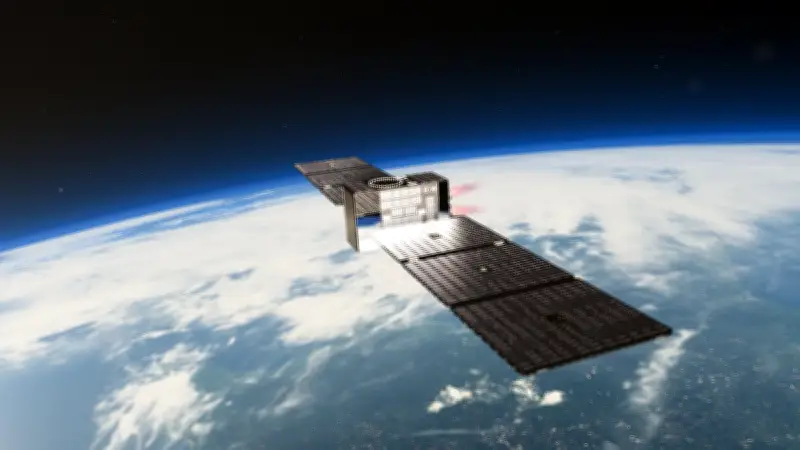
While SpaceX's blockbuster IPO and Elon Musk's brief trillionaire status grabbed headlines, a UK company in Reading is quietly pioneering a different frontier: flying satellites much closer to Earth. Anatolii Papulov's NewOrbit aims to operate satellites at just 200 to 300 kilometres altitude, roughly three times lower than conventional orbits.
Why Lower Orbits Matter
"The idea behind NewOrbit is that we can fly satellites three times closer to the ground compared to where they are flying right now," says Papulov, the company's chief executive and co-founder. This region, very low Earth orbit (VLEO), offers significant advantages: sharper imagery from cameras and stronger signals due to reduced distance. However, the denser atmosphere at that altitude creates drag, causing conventional satellites to lose orbit and burn up within weeks.
Jean-Jacques Dordain, former director general of the European Space Agency and an adviser to NewOrbit, calls VLEO "one of the few genuinely new commercial categories remaining in space, requiring a rare combination of engineering excellence and institutional discipline."
Engineering the Solution
Papulov, who studied physics and collaborated with MIT during his master's, began tackling the problem during his studies. He co-founded NewOrbit with Ruslan Rakhimov in 2021, focusing on propulsion, drag reduction, and autonomous control. The company aims to extend satellite lifespan in VLEO to five years, enabling high-quality outputs. Cameras could produce sharper imagery, weather forecasting could improve by collecting data from the lower atmosphere, and communications satellites could serve customers more effectively.
Different from Starlink
While NewOrbit's technology could complement satellite internet networks like SpaceX's Starlink, Papulov distances his firm from direct competition. Unlike Starlink, NewOrbit sells satellites and infrastructure to other companies, not consumer services. "This is a very important technology for the whole of society and for humanity in general to make us better," says Papulov.
In June, NewOrbit raised $18.5 million (£14 million) in funding, with investors backing the promise of its first satellite planned for 2028. The capital will build a production facility that Papulov describes as "a gateway for the entire world" to access VLEO from Europe. He envisions "hundreds and thousands of satellites" operating in VLEO by the end of the decade, predicting this will become "the future of all the space industry."