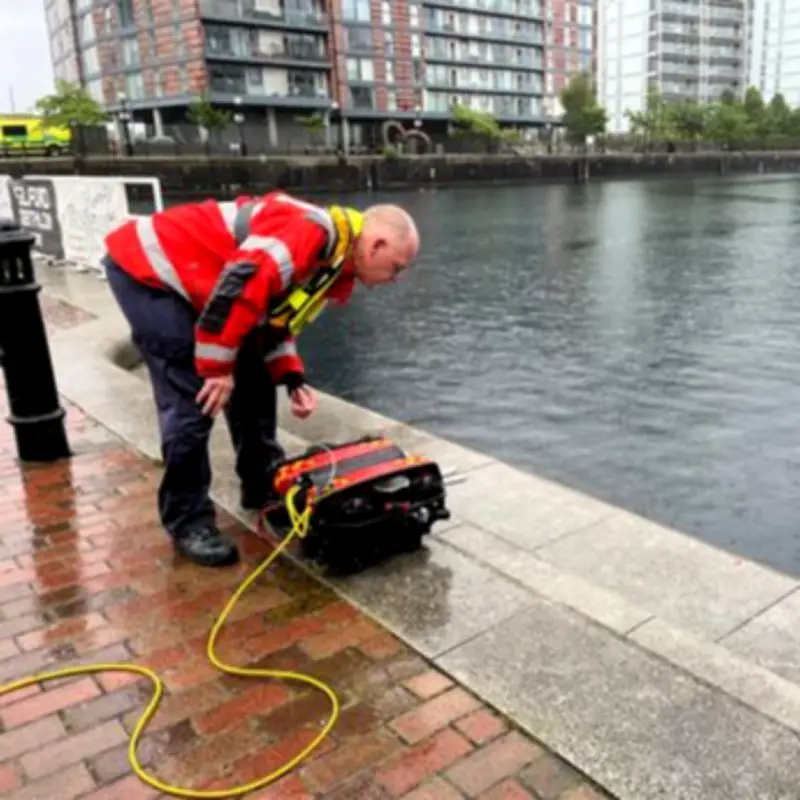
A Salford firefighter has developed an innovative underwater drone that can locate and potentially rescue people from bodies of water, as emergency services urge the public to respect open water ahead of a heatwave this weekend.
New technology demonstrated at Salford Quays
North West Ambulance Service, Greater Manchester Police, and Greater Manchester Fire and Rescue Service promoted the devices at Salford Quays on June 11. The underwater drone, known as an Underwater Remotely Operated Vehicle (UROV), was created by firefighter Dave Allsey and his watch from Salford Community Fire Station.
Dave Allsey said: "It was born out of frustration of attending drowning incidents in Manchester City Centre and here at the Quays. The fact is our equipment was very, very limited when someone goes sub-surface so, sadly, despite the fact that we can be here in like five or six minutes of an actual person going underwater, there’s very little we could do."
He added: "This is like having a diver in the water but with enhanced vision. It’s a huge improvement on the systems we’ve got at the moment and it means we can affect a rescue or recovery at a water incident now rather than struggling with some of the equipment we now use."
Heatwave expected this weekend
The UK is set for a "prolonged spell" of warmer weather from this weekend, with the Met Office predicting temperatures could soar to 29C. This follows a May heatwave that saw record-breaking temperatures and 19 deaths in open water, including 13 children.
Dave Allsey noted: "The reality is that in this country water deaths now exceed fire deaths by a significant margin. Last year, there was around 225 fire deaths in the UK and over 450 drownings - 60% of those were in-land waterways."
Capabilities of the underwater drone
The UROV is equipped with advanced sonar and imaging systems, operating at depths of up to 300 metres. It enables crews to locate sub-surface casualties more quickly and reduces the need for firefighters to enter the water during early stages of an incident.
Karl Gibbons, Head of Prevention for Greater Manchester Fire & Rescue Service, said: "It’s a really important piece of kit for us. We can drop that in the water, it can go to depths of 300 metres and it's equipped with a really powerful, high definition camera, so we can locate casualties."
He added: "It also has a built-in sonar so the operators can see images of objects on the surface and below the surface. If we're looking for casualties, then it gives us an opportunity to do that really quickly without having to put firefighters in the water."
Police also demonstrate new equipment
Greater Manchester Police demonstrated their own UROV, designed for body location and recovery, which has been in use since January. The sonar device allows divers to see underwater and identify hazards.
Luke Rose from the North West Underwater Search Unit said: "The kit for us makes a massive difference. It's creating a 3D image. It's a multibeam sonar, which is giving us a much better chance of locating people underwater."
He added: "It allows the people on the surface to give visibility and describe what the diver sees because when a diver’s underwater, there's no visibility in these canals. In Manchester, it's not like the South of France where you can see - there’s zero visibility."
"It might mean instead of putting a diver in the water for three hours to try and find someone, this can find them in the space of minutes. It's like shining a torch underwater, it gives us that type of clear visibility."
Water safety campaign
The water safety campaign reminds people that jumping into open water can be fatal, even on warm days. Cold water shock can quickly overwhelm the body, while hidden hazards beneath the surface can place people in danger within seconds.
Karl Gibbons urged: "As much as we are here to protect the public, we also have to consider the risk to our firefighters and that helps to prevent people from entering the water unnecessarily."
The key safety message is to "respect open water." People should swim at designated swimming areas with attendants. Risks include cold water shock, hidden debris, and the danger of swimming alone. If someone is in trouble, call 999, advise them to float on their back, and throw them something to help them escape.