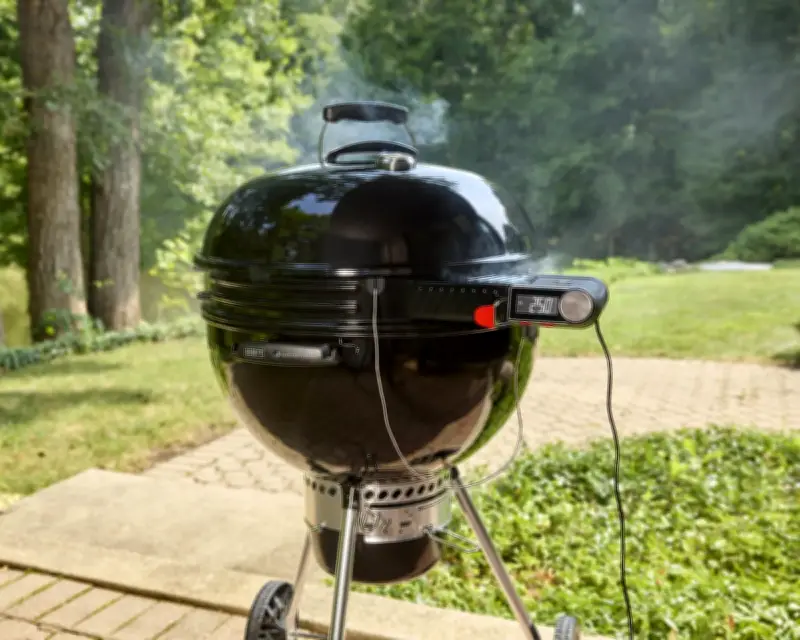
The Weber Kettle Smart Ring is a new accessory that turns a standard 22in kettle grill into a capable smoker, using a built-in fan and computer to maintain steady temperatures. It fits between the bowl and lid, adding a controller, fan, and ambient temperature probe that regulate airflow to hold temperatures from about 180F to 450F (82C to 232C).
Who is the Weber Kettle Smart Ring for?
This accessory is a good entry point into making real barbecue, easier and less expensive than buying a dedicated smoker. It isn't as hands-off as a fully automated pellet smoker, but it produces food with a more pronounced barbecue flavor. Adding it to a kettle also preserves your ability to grill, something pellet smokers generally can't match.
Expect to spend a few cooks learning how the fan affects the fire: how much charcoal to use, how to adjust the top vent, how long the fuel lasts, and how long it takes food to reach its target internal temperature. Weber's app is easy to use and lets you remotely adjust two key settings: the kettle's ambient temperature and the probe's target temperature.

What makes the Kettle Smart Ring worth it?
Backyard pit-masters have been turning out brisket, pork shoulder, and ribs on these humble cookers for decades with little more than charcoal, wood chunks, and careful vent adjustments. Hold the fire between 225F and 250F for hours, and a kettle can best pellet smokers that cost far more.
The Kettle Smart Ring strikes a balance between traditional charcoal cooking and smart technology. It raises the grill by about 4in, adding automation without fundamentally changing how you grill.
Getting ready to grill
Putting everything together takes only a few minutes. Make sure there's a nearby outdoor outlet within range of your home's wifi network, as the controller needs power to operate. Weber supplies a 6ft-long power cord with a standard wall plug and USB-C. The controller draws just 5 volts at 12 watts, so you can also run it with a portable power station that has a USB-C port.
When you set the ring in place, its metal air chute hugs the inside of the bowl and positions its outlet just above the charcoal grate. Beneath the controller are two probe ports, and Weber includes one leave-in thermometer. Additional Weber-specific probes cost $25 each. Weber also added silicone-gasketed pass-throughs that allow rotisserie accessories to fit without modification.
The grill's lid seals tightly against the ring's porcelain-enameled edges, and the top vent should be positioned opposite the fan for proper airflow. The accessory fits Weber's 22in kettle grills, including Performer models. Compatibility with non-Weber brands is unclear. Storage is the only real downside: the standard kettle cover no longer fits with the ring installed, so you'll have to remove it before storing the grill.
What's it like using the Kettle Smart Ring?
Weber recommends two charcoal setups, depending on the temperature you want to reach. To maintain temperatures between 180F and 350F, use a 'sloppy snake' of briquettes loosely curled around a 9x13in disposable aluminum pan, with the lid vents open one-quarter of the way. For roasting temperatures from 350F to 445F, create a two-zone fire setup: bank the briquettes into a pile on one side and place the pan on the empty side with the lid vents half open. Keep the charcoal 4-5in from the fan's air chute.
For both setups, keep the bottom vent closed and use three to four pounds of briquettes (60 to 100 chunks). Expect about four to six hours of heat from 3lbs of charcoal and six to eight hours from 4lbs.
Over a couple of cooks, I smoked two 10- to 12lb pork butts and several racks of ribs. I used Weber's wireless probe in the meat, set to alert me at 203F. To check temperatures, I used ThermoWorks' RFX, an ambient probe clipped about 2in away from the food.
The first cook
I built a loose, roughly 3lb charcoal snake around the edge of the disposable pan, studded with cherry wood chunks. After lighting fire starter cubes, I turned the controller on, set it to 225F, and watched as it pushed air onto the flames. After about 20 minutes, I set the pork butt in the middle of the grill.

Over the seven-hour cook, ThermoWorks' ambient probe registered temperatures about 27F lower than Weber's controller reported. The barbecue still turned out fantastic, with an intense but clean smoke flavor, though it took longer than expected. Weber's probe was off by about 10F, possibly due to sensor placement. Weber said the ambient sensor is calibrated to report the kettle's average temperature, which may explain the difference.
The second cook
This time, I used 4lbs of charcoal, the same cherry chunks, and set the controller to 250F to get the air around the food closer to 225F. The pork emerged with a deep, well-developed bark and a more pronounced smoke flavor than I'd expect from a pellet smoker. The pan also kept the kettle tidy by catching much of the rendered fat.
How I plan to cook with it from now on
Going forward, I'll use slightly more charcoal than I think I need, because the snake method lets you save unburned charcoal for the next cook. Position the grate so the hinged ends are above the charcoal, in case you have to adjust coals or wood chunks. After adding the meat, keep an eye on the kettle's temperature for the first hour or so, using the app or the lid thermometer.
Weber's videos claim you'll never have to fiddle with the vents again, but until you have a few cooks under your belt, expect to adjust the lid vents. To raise heat, open them wider; to lower, close them slightly but not all the way. You may also want to use the controller's manual mode, which offers 10 fan settings, including off.
The Kettle Smart Ring doesn't make it possible to smoke real barbecue – a Weber kettle has always been capable of that. What it does is make the process easier and more reliable, which matters when you're investing eight to 12 hours cooking a large cut of pork or a brisket. It's a modest upgrade that adds a new capability to a grill you already own.