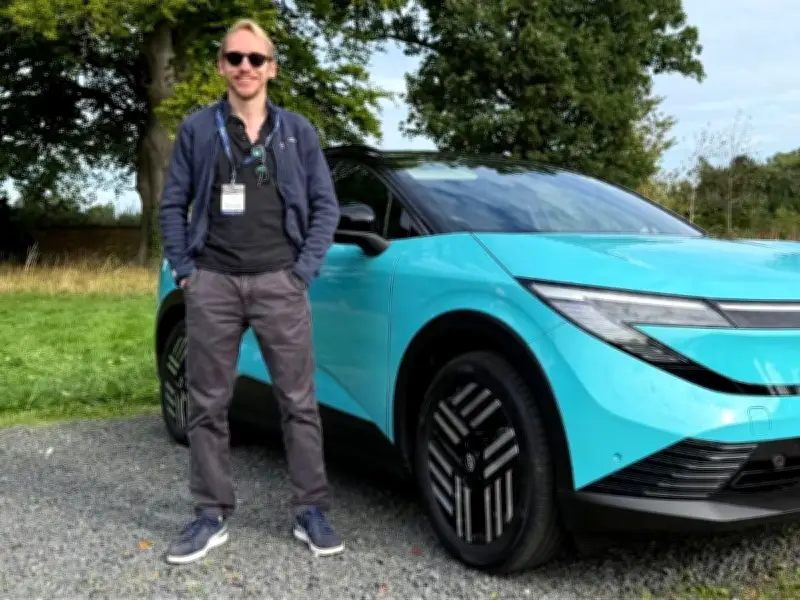
The new Nissan Leaf electric SUV bears a striking resemblance to the Ferrari Luce, but at £37,999 it costs a fraction of the £450,000 Ferrari's price. Christopher Sharp drove it last month to find out more.
Ferrari's first electric model draws comparisons
Ferrari has considerable expertise when it comes to producing groundbreaking and dramatic automobiles. In its near century of existence, the Italian manufacturer has created icons such as the Dino, Enzo, Testarossa and numerous others that have fundamentally reshaped what it means for a car to be a Ferrari. Last year, the company set the internet ablaze when it unveiled its first all-electric model - the Luce.
While unmistakably from Maranello's stable, the car immediately drew comparisons with a considerably more affordable vehicle driven recently at SMMT's Drive Live event near Worcester. That car was Nissan's third-generation Leaf, which has made the transition from a hatchback into an SUV.
Price gap and specifications
The difference in price between the Nissan and the Ferrari is staggering. While the Nissan carries a recommended retail price of £37,999, that figure is dwarfed by the reported £450,000 asking price of the Ferrari. The gap between the two amounts is a whopping £412,000, though that is perhaps to be expected when comparing a car designed for mass production with one crafted exclusively for the extremely wealthy. This is not to detract from the excitement surrounding the Leaf, however.
The comparison with its Italian near-twin has generated considerable interest in the car, and it was precisely this curiosity that led to seeking it out on a warm day in late September. The particular Leaf model tested was the 75kWh Advance variant, boasting a range of 387 miles and a power output of 160kW (214bhp). That output is tasked with moving a five-door, five-seat platform weighing just under two tonnes — a mass distributed across a vehicle measuring just over four metres in length and approximately two metres in width.
Interior and driving impressions
The cabin is quintessentially Nissan and immediately familiar, particularly as time was spent in the car's hybrid counterpart, the Qashqai, over the summer. As such, you'll find an array of physical buttons on the steering wheel, straightforward switches on the dashboard for toggling between drive, reverse, and neutral, and the obligatory touchscreen.
Much like other manufacturers, however, Nissan has shown considerable restraint, refusing to allow the screen to dominate the dashboard and instead keeping it only as large as it needs to be. There are ample manual shortcuts and controls for key functions such as the air conditioning and deactivating the lane assist. As with the Qashqai, the seats are firm yet comfortable, and the steering wheel is not overly thick, making it pleasantly easy to grip. Everything feels practical and straightforward to navigate.
Out on the road, the Nissan feels sufficiently light and agile to make swift progress, yet without ever inducing any sense of unease. One of the growing frustrations with contemporary electric vehicles is that manufacturers tend to endow them with excessive power, making them far too rapid for everyday driving. Nissan has avoided this pitfall, meaning the car reaches motorway speeds swiftly rather than jarringly. The tyres offer sufficient grip to rely upon, while the sidewall depth works in conjunction with the suspension to absorb the worst road imperfections.
The regenerative braking is unobtrusive and straightforward to adjust. Even for those unfamiliar with the system, it is simple enough to master, once you get used to the fact that clicking minus actually increases rather than decreases regeneration — something found on other vehicles too. It feels firm yet well-damped for an SUV. There is a slight sense of cost-cutting compared to pricier alternatives such as the Polestar 4, though the Nissan ultimately proves more enjoyable to drive and considerably more intuitive to get to grips with.
A sub-two tonne SUV will never handle quite as nimbly as a hatchback, but this was perfectly acceptable. Much like the Qashqai, it was composed, stable and thoroughly capable despite its two-wheel-drive underpinnings. A solid effort all round. Verdict: 7.5/10.