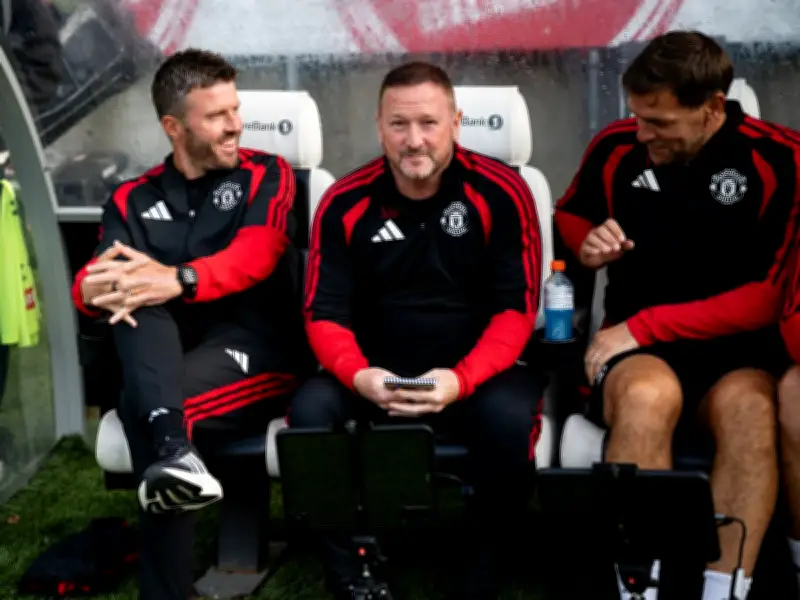
Manchester United's coaching staff are building a team that can control games next season, a strategy that goes against current Premier League trends.
Premier League trends last season
The trends in the Premier League last season were clear: set-pieces, duels, and physicality, with little emphasis on control. As more teams adopted man-marking, games became about 11 distinct battles. Winning more battles allowed teams to claim territory, earn set-pieces, and eventually win matches.
What was often missing was rhythm and control. Even Pep Guardiola's Manchester City struggled to assert authority from midfield at times. The league's intensity increased, making space a premium and hindering midfielders who rely on short passes and game control.

Possession statistics decline
Possession is less central in the Premier League than it has been for a long time. Two seasons ago, four teams averaged over 60% possession per game, and six had over 58%. Last season, only City (60.5%) exceeded 60%, and only Chelsea had over 58%. The trend is clear: fewer teams prioritise possession, focusing instead on duels.
This makes Michael Carrick's approach at Manchester United particularly interesting. The club lost a physical midfielder when Casemiro left on a free transfer. The plan to overhaul the midfield has prioritised technical skills over physicality.
Technical signings and tactical shift
Manchester United have signed Andrey Santos and Youri Tielemans this summer. Both have Premier League experience and are high-level technical midfielders with excellent passing ranges, recruited from Chelsea and Aston Villa respectively. Carrick has also repurposed Mason Mount as a deep-lying midfielder to support the plan.
This is Carrick's first transfer window to put his stamp on the team and the first pre-season to focus on tactical changes. In his playing days, Carrick's work as a deep-lying midfielder was about passing and controlling the game with the ball. He wants his team to do the same. Even at Middlesbrough in the Championship, he built a team that wanted to play with the ball, signing Aidan Morris for passing quality. A criticism at the Riverside was that control did not lead to enough penetration in the final third.
The challenge is that this approach bucks the current Premier League trend. Possession seems harder to keep than ever, but United are focused on what they can do with the ball.