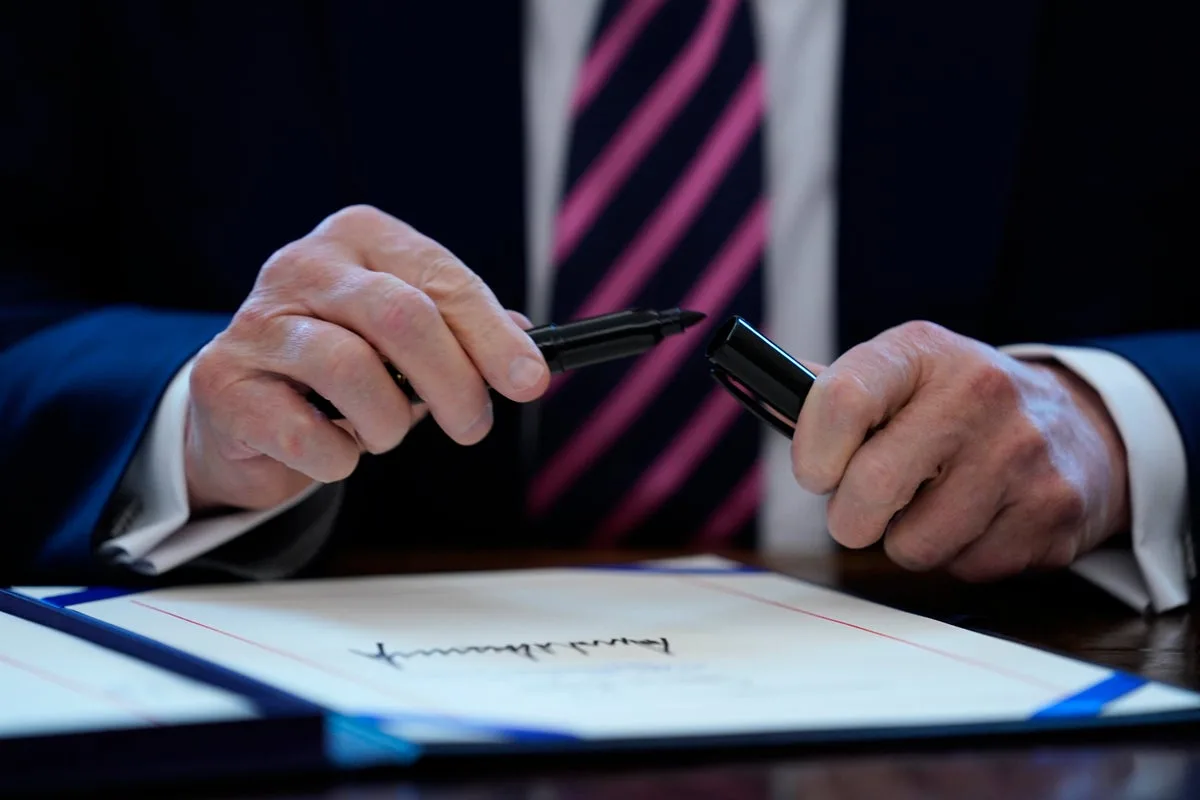
For years, Donald Trump’s large and bold signature has drawn public attention, fitting neatly with his history of self-adulation. A psychologist with decades of fascination for signature size has studied what such scrawls reveal about personality, including status, self-esteem and narcissism.
The research began unintentionally in 1967 when the psychologist, then a work-study student at Wesleyan University, noticed that faculty members used much more space when signing library cards than students did. After measuring signatures, he found that eight of nine faculty members used significantly more space than students with the same number of letters in their names.
A follow-up study compared blue-collar workers, students and faculty on blank cards. Blue-collar workers used more space than students but less than faculty, suggesting both age and status played a role. Further analysis of psychologist Karl Scheibe’s book signatures over decades showed they generally grew larger, peaking during senior year and after joining the faculty.

Published studies concluded signature size relates to self-esteem and what the researcher termed 'status awareness.' The pattern held even in Iran, where writing flows right to left. Decades later, the Harvard Business Review sparked renewed interest: University of Maryland professor Nick Seybert suspected a link between signature size and narcissism in CEOs.
Testing the idea, the psychologist found a significant positive correlation between signature size and scores on a narcissism scale among his students. Seybert replicated the finding with his own students. By 2020, the Journal of Management included signature size as a measure of CEO narcissism, cementing the link between a simple scribble and core personality traits.