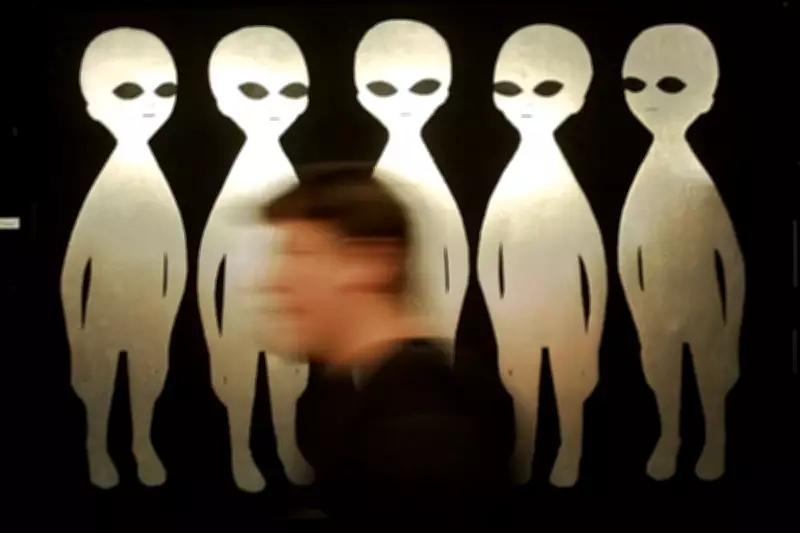
In a significant move that has reignited public fascination with the unknown, former President Donald Trump has ordered the release of classified government files on Unidentified Flying Objects (UFOs) and Unidentified Aerial Phenomena (UAPs). This directive, announced via social media in February 2026, cites "tremendous interest" in the subject, following earlier comments by Barack Obama that aliens are "real" though he clarified he had not seen them personally.
A Cosmic Perspective on Human Folly
The renewed focus on potential extraterrestrial life has prompted experts to consider a profound question: if aliens exist, what would they think of humanity? Theoretical physicist Avi Loeb, director of Harvard's Galileo Project, offers a bleak assessment. "If I were looking at Earth from a distance, I would be pretty disappointed," Loeb stated, pointing to global conflicts like the Ukraine war as evidence of limited intelligence. "Most of our investing is dealing with conflicts to prevent other people from killing us or us killing others. That is not a sign of intelligence."
Public Fascination and Government Secrecy
Public interest in UFOs has surged, with a 2021 Pew Research Center survey showing about two-thirds of Americans believe intelligent life exists on other planets. Approximately half think military-reported UFOs are evidence of extraterrestrial intelligence. This curiosity dates back to the 1947 Roswell incident, where debris recovery sparked decades of speculation and pop culture phenomena, from flying saucers to "Star Trek's" First Contact Day.

However, government secrecy remains a barrier. Retired Rear Adm. Timothy Gallaudet, who participated in a 2024 congressional hearing on UAP disclosure, asserts that evidence shows UAPs are real and zipping through airspace and oceans. "The nonhuman intelligence that operates them or controls them are absolutely real," Gallaudet says, though he notes the origins are unclear. He emphasizes the need for transparency, arguing that ignorance is not a viable national strategy.
National Security and Scientific Inquiry
Much of the government's reluctance to share data stems from national security concerns. Bill Diamond, president of the SETI Institute, explains that advanced technologies used for defense sometimes detect unexplained objects, and the sensitive nature of these systems is protected. Yet, Gallaudet advocates for releasing a "trove" of UAP videos held by the Navy to scientists for research, highlighting incidents where UAPs have nearly collided with aircraft.
Despite this, a 2024 Pentagon study found no evidence of aliens or extraterrestrial technology in nearly a century of investigations, and the All-Domain Anomaly Resolution Office continues to track reports. In 2023, NASA concluded that studying UFOs requires new scientific techniques and a shift in perception, while former Air Force officer David Grusch's claims of a concealed reverse-engineering program were denied by the Pentagon.
Cultural Reflections and Human Nature
Popular culture often portrays aliens as aggressive, a projection of human behavior, according to Priscilla Wald, a Duke University professor. "It seems to me it's a reflection on who we are, that we're projecting onto aliens the way we treat each other," Wald says. This sentiment echoes in a world grappling with war, climate change, and divisiveness, making it easy to wonder how extraterrestrial observers might view our struggles.
Eyewitness accounts add to the mystery. Debbie Dmytro, a medical professional from Michigan, describes seeing unexplained lights in the sky, including four yellow lights flying low and silently in 2023. "I've never seen anything so low without any noise and flying in complete uniformity," she says, reflecting the widespread desire for scientific proof and government transparency.

The Search for Cosmic Companionship
Underlying the UFO debate is a deep human yearning not to be alone in the universe. "We don't want to think this is the only place in this extraordinarily and incomprehensibly large universe where life and intelligence and even technology have emerged," Diamond notes. University of Michigan Astronomy Professor Edwin Bergin adds that the likelihood of life elsewhere is high given billions of galaxies, but if intelligent beings visited Earth, they would likely make themselves known, despite humanity's chaos.
Loeb speculates that extraterrestrials might be watching us "to make sure we will not become predators, that we will not become dangerous to them." As Trump's data release unfolds, the quest for answers continues, driven by the enduring belief, as echoed in "The X-Files," that "the truth is out there."