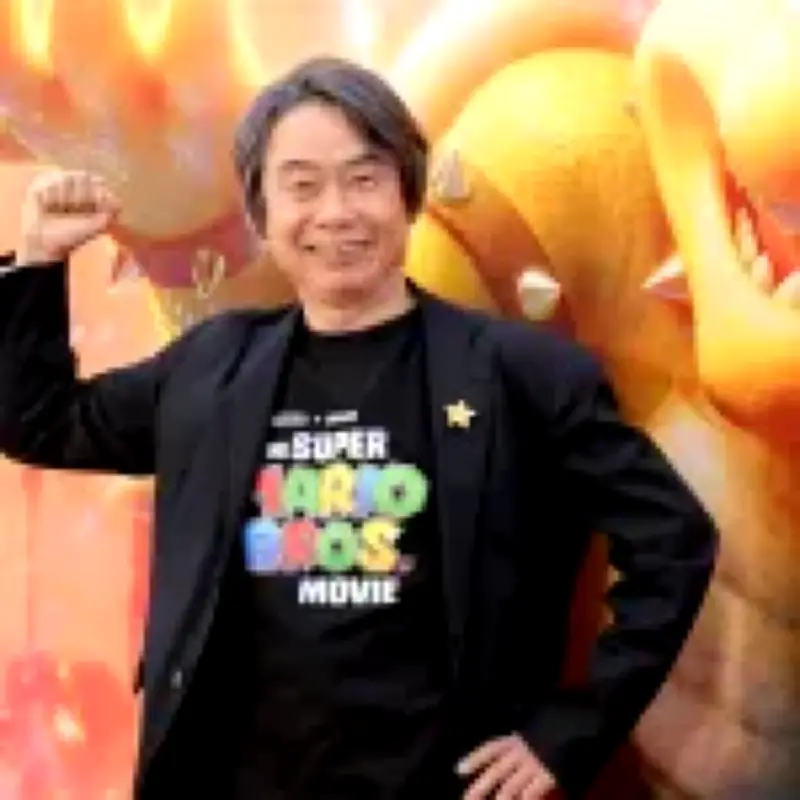
Shigeru Miyamoto, Nintendo’s legendary game designer, has said generative AI could have a positive impact on creativity in games, comparing its rise to the introduction of word processors on computers. Speaking during a press conference after accepting Japan’s Order Of Culture award, Miyamoto offered a nuanced view of the technology that has divided the games industry.
AI Compared to Word Processors
Miyamoto explained that just as computers changed the role of designers, generative AI could similarly shift the focus onto individual creativity. He noted that in the past, designers were taught in school how to create beautiful lettering for posters, and possessing that skill alone was enough to be called a ‘designer’. Alternatively, one could take a design that was trending abroad, give it a ‘Japanese-style’ twist, and be labelled a designer.
‘However, as computers and technology advanced, a designer’s true individual capabilities, such as their innate sense of layout, finally came to the fore. I believe generative AI represents a similar shift,’ Miyamoto said, as translated by VGC.
Distinction Between Creation and Labour
Miyamoto drew a distinction between ‘creating’ something and the ‘labour’ involved, warning that the enjoyable side of the labour can deceive game developers into mistaking satisfaction for genuine quality. ‘While the act of creation is inherently satisfying, there’s a danger: one might find satisfaction in the labour itself and mistakenly believe that a high-quality piece of work has been created,’ he added. ‘In that sense, the more AI replaces these tasks, the more it provides an opportunity to reflect on what’s really important, which I think is a positive thing.’
He concluded that even if generative AI becomes prevalent in development, it will always need human guidance to create anything of merit. ‘Looking back at past designs, there are some that were created merely by copying and pasting. Yet, such work rarely stands the test of time; it lacks the individual’s particular design intention,’ he said. ‘Because the process relies on an individual’s intent, with the computer serving as an assistant for the labour, I believe that even as technology continues to evolve, and even if AI were to eventually handle everything, there will always be a role left for us to play.’
Sakurai’s View on AI Reproductions
Miyamoto’s response is not dissimilar to the view of Super Smash Bros. creator Masahiro Sakurai, who primarily sees generative AI as a backwards-looking technology that can only create ‘reproductions’. In an interview with Japanese outlet Denfaminicogamer (via Google Translate), Sakurai said the volume of games being made will only increase thanks to AI, but most will be ‘unprofitable titles’.
‘When it comes to things created with AI… or things mass produced with poor quality, I think most of them will simply be reproductions of systems seen in various other games,’ Sakurai said. ‘I think there are already a lot of those now.’ Sakurai suggested AI could easily replicate simple puzzle games now and, eventually, may be able to recreate complex titles like Fumito Ueda’s Ico or Shadow Of The Colossus. However, he emphasised that it can’t create Ueda’s future games. ‘That’s something only he can create,’ he added. ‘I think that’s where human creativity lies.’
Nintendo has been careful in the past when addressing the issue. CEO Shuntaro Furukawa acknowledged the ‘problematic’ elements of generative AI in a statement from 2024, but didn’t rule out its use entirely. Other Japanese developers like Capcom have said it uses generative AI to ‘improve development efficiency and productivity’, as well as to ‘streamline routine tasks’, but it will ‘not implement assets generated by AI into our games’.