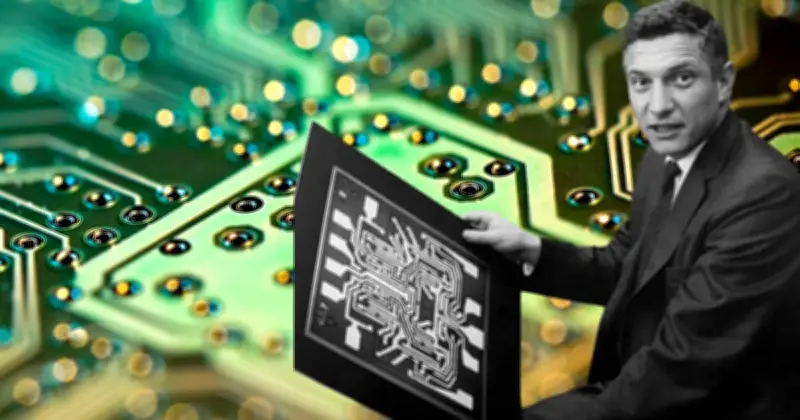
The world's most indispensable technology is a postage stamp-sized electronic device called a microchip. Also known as a chip or integrated circuit, it contains billions of microscopic switches that perform calculations at lightning speed. Chips power smartphones, cameras, televisions, microwaves, and cars. They birthed computers and the internet, revolutionizing healthcare, the economy, personal behavior, and warfare. Modern aircraft, spacecraft, and missiles depend on chips for navigation, control, safety, and communication.
The Invention and Early Race
The transistor was invented in 1947, but it took another twelve years for the chip to be realized. Jack Kilby at Texas Instruments first implemented a chip in 1959. The New York Times named it one of the top three inventions of the year. Robert Noyce from Fairchild Semiconductor soon developed a version suitable for mass production. The US gained a headstart through funding and market from the Minuteman missile program and the Apollo spaceflight program. The Soviet Union and its allies attempted to develop indigenous chip technology and clone state-of-the-art designs, but they never achieved parity with the US. Japan challenged the Americans until the 1980s, but their efforts unraveled in the 1990s. South Korea, Taiwan, and China became centers of chip manufacturing after the 1980s, leveraging state support and lower costs.
Global Chipmaking and Its Costs
Today, chipmaking is a global exercise. No single country owns all stages end-to-end. A single chip can travel over 25,000 miles and cross international borders more than 70 times before reaching the end customer. However, this success has come at a price. Chipmaking has high energy and water costs, straining local communities. It produces significant emissions, and many inputs come from regions with poor regulations and human rights violations. High demand and usage also create challenges; chips in large data centers consume substantial energy and water, impacting electricity bills, power reliability, and water availability.
Challenges Facing the Chip Industry
The industry faces trust vulnerabilities from globalized production, where bad actors can meddle at any stage, creating security problems and counterfeit chip markets. Supply risks are heightened because a natural disaster, accident, sabotage, or geopolitical conflict can stall overall chip production. Production costs are also rising; the most advanced chips are particularly expensive to produce, and only one firm in the world—TSMC, based in Taiwan—can manufacture them. This creates an additional supply risk, as a natural or geopolitical event in Taiwan could throttle advanced chip production for the entire world.
Chips and the AI Race
Chips are critical to winning the artificial intelligence (AI) race. AI models need a large number of the most advanced chips to develop and use. Nations with access to these chips will likely lead AI. As a result, a global chess match is underway. The US and China are engaged in a game of one-upmanship. China is investing enormous resources to achieve chip self-reliance, allegedly using espionage and intellectual property theft. The US is using export controls and pressure tactics, involving its allies, to prevent China from accessing advanced chips and technologies. Both recognize that the outcome may determine future economic and military world order.
Taiwan as a Flashpoint
In this great power competition, Taiwan is fast becoming a flashpoint. Since TSMC is the only company that can manufacture the most advanced chips, any Chinese aggression in Taiwan would have dramatic consequences. Some believe TSMC creates a silicon shield for Taiwan, as the world will not let China take over the island and its chip supply. Others believe potential control of TSMC gives China added motivation to attack. TSMC is building some advanced factories outside Taiwan, mostly in the US, both under pressure and as a strategy, further complicating the equation. Chips will be a critical factor in determining the future of US-China-Taiwan relations.
The Future of Chips
Chips are the new oil—everyone needs them, everyone wants to reduce reliance on others, and everyone benefits from producing them. We will see increased efforts by nations to achieve chip sovereignty. The UK and the EU have already invested large sums into growing chipmaking at home, with plans for further investment. Alliances are forming to secure supply, with current European alignments running through the US. We will likely see a strengthening of alliances in the West to prevent chip access to the CRINK (China, Russia, Iran, North Korea) bloc. Efforts will also increase to manage the emissions, water, and energy footprint of chips. As Rakesh Kumar, author of The Chip Age, notes, 'We are living in the chip age, and chips will continue to define our future.'