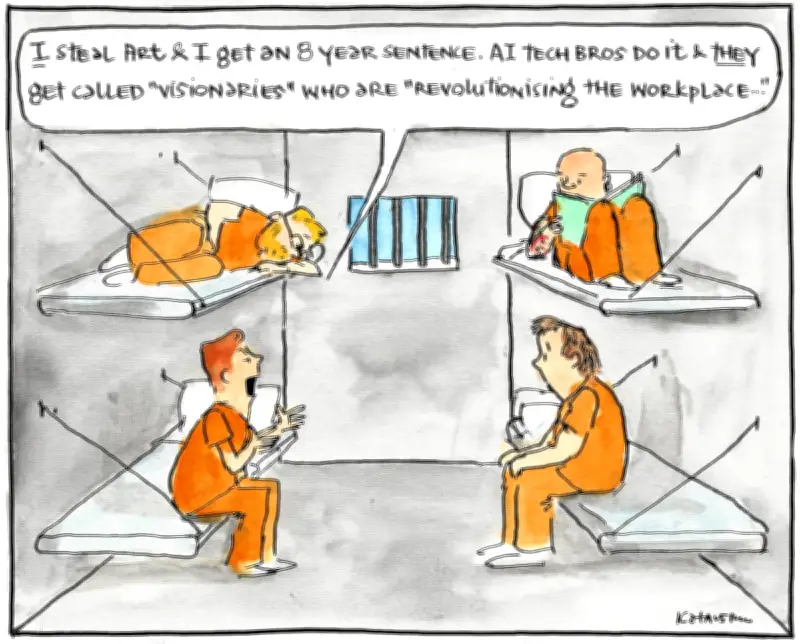
AI Companies Under Fire for Alleged Criminal Practices
Artificial intelligence companies are increasingly accused of operating with impunity, raising questions about whether they are getting away with what would be considered crimes in other sectors. From scraping copyrighted content without permission to deploying unsafe systems, the tech giants behind generative AI are facing mounting legal and ethical challenges.
Critics argue that current laws are ill-equipped to handle the scale and speed of AI development, allowing firms to push boundaries without facing consequences. Recent lawsuits have highlighted instances where AI models were trained on protected data without consent, potentially violating intellectual property laws.
High-Profile Cases Highlight Legal Gaps
In one notable case, a group of authors sued an AI company for using their books without authorization to train language models. The company argued that the use fell under fair use, but many legal experts are skeptical. Similarly, news outlets have accused AI firms of misappropriating journalistic content to generate summaries and articles, undermining the original publishers' revenue.

According to a recent report by the AI Accountability Project, over 60% of AI companies surveyed did not conduct adequate safety testing before launching products. This has led to harmful outputs, including biased decisions, misinformation, and privacy breaches.
Regulators Struggle to Keep Pace
Governments worldwide are wrestling with how to regulate AI. The European Union's AI Act is one of the first comprehensive attempts, but enforcement remains a challenge. In the United States, the Federal Trade Commission has warned that it will pursue companies that engage in unfair or deceptive practices involving AI, but critics say enforcement has been slow.
Dr. Sarah Jenkins, a technology law expert at Oxford University, stated: “The current regulatory framework is like trying to catch a speeding car with a bicycle. AI companies are moving so fast that regulators cannot keep up, and many are exploiting this gap.”
Industry Responses and Future Outlook
AI companies often claim that they are innovating in a vacuum and that existing laws do not apply to their operations. Some have called for new legislation tailored to AI, while others resist any form of oversight. Meanwhile, public trust is eroding as more incidents come to light.
The debate is likely to intensify as AI becomes more integrated into daily life. Without stronger accountability measures, the risk of harm increases, and the question remains: will AI companies continue to get away with it?