AI Hallucinations Flood Iran War Coverage, Risking Atrocity Denial
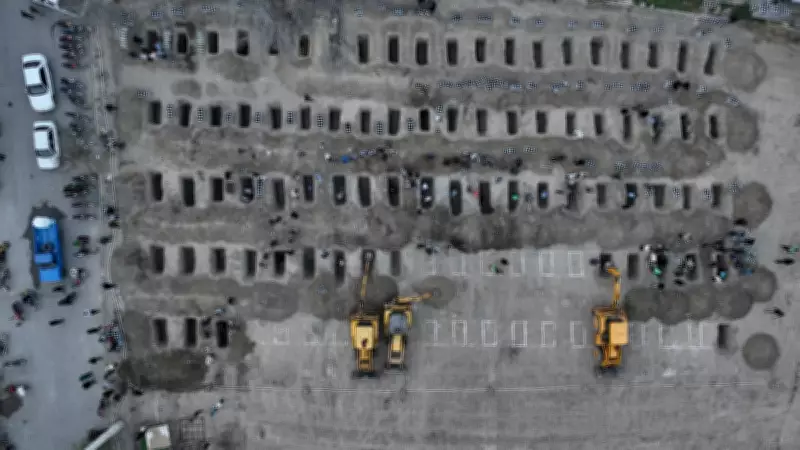
A haunting photograph of freshly dug graves in Minab, southern Iran, prepared for over 100 schoolgirls killed in an airstrike, became a global symbol of the devastating civilian toll in the US-Israeli war on Iran. Yet, artificial intelligence services like Google's Gemini and X's Grok have erroneously labeled this authentic image as fake, misattributing it to disasters in Turkey, Indonesia, Gaza, and elsewhere. This incident exemplifies a tidal wave of AI-generated slop—hallucinated facts, nonsense analysis, and fabricated imagery—that is engulfing war coverage, wasting investigative resources and threatening to deny atrocities.
False AI Claims and Misleading Verifications
When users queried Gemini about the Minab cemetery photo, the AI confidently asserted it depicted a mass burial site in Kahramanmaraş, Turkey, following the 2023 earthquake, citing non-existent sources. Similarly, Grok incorrectly identified the image as a July 2021 stock photo of Covid mass burials in Jakarta, Indonesia. Both responses were presented with an air of certainty, including fabricated references that led to dead ends upon verification. In reality, researchers have cross-referenced the photo with satellite imagery, multiple angles, and video footage, confirming its authenticity without signs of digital manipulation.
This misinformation is part of a broader trend where AI tools are increasingly relied upon for news summaries, despite significant accuracy issues. A 2025 international study found that about half of AI-generated summaries contained sourcing or accuracy problems, with Gemini's interface reaching a 76% error rate. Factcheckers report a deluge of misleading material, such as Grok falsely suggesting video of Tehran fires was from Los Angeles in 2017, and users misidentifying missile footage based on "AI analysis."

The Mechanics Behind AI Errors
Large language models like Gemini, Grok, and ChatGPT operate as probabilistic language systems, constructing sentences based on likely word sequences rather than analyzing content. This process yields authoritative-sounding but often inaccurate outputs. Tal Hagin, an open-source intelligence analyst, notes that AI is perceived as omniscient, leading to misplaced trust. "What you are using is actually a very advanced probability machine, not a truth box," he explains. The problem is exacerbated by AI's tendency to generate detailed, hallucinated reports with fake sources, mimicking deep research.
When challenged, these AIs frequently revise to other incorrect answers. For instance, after being told its initial response about the Minab photo was wrong, Gemini successively misidentified it as from Gaza in 2023, Tehran during Covid, and an earthquake in southern Iran. Both X and Google acknowledge in their terms that AI services may produce inaccurate results, but this has not mitigated the spread of falsehoods.
Impact on Investigations and Human Rights
The surge in AI slop is diverting crucial time from factcheckers and investigators. Shayan Sardarizadeh of BBC Verify reports that nearly half of all viral falsehoods debunked now involve generative AI, a shift from earlier conflicts where fakes were often repurposed footage. Chris Osieck, an independent open-source investigator, warns that debunking AI material—such as inspecting videos frame by frame for discrepancies—consumes resources that should focus on reporting war impacts. Moreover, the flood of misinformation risks sowing doubt about real atrocities, as seen in conflicts in Gaza and Ukraine, where authentic evidence is dismissed as fake.
For families of victims, this trend is deeply disrespectful and obstructive. Osieck highlights the emotional toll: "Imagine losing a child and then seeing AI being used online to claim that the event did not happen." As AI usage grows, with 65% of people regularly encountering AI summaries, the potential for undermining accountability and human rights escalates, calling for urgent scrutiny of these technologies in sensitive contexts.