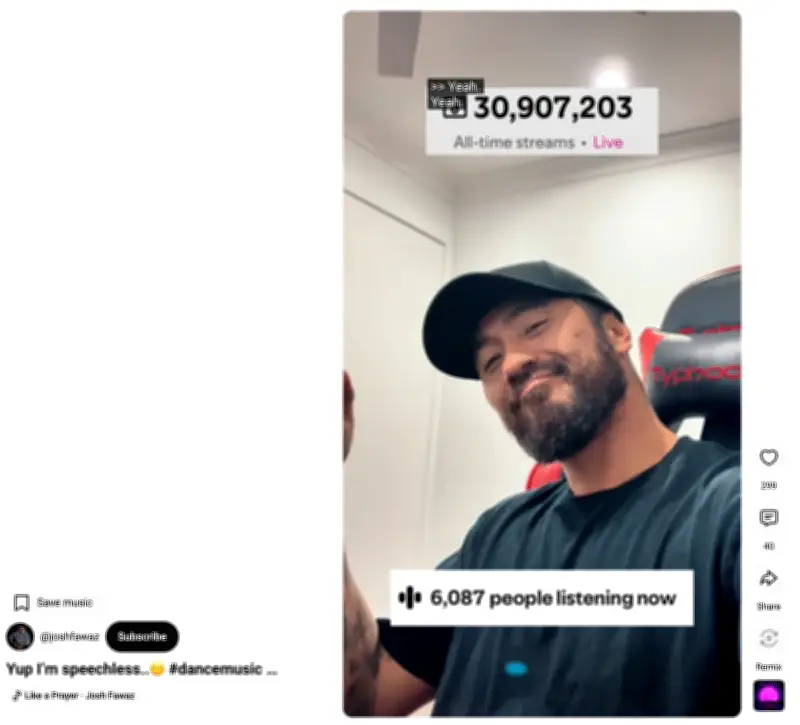
Josh Fawaz, an Australian producer, has skyrocketed from obscurity to viral fame in months as his cover of Madonna's Like a Prayer topped the National Radio Airplay chart and the global iTunes electronic music chart. However, music experts and fellow musicians question whether the track was produced using generative AI, raising concerns about transparency in the music industry.
AI Hallmarks in the Hit Song
Sam Whiting, a senior research fellow at RMIT's School of Media and Communication, noted that the song exhibits characteristics typical of AI music generators like Suno, such as being "heavily compressed." Whiting stated, "This is a very impressive vocal performance if it was delivered by a human, but if it's not, that brings in really worrying questions around what we value any more in terms of human expression."
While producers commonly use software like Ableton Live or AI for mixing and mastering, generative AI creates the entire song from a text prompt, requiring no human input beyond the prompt itself. The credits for Like a Prayer list Fawaz as the performer and his uncle Fadi Fawaz on synths and production.

Commercial Success and Streaming Numbers
Since its release in April, Fawaz's version of Like a Prayer has amassed 35 million streams on Spotify and topped the iTunes Electronic chart worldwide. His debut 18-track album, Dance Like Nobody's Watching, which includes covers of hits like Oasis's Wonderwall and Cyndi Lauper's Girls Just Want to Have Fun, climbed to No. 18 on the ARIA Australian artist albums chart.
On 1 July, a new commercial radio code of practice took effect in Australia, requiring transparency about AI-generated voices on air, but it does not apply to music. Major radio networks ARN, Nova Entertainment, and Southern Cross Austereo did not respond to requests for comment on their AI policies.
Industry Backlash and Royalty Concerns
Producer and DJ Needs No Sleep called AI-generated content the "biggest issue in music right now" on Instagram, highlighting that AI-produced music receives royalties each time it is streamed or played on the radio, diverting funds from human artists. He said, "Those royalties that are collected are diverted away from other artists making real music. Artists count on these royalties, and they're now going to compete with AI music for a smaller and smaller slice of the pie."
Fawaz responded on Instagram, claiming he uses AI "as a tool" and stating, "What I care about is providing my listeners with good music." Neither Fawaz nor his management company, Hallwood, responded to requests for comment.
Copyright and Legal Implications
The Australasian Performing Right Association and Australasian Mechanical Copyright Owners Society confirmed that Fawaz has been a member since 2021, and that royalties for Like a Prayer—a cover of a song by Madonna and Patrick Leonard—will be paid to the original human rights holders regardless of how the recording was made.
The Media, Entertainment and Arts Alliance is advocating for equitable remuneration in copyright law to compensate creators when their work is used by AI companies, and for mandatory watermarking of AI-generated content. A spokesperson warned that massive datasets are being scraped to train AI, driving job losses and hollowing out Australia's creative industries.
Broader Context of AI in Music
Fawaz is not the first to achieve success with AI-assisted music; last year, three AI songs reached top spots on Spotify and Billboard charts, and major labels are striking deals with AI music companies. Whiting argued that streaming culture and the "TikTok-ification" of music have conditioned listeners to accept AI-produced sounds without critical scrutiny. He added, "Commercial radio in Australia has decided to heavily promote this track without any scrutiny of where it's come from, who's involved, or where those vocals were generated."