Local legends and eyewitness accounts say Wales is full of spooky places haunted by ghosts and lost spirits. Many of these creepy destinations attract ghost hunters and paranormal enthusiasts from all over who come to see if they can spot scary spooks and ghastly ghouls.
From haunted castles and manor houses to ancient burial chambers and spooky woodland sites full of scary stories and paranormal sightings, Wales offers plenty of ghoulish places to visit or spend the night. So would you dare to check in for a night of supernatural suspense? Here are some of Wales' most haunted spots where you can stay over or go on a late-night ghost hunt. Just bring your courage and a trusty flashlight.
Craig y Nos Castle
This prestigious wedding venue is also one of Wales' most haunted castles, offering accommodation for wedding guests and ghost hunters who want a spooky bed-and-breakfast stay. The Castle and Country Park sits alongside the upper River Tawe on the edge of the Black Mountains, with several local walks starting directly from your room. It's open to the public year-round, and admission is free. The castle has two car parks with free parking for visitors and guests.
According to Haunted Rooms, Captain Rice Powell built Craig y Nos Castle in 1843. However, in 1898, the famous opera singer Adelina Patti fell in love with the castle and made it her home. Patti gained worldwide fame for her exceptional voice and her ability to perform "vocal gymnastics" effortlessly. Between tours, she recharged and entertained her many friends at Craig-y-Nos Castle on Brecon Road, according to the venue's website.
Patti transformed the property into a luxurious retreat, hosting elite guests such as Henry of Battenberg, the Crown Prince of Sweden, and even Edward VII. After Patti’s death, the castle took a much darker turn and was converted into a tuberculosis hospital and later a care home for the elderly. The castle didn’t return to private ownership until 1986. With so many lives lost within its walls, it's no surprise the castle is said to be haunted.
Today, haunting stays and chilling ghost tours are on offer, with visitors guided through the venue's most haunted rooms, where people report hearing high-pitched noises and feeling objects, such as tables and chairs, move. For the brave, you can also stay for a short B&B break, a dog-friendly getaway, or a budget-friendly family holiday.
Tyn Dwr Hall and Roch Castle
Tyn Dwr Hall is a Grade II-listed building. Ironmaster John Dickin built it in the 1800s, and it has been used as a youth hostel and educational venue. A local builder bought the historic mansion for around £1m in 2015 and has since restored and renovated it into a luxury boutique wedding venue.
The Paranormal Database claims this beautiful hotel is also haunted by a handful of ghosts roaming the building and the surrounding area, including a gamekeeper and a woman in a rustling dress. The Haunted Rooms website has also named it one of Wales's most haunted hotels. People have also witnessed a mysterious green mist here, and others have reported hearing children laughing. For ghost-hunting brides and grooms, it's the perfect place to give your wedding guests a spooky thrill. If you are brave enough to stay a night in this historic property, you can choose from a variety of rooms and glamping options, all including a delicious continental breakfast and a full Welsh breakfast.
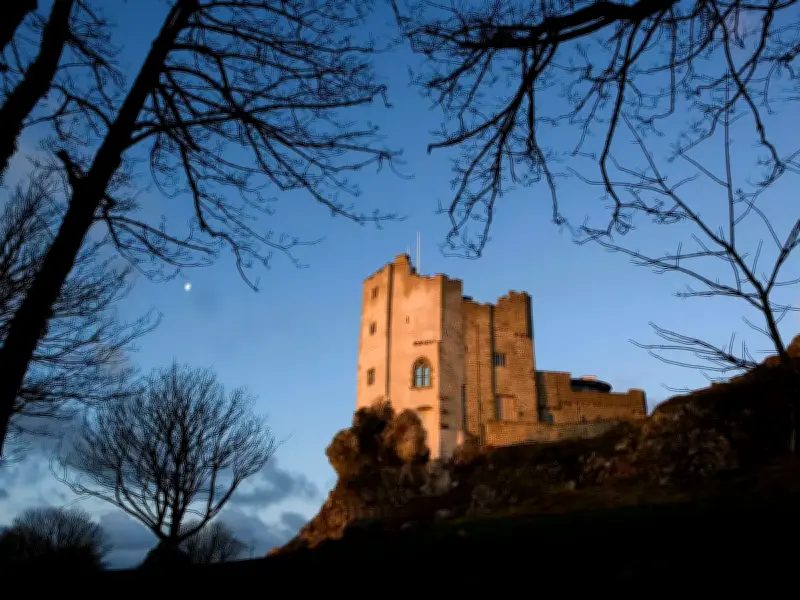
Roch Castle sits high above the landscape on a volcanic, rocky outcrop, offering 360-degree views of Pembrokeshire. This heritage property has been beautifully restored and features six luxurious en suite bedrooms, along with a unique, haunted history. Roch Castle in Haverfordwest was built in the late 12th century and was home to Lucy Walter during the 1630s. She was Charles II's consort and the mother of the Duke of Monmouth. Many believe Lucy haunts the castle. Some claim to have seen her floating through locked rooms in a white dress. Guests have also heard noisy footsteps running at night.
Ruthin Castle and Skirrid Inn
The historic 13th-century fortress operates as a four-star hotel, the Ruthin Castle Hotel & Spa. The castle dates back to 1277, when Dafydd, brother of Prince Llewelyn ap Gruffydd, built it for King Edward I of England in return for his help during the invasion of north Wales. The castle was sold at auction in 1960 and converted into a hotel. Lady Grey is probably the most well-known ghost said to haunt the castle.
The website hauntedrooms.co.uk explains that Lady Grey killed her husband's mistress, a peasant girl, after finding out about the affair. She was sentenced to death and, since then, has been seen in the banqueting hall and wandering the castle battlements. The website notes that a ghostly soldier has also been seen wearing one glove and "wandering the ground of the castle."
Skirrid Inn is probably best known as Wales' most famous "haunted" spot. At least four spirits are said to linger within the walls of the former farmhouse, including the famous Colonel Prichard. Some, they say, have good intentions; others return with a vendetta. Haunting Happenings runs ghost hunts at Skirrid Inn in Abergavenny, said to be Wales' most haunted pub. The Inn has been standing since Norman times, and with reports of slamming doors, footsteps, and hushed voices, you’ll need to be brave to stay the night.
Baskerville Hall, Bodelwyddan Castle, and Margam Castle
Baskerville Hall in Glasbury, near Hay-on-Wye, is reputed to have inspired the classic Sherlock Holmes story The Hound of the Baskervilles, but Arthur Conan Doyle is said to have set the book in Devon "to ward off tourists". The website Haunted Rooms also says Baskerville Hall is known for its ghostly goings-on. It reads: "You may catch a glimpse of The White Lady, who is regularly spotted in the rose garden, or you may come into contact with an unknown male apparition who is reported to be seen on the main staircase. Many guests and staff alike have also heard unexplained banging noises and footsteps coming from the corridors at night."
The Humphreys family of Anglesey built Bodelwyddan Castle as a manor house around 1460 and reconstructed it between 1830 and 1852. The castle also served as a girls' boarding school from 1920 to 1982 before becoming a visitor attraction. One apparition is said to be the Blue Lady, seen wandering through the kitchen. Haunted Rooms notes that she "is often heard rattling dishes and pans in the dead of night". A woman dressed in white has also been seen disappearing into a wall in Watts Hall. Customers have also reported their glasses flying off the tables for no apparent reason, with the ghost of a headmistress who disapproved of drinking thought to be the culprit. Sighs and voices have been heard, with others who have stayed there reporting dragging noises across rooms, leaving them terrified.
You can’t technically stay the night at Margam Castle, as there is no formal accommodation, but you can join late-night paranormal investigations and ghost tours that sometimes run until 3am. Visitors to this 19th-century Gothic mansion in Neath Port Talbot have long shared eerie tales of spectral figures, unexplained laughter, and objects that seem to move on their own. From the Bronze Age through to Roman times, and later the founding of the Cistercian Abbey in the 12th century, this site has seen centuries of human life and, perhaps, lost spirits.
Margam Castle is part of Margam Country Park, a gorgeous 1,000-acre South Wales estate in the Neath Port Talbot region and, unlike many other castles in Wales, such as Cardiff and Caerphilly, is free to enter. The entrance Hallway and Staircase Hall are open to the public, and several ticketed ghost-hunting events take place during the spooky season. Built between 1830 and 1840 by architect Thomas Hopper for Christopher Rice Mansel Talbot, the castle is a striking example of Tudor-Gothic architecture. The Talbot family owned the estate until 1942, and a devastating 1977 fire left it in disrepair.
The most infamous spirit of Margam Castle is allegedly Robert Scott, a gamekeeper who was murdered on the estate, some say by a poacher, others by an escaped convict. His presence is said to rage through the castle and the estate to this day. Scott is frequently spotted making a determined ascent of the Gothic staircase leading to the castle. His presence is a recurring theme among psychic investigators, who all agree that his spirit seethes with fury, unable to rest after his untimely and unjust death.