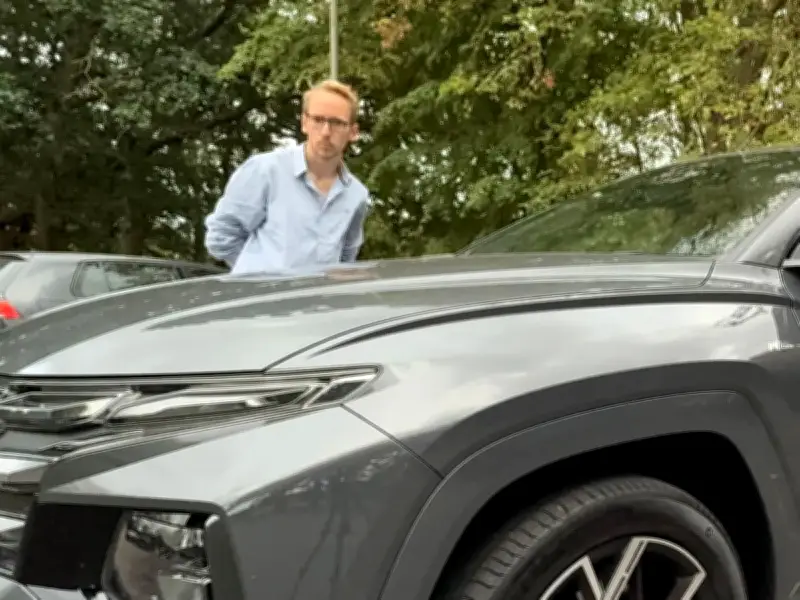
Christopher Sharp has driven four of the most popular SUVs on the UK market this year to determine which is best. The Hyundai Santa Fe emerged as the winner with a score of 9/10, ahead of the Nissan Qashqai at 8/10, with the Hyundai Tucson and Kia Sportage tied at 7.5/10.
The rise of the SUV
Over the past 20 years, SUVs have risen inexorably in popularity. Initially, they were dedicated 4x4s made by only a few manufacturers, built to conquer mountains. Then Porsche and BMW introduced the Cayenne and X5, making SUVs sportier without being distasteful.
In the mid-2000s, the explosion began properly with one Japanese company proving that SUVs could be affordable and widely desired. Today, every manufacturer produces them at various price levels. The Kia Sportage, Nissan Qashqai and Hyundai Tucson are among the most popular on UK streets, with the first two making it into the SMMT's top 10 best-selling cars of 2026 and the latter in last year's list. The Hyundai Santa Fe, a larger seven-seater, offers an option for bigger families.
Hyundai Santa Fe - RRP £49,090
Sharp says the Tucson, Qashqai and Sportage are all generally good, but the Santa Fe is even better. The seven-seater has been one of his top cars of 2026 so far, feeling small from behind the wheel despite its size. It is practical, but in cities it does not feel its width or length.
On wider roads, it embraces its SUV character, handling like a large car that prioritises comfort and gentleness. Its styling is not trying to be sporty but aims to be a big family-friendly bus. It has faults, including big touch screens and a four-cylinder engine that struggles with the weight it must pull, and its sheer size may put people off. Sharp compares it to a well-behaved adult golden retriever: they have their faults, but they are brilliant too.
Hyundai Tucson - RRP £35,755
The Hyundai Tucson is a hybrid SUV measuring 4.5m in length and approximately 1.8m in width. Under the bonnet sits a 1.5-litre four-cylinder engine delivering 235bhp and producing 265Nm of torque, capable of propelling its 2,190kg frame from 0-62mph in just over eight seconds. Inside, there is room for five passengers, with 616 litres of boot capacity when the seats are upright and 1,795 litres when they are folded down.
The Tucson features haptic touch pads for the air-conditioning and heated seats, with a large touchscreen above and a handful of physical shortcut buttons, plus additional controls on the steering wheel. The steering wheel is a conventional round shape, unlike the Sportage's flat-bottomed design. At the front of the main dash, there are two USB-C charging ports, two cupholders and a wireless charging pad. Both cupholders are practical and generously sized, while the wireless charging pad does not overheat the phone.
The touchscreen can prove fiddly on the move, though connecting to Apple CarPlay is straightforward. Out on the road, the N-Line is capable on motorways, with the hybrid system transitioning between electric mode and the petrol engine more seamlessly than the Sportage. Switching into Sport mode is unnecessary, as the car handles it well but it simply is not needed. In standard mode, it is comfortably spacious, offering ample room in the rear for three adults and a boot large enough for their luggage.
Kia Sportage - RRP £31,395
Sharp previously compared the Kia Sportage with the Ford Puma, finding the Sportage performed far better than its American competitor. He was baffled as to why the Ford topped SMMT's best sellers. Months later, he pitted the Sportage against the Nissan Qashqai, where it came second by half a point, and it finishes as runner-up here again.
The Sportage has a welcoming, family-friendly cabin with physical buttons complementing the touchscreens and supportive seats offsetting the angular steering wheel. Like the Hyundai, its sports mode seemed superfluous, though Sharp was impressed by its futuristic, cyberpunk-style appearance. On the road, its boxy stance delivered stability while remaining agile. Its powertrain in sport mode felt somewhat raucous, but otherwise it proved an undemanding drive on motorways and country lanes. It was capable and visually distinctive, just not the one he would pick from this pairing.
Nissan Qashqai - RRP £30,635
The Nissan Qashqai is the SUV that sparked a revolution. Two decades ago, the Mk1 version launched something that has resulted in virtually every manufacturer building many of them today. It remains a formidable offering, straightforward to get along with, simple to learn, effortless to drive and a breeze to operate.
Of all the SUVs tested, this was the one Sharp felt most at home in, and most quickly. It boasted sporty looks paired with a laid-back character, and one-pedal driving through its hybrid system felt natural and intuitive. Ultimately, it was that hybrid system that saw it edge out the Sportage and rivals from Ford and Jaecoo. The car felt marginally more practical overall, offsetting the slightly budget feel of the interior compared to the more upmarket Sportage.
When weighing up the Qashqai against the Tucson, the particular Tucson tested was aiming for a sportier character than the Nissan, so the Nissan was always likely to come out on top for comfort, which it duly did. In terms of practicality, the two are remarkably evenly matched given their similar dimensions, but the Nissan still clinches it thanks to its marginally superior hybrid system.