The Scotland risk and reward dilemma facing Steve Clarke for Brazil as confusion in painful 70 seconds proves one thing. Our man Craig Swan analyses the defeat to Morocco and looks ahead to that massive Miami showdown against the five-time world champions.
Kieran Tierney's Role and the Gameplan
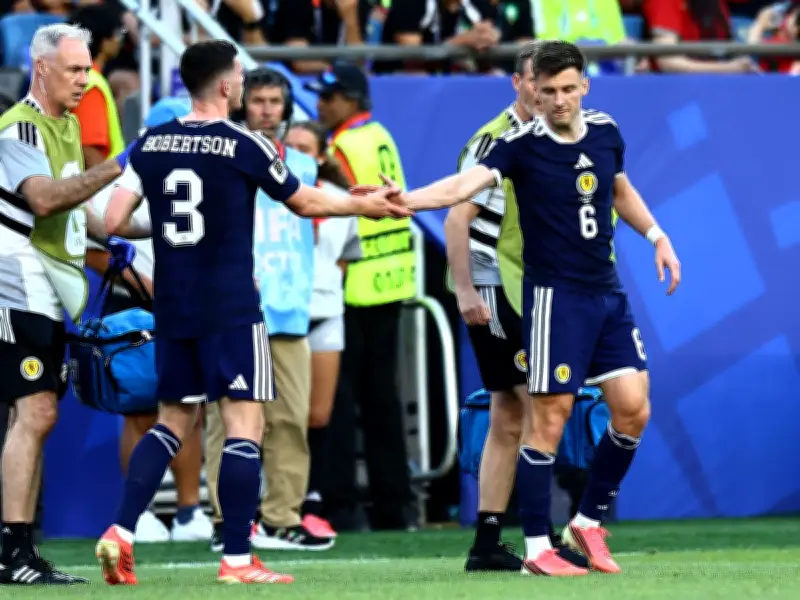
Kieran Tierney of Scotland shakes hands with Andy Robertson. Kieran Tierney took position at kick-off one ahead of Andy Robertson on the left-hand side. With Morocco's superstar right back Achraf Hakimi in his eyeline, his job appeared to have been detailed out. Steve Clarke seemed to have a gameplan hatched which included the key detail of getting a handle on a highly-influential area of the African champions. With Real Madrid's Brahim Diaz ahead of PSG ace Hakimi down the right, skipper Robertson would need solid back up in his left-back role against the pair and no fan would argue that Tierney was the perfect man for that job.
The Painful 70 Seconds
For the first 40 seconds, Hakimi was right where the Scotland pair would have expected him to be, where the Celtic man could work to get close. Yet the next 30 seconds which unfolded almost in the blink of an eye proved it's almost impossible to make plans and provisions based on the behaviour of others. As possession calmly moved across to Morocco's left-back area and into the feet of Manchester United's Noussair Mazraoui, Hakimi, without warning, suddenly decided he was going to almost-immediately vacate his natural habitat and go off for a wander across the width of the park and into the left wing patch.
Morocco's Ayyoub Bouaddi, right, is challenged by Scotland's Ryan Christie. He'd have been fairly sure the Parkhead man wasn't going to just follow him because few players would in that scenario. You pass him on. But, nonetheless, it's already caused a bit of confusion inside a minute. As the Moroccans then begin moving the ball back across and the play switches gain, Hakimi has now decided to make the return journey towards his normal side of the park. In doing so, he's catching eyes, wandering across the area where Lewis Ferguson would have to unexpectedly pick him up.
Tierney, at that point, has been briefly left in a mini no-man's land. Professional and eager to get tight to someone, when the next pass reaches Diaz, the Celt steps forward to get closest to him, yet Robertson, knowing he's also got to keep an eye on the Real ace, then briefly seems to catch sight of Hakimi also coming back onto his side. Jack Hendry has edged over as well and, while all this unfolds, one Diaz ball takes the three of them out of the game. When Grant Hanley opts to play for offside, it doesn't work and the goal is lost.
Clarke's Dilemma
Clarke was bang on to identify the threat of Morocco's right hand side and make a plan to try and combat its effectiveness. Yet he knows that, no matter what he does or asks his boys to do, he and they can't legislate for what opposition do, unless you tell guys just follow players all over the park, which is just unrealistic given the fluidity of some sides. In the modern game, you'd end up with players everywhere. This seemed an example of what can happen when opposition players are not in the places you would most expect them to be, or set up to face against.
The outcome, although it could still have been avoided, was devastating when Ismael Saibari smashed Diaz's pass beyond Angus Gunn and Scotland were never able to claw back from that concession. It was painful for plans to be undone in 70 seconds by the Africans and it would be fascinating to see inside the mind of Clarke now heading into the contest against Brazilians.
Balancing Threat and Own Game
Of course, any manager worth his salt, and Clarke is far more than just worth his salt, makes provisions to nullify and cope with opposition threats. But it seems the hardest bit for any boss is finding that wafer-thin balance between limiting the strengths of the illustrious opposition, while also managing to get as close to playing your way as you can. Certainly in the case of the underdog. Scotland are not in a position to just simply impart their way onto teams who are operating in the Top 10 in the world. Two of which are Morocco and Brazil.
However, that first 70 seconds in Boston just goes to show it's almost impossible to perfect a plan to stop everything. Clarke will no doubt have been through the players and styles of Brazil, the workings of Carlo Ancelotti like a fine-tooth comb. So perhaps the biggest challenge or decision now is how much percentage of Scotland's next gameplan is based on Brazilian threat and how much on Scotland's ability to hurt the South Americans.
Brazil's Vulnerabilities
Brazil national team line up. Brazil were able to coast against Haiti. But, against Morocco, they looked sluggish in stages in the middle of the park. Bruno Guimaraes, Casimero and Lucas Paquetá got the runaround at times from the effervescent Moroccans and there wasn't much in the way of threat outwith the magic of Vinicius Jnr, who brought a goal. That trio were far more slick against Haiti and the attack had added punch with the inclusion in the starting line-up of Manchester United's Matheus Cuinha, who scored twice.
A point will do Scotland, but playing for one is a hard thing to do. Clarke has got the midfield players in Scott McTominay, John McGinn and Lewis Ferguson with the power and talent to match Brazil's three, but you can't just abandon jobs and go toe to toe. Article continues below. Clarke will be wary of Ancelotti's side. And he's way too smart not to be. But Scotland's chances may depend on just how much the manager feels his team has to be set-up to try and stop them. And, in turn, just how much he feels he can risk in the beginning with a plan for his own boys to damage Brazil.