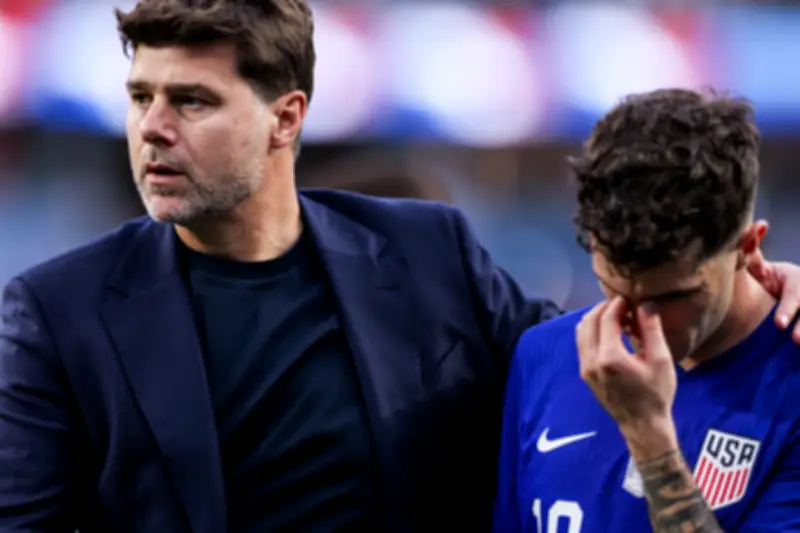
Mauricio Pochettino's US team had just lost the 2025 Gold Cup final to Mexico, their arch-rivals, in a hard-fought match. Tears welled in his eyes. But as Pochettino explained this week, these were also tears of empathy for his players. They had just played a tournament final in Houston, one of the largest metro areas in the United States, yet the crowd was hostile, visibly and vocally in favor of their rival.
Early Setbacks: The 'Big Bang, Punch'
The 'punch' he referred to actually came months before the Gold Cup heartbreaker, the first of three setbacks that have shaped the path of this US team. In March 2025, the US's task in the Concacaf Nations League seemed straightforward: get past Panama in the semi-final before their usual regional final against Mexico or Canada. The US had won its first three installments of the competition, launched in 2019-20. This time, they couldn't even reach the final.
“It was empty,” Pochettino reflected. “You remember the game, Panama? It was the Mexican people [in the stands] because they played after us.” For decades, the US dominated Panama, boasting a 17-4-2 record as of mid-2021. But on this day, Panama claimed a fourth win in their last six matchups, including the 2023 Gold Cup semi-final, a 2024 Copa América group game and now a first berth into the Nations League final, pouncing on a US mental lapse to score with just their third shot.
“That was [a] good crash, no?” Pochettino said this week. “And it was good to see. … When people say, ‘Yeah, but you have bad results.’ Yeah, yeah: bad results. No worries. We know what we are going to do. When we detect all the problems, we go for the solution. And we knew that the solution would arrive.”
Culture Shift: All-In or Watch from Home
Among the problems Pochettino identified was the very culture of the team. Players had grown comfortable. So when Christian Pulisic asked Pochettino if he could miss the Gold Cup but be involved for the preliminary friendlies against Turkey and Switzerland, Pochettino declined, wanting one cohesive group from day one of camp through the end of the tournament – the same approach he took with his World Cup roster. This kicked off a back-and-forth between player and coach, and decisive losses in those pre-Gold Cup friendlies ratcheted up the pressure. But Pochettino had established an expectation: be all-in, or watch from home.
The Gold Cup unearthed new members of his eventual core. Malik Tillman finally had a chance to be his national team's chief playmaker. Matt Freese took over in goal and outlasted the esteemed Keylor Navas in a shootout. Alex Freeman became an undroppable young option. Sebastian Berhalter worked into Pochettino's midfield rotation.
Evolving the System: 'Why Not Us?'
Pochettino evolved, too. International tournaments more closely resemble the club side of the game than the infrequent cadence of friendly windows. For over a month, he worked with a fixed squad every day. He could better refine his system and more directly improve their game. Even as he fought back tears after losing the final to Mexico, Pochettino praised his team's heart, lauding it as necessary to actualize his ambitions for the World Cup.
“Keep improving, but please don't change,” Pochettino urged in the locker room, his mind still on the environment that greeted them that night. “We were in Columbus watching Ohio State against Texas,” Pochettino said, citing a college football game played on 30 August 2025. “There were 70,000 fans there. And my question was, you know, why not? If the fans are very passionate, why not with us, with soccer? Because if [the support is] with us, they will be and show the same passion. It's massive. It's so powerful for the player.”
A mantra was born: “Why not us?” And with it, a new style of playing. With Pulisic and other program mainstays returning in September, Pochettino debuted what eventually became the team's base shape: a fluid side that morphs rapidly to unsettle opponents with off-ball movement, quick switches from side to side, and fearlessness when openings present themselves.
Credible Results and Another Hard Lesson
Credible results ensued: a 2-0 win over Japan in September, a draw with Ecuador and a win over Australia in October, then a November window that featured a win over Paraguay and a 5-1 romp of Uruguay to close 2025 on the highest note imaginable. And then, the third hard lesson: two defeats this March. Worse than the humbling 7-2 aggregate, the team looked unsure of themselves. The defense was over-run, even reverting to a previous, more porous structure against Belgium. Mired in a career-worst goal drought, Pulisic was given a rare start at center-forward against Portugal to little impact.
“I feel like we've always bought in,” Chris Richards said this week, “but I really feel like the March camp that we had was really important. … I think we really gave, you know, two really good teams in Europe a really strong game.” Pochettino kept the faith, but even in his defense, he admitted: “Belgium and Portugal have, in the top 100 players, [a] few or some players in that top 100. I think we don't have [any].”
Rounding into Form for the World Cup
Despite the internal positivity, the pessimism surrounding the program had returned. Wouldn't they regret scheduling pre-World Cup friendlies against two strong sides in Senegal and Germany? “No,” Pochettino said. “That is good for us. It's going to measure our level.” A 3-2 win over Senegal and a 2-1 defeat to Germany showed his team rounding into form in the nick of time. And then, a dominant 4-1 bulldozing of Paraguay, a 2-0 silencing of Australia, and on Thursday, a dead-rubber fixture between an eliminated Turkey and the US, already the winners of Group D.
Only four teams at this World Cup won their groups after two games. Argentina and Germany are among the most storied teams in men's football. Mexico enjoy famously strong support and benefit from playing at altitude in hostile environments. In their company sit Pochettino's US. “It's not going to be figured out overnight, it's not going to be figured out in one camp, or sometimes in six months, or 12 months, maybe not as fast as everybody wanted to,” defender Mark McKenzie said. “I think we're showcasing that it's a process.”