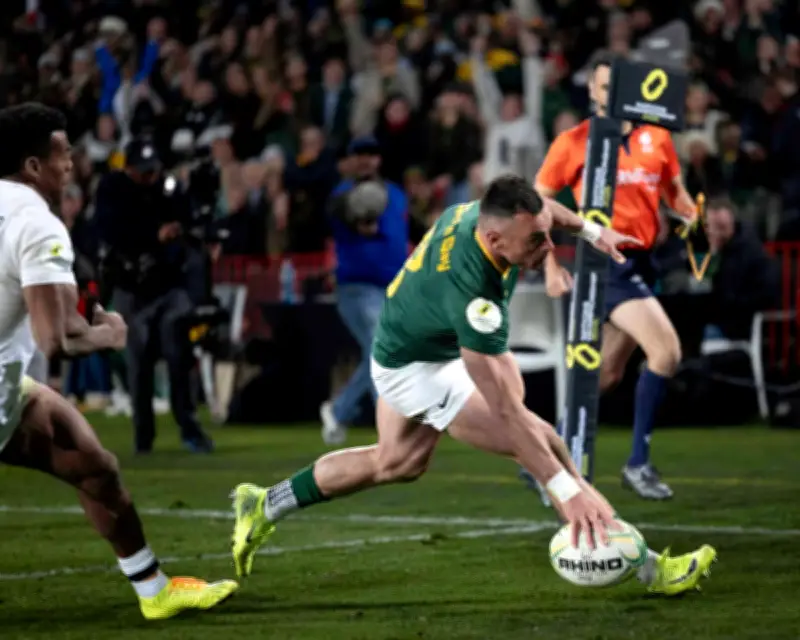
South Africa cruised past England inside a fervid Ellis Park with a 45-21 win, a result that has reignited discussions about the Springboks' potential to secure an unprecedented third consecutive Rugby World Cup title in Australia next year. The victory, witnessed by a passionate home crowd, underscored the depth and physical prowess of Rassie Erasmus's squad, even as several key players were absent.
Springboks' Depth on Display
England were gallant, but anyone would have struggled to contain the hosts when they were in full flow. “They’re just very good when they get into that cycle,” said Jamie George, England’s captain. That was despite the Boks being without, among others, Siya Kolisi, Eben Etzebeth, Lood de Jager, RG Snyman, Franco Mostert, Wilco Louw and Sacha Feinberg-Mngomezulu. A new green machine with go-faster stripes is emerging from Erasmus’s workshop and it spells potential trouble for all and sundry.
Reinvention and Regeneration
The best sports teams constantly look to reinvent themselves. Their core principles remain in place but, crucially, they never stand still. The ultimate example in rugby, until now, has probably been the All Blacks. For decades it was not only about winning the next game, but underlining their position as “the most dominant team in the history of the world”. Even the greatest All Black sides, however, never won three consecutive Rugby World Cups. New Zealand did lift the Webb Ellis trophy in 2011 and 2015, but an unprecedented treble has remained stubbornly elusive.
Which now leaves the door ajar for their longtime rivals South Africa, champions in Japan in 2019 and in France in 2023. Erasmus already looks to have pulled off the cutest of tricks: blood talented youngsters, encourage them to stake a permanent claim and then watch their seniors respond accordingly. Get that balance right and there is no surer way to regenerate the collective.
Emerging Talent and Key Players
We are certainly going to see plenty more of Zach Porthen, Cameron Hanekom and Paul de Villiers in the years ahead. The same applies to those who have already been around the squad for a while: Damian Willemse, Grant Williams, Canan Moodie … their ability has never been in doubt and experience is improving them further. Which puts the onus on everyone else to try to catch them up.
New Zealand and France, as demonstrated by last Saturday’s excellent game in Christchurch, are the likeliest candidates. The All Blacks have started to play proactive All Black-style rugby again under Dave Rennie and look much happier for it. France, without numerous frontliners, scored four tries and gave notice of their own impressive depth. On another day Matthieu Jalibert might easily have conjured another score or two.
Challenges Ahead for Rivals
It will also be interesting to see what unfolds when Ireland pitch up in Auckland on 18 July. The All Blacks’ unbeaten sequence at Eden Park stretches back 52 Tests to 1994, but old certainties are under increasing strain. There was an average of 63 points per game on the opening week of the Nations Championship and sides unable to rack up in the region of 30 points will find it hard to win games regardless of the opposition or the venue.
Which is another reason why the Boks are going to take some beating. There are ways to outflank their suffocating rush defence, but good luck trying to run through Damian de Allende and Jesse Kriel. Kicking the ball to space invaders such as Willemse, Cheslin Kolbe and Kurt-Lee Arendse is also a tactic fraught with obvious danger. Scotland, their opponents in Pretoria on Saturday, will have to be even more ruthless than they were against Argentina in Córdoba to make consistent inroads.
Conclusion: A Beastly Proposition
Much can change in 15 months, but it is meant as a compliment to describe South Africa as a beastly proposition. Might they, at full strength, even be a match for the New Zealand side spearheaded by Richie McCaw, Dan Carter, Brodie Retallick and co? Or even the all-powerful All Blacks teams of the late 1980s and 1990s? Time will tell, but Erasmus’s rejuvenated Springboks have an increasingly ominous look about them.