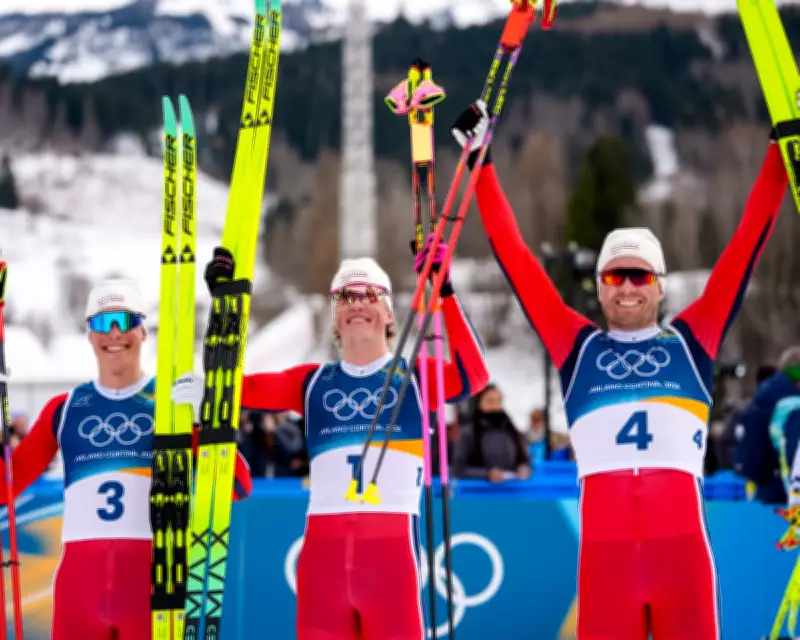
Klæbo Seals Historic Sweep with Record Sixth Gold of Winter Games
At the conclusion of one of the most gruelling races in Winter Olympic history, the greatest athlete in the history of the Games emerged triumphant. Johannes Høsflot Klæbo of Norway secured his sixth gold medal of the 2026 Winter Olympics by winning the men's 50km classic cross-country skiing event in Tesero, Italy.
A Record-Breaking Performance
After more than two hours of intense racing, Klæbo crossed the finish line just 17.4 seconds ahead of his Norwegian teammate Martin Løwstroem Nyenget. This victory broke the long-standing record for most gold medals in a single Winter Games, previously held by American speed skater Eric Heiden who won five golds at Lake Placid in 1980.
Klæbo's achievement represents an unprecedented level of dominance in Olympic competition. The 29-year-old has now accumulated 11 Olympic gold medals throughout his career, placing him ahead of entire nations on the all-time Olympic medal table. Remarkably, if Klæbo were a country, his performance in these Games alone would rank him ninth in the 2026 medal standings.

Unprecedented Olympic Dominance
What makes Klæbo's accomplishment truly extraordinary is the sheer volume and variety of his victories. Over the past fortnight, he has competed in 10 races covering 115 kilometers across six different events, winning every single competition he entered. No athlete has ever swept all cross-country skiing events in a single Olympics before, a feat many considered impossible in such a physically demanding sport.
With his latest triumph, Klæbo now stands second only to American swimmer Michael Phelps in total Olympic medals won. In just one week of competition, he has surpassed legendary athletes including Larisa Latynina, Carl Lewis, Katie Ledecky, and Paavo Nurmi in the Olympic pantheon.
The Gruelling 50km Challenge
The 50km classic is widely regarded as the most challenging event in the Winter Olympics. For much of the race, Klæbo battled alongside teammates Nyenget and Emil Iversen, the three Norwegians moving in perfect synchronization like migrating geese. They maintained this formation through the winding trails between larch trees and over the demanding hills of the course.
By the 30-kilometer mark, the Norwegian trio had established a commanding lead, with Russian skier Savelii Korostelev trailing by nearly two minutes. Iversen eventually fell back during the final lap, but Nyenget remained locked with Klæbo until the very end. Nyenget launched two attacks in the closing kilometers but couldn't shake his determined teammate.
A Dramatic Finish
As the two Norwegians approached the finish line, they appeared dead level with not even a hundredth of a second separating them. Then, on the final uphill section, Klæbo made the decisive move that thousands of spectators had been anticipating. Demonstrating remarkable endurance after two weeks of intense competition, he surged ahead on the last bend and entered the home stretch with a tenth-of-a-second lead, crossing the finish line to thunderous applause from the crowd.
Mastering Multiple Disciplines
Klæbo's victory represents the culmination of years of dedicated training across different skiing techniques. Originally a sprinter competing over 1,500 meters, he gradually expanded his repertoire to include marathon distances with the specific goal of winning the prestigious 50km event. This required mastering two fundamentally different techniques: classical skiing, where skis remain parallel in groomed tracks, and freestyle skiing, characterized by a V-shaped motion.
Not content with conventional methods, Klæbo developed his own unique uphill running technique—a high-tempo diagonal stride that proved devastatingly effective in cross-country classic sprints. A viral video clip shows him storming up a 240-meter hill on skis at six-minute-mile pace, one of the most astonishing sights of these Olympics. His childhood coach revealed this technique originated accidentally when Klæbo discovered that running worked better than skiing on poorly waxed skis.

Respect from Rivals
The magnitude of Klæbo's achievement is perhaps best measured by the admiration of his competitors. French skier Theo Schely declared him "the GOAT in the whole sport, the greatest skier we will ever see." American Ben Ogden acknowledged the reality facing other athletes: "I like to go to every race thinking that it's a race for the win, but these days, a lot of the time it's a race for second."
Norwegian teammate Oskar Vike simply stated, "He's the best skier of all time, and it's an honour to share a podium with him." Even those further back in the field recognized Klæbo's superiority, with Britain's Andrew Musgrave, who finished sixth, quipping that "Johannes could probably have gone backwards faster than me up the last hill."
Klæbo's historic performance has redefined what's possible in winter sports, establishing a new benchmark for Olympic excellence that may stand for generations to come.