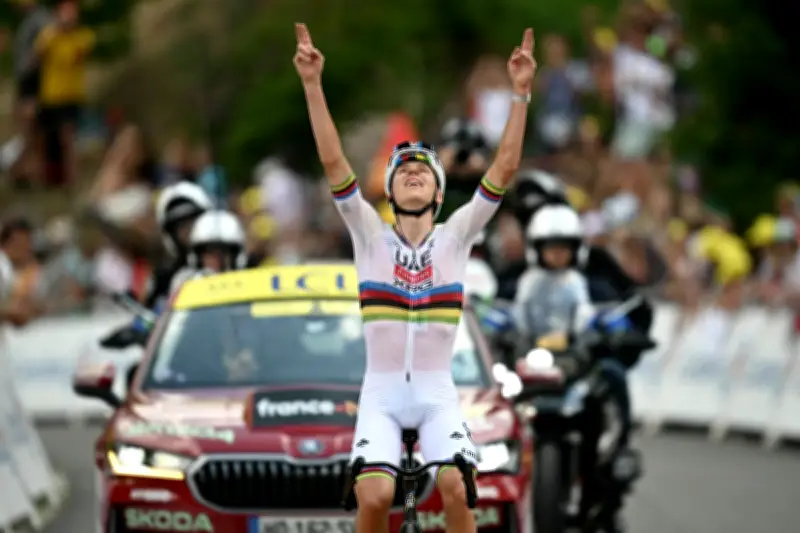
Riding the Tour de France in 40°C is hard enough without having to race against Tadej Pogacar and UAE Team Emirates XRG every day. As the peloton finally takes a breather, lounges in the shade and rehydrates on the Tour's first rest day, most team managers are pondering what genuine opportunities they might still have, in the face of Pogacar's domination, to try to achieve success.
Criticism and admiration for Pogacar's dominance
“Is Pogacar killing cycling?” asked L’Équipe after he and his team were criticised for chasing down breakaways, even if they posed little or no threat to the overall standings. On Sunday’s stage to Ussel, UAE Team Emirates asked for help from other teams in pursuing the day’s escapees, one of whom was Tom Pidcock. Pidcock’s former team, Netcompany Ineos, promptly obliged, although many found it hard to understand their motivation. “We decided to contribute to the chase because we believed in Pippo Ganna,” the team’s sports director, Daryl Impey, said afterwards.
Pogacar as the new 'patron'
Pogacar and his team would deny it but there’s no doubt that the four-time champion is cycling’s new “patron”, echoing other serial Tour winners, from Eddy Merckx to Lance Armstrong, who effectively controlled the outcome of most stages in the Tour, even the ones they weren’t bothered about winning. Untouchable in the mountains, his detractors would say Pogacar has become untouchable in other ways too. Few on this Tour have displayed much scepticism towards the Slovenian, even after he shattered the record climbing time on the Col du Tourmalet.
Growing incredulity at the roadside
There is not the same open cynicism in France that was on show during the Armstrong era, or even towards Chris Froome, who won four Tours while with Team Sky. But there is nonetheless growing incredulity at the roadside towards Pogacar’s supremacy. Pogacar and his team have won three stages and it seems inevitable they will win more. With six mountain stages still to come, including a mountain time trial, he maybe out of sight by the time the Tour finally turns towards Paris. But he is also in control elsewhere in the race.
Successor and team dominance
Already it feels as if he has chosen his successor and, on the basis of what we have seen so far, it is more likely to be his Mexican teammate Isaac del Toro than the highly sought-after French prodigy Paul Seixas, who is subject to contract offers from most leading teams. While Seixas, a Tour debutant, is still an apprentice, Del Toro has already finished on the podium of the Giro d’Italia and is currently breathing down second-place Jonas Vingegaard’s neck. The UAE team are also one of Seixas’s suitors. Nino Seixas, his brother, was hosted at a winter training camp and Pogacar himself has made a point of singing the French rider’s praises. If his team were to sign Seixas, they would employ three of the world’s top 10 riders.
Budget disparity and salary caps
“In the World Tour,” said Jonathan Vaughters, manager of the EF Education EasyPost team, “there’s essentially five haves and there’s 13 have-nots. Your average budget now is €32m or €33m, and it’s actually just five teams that are on €50m to 55m. You can see with what UAE did last year, winning 100 races, that this year they’re on track to do it again.” The American has long been an advocate of salary caps. “Very few different teams are able to win the races now. Everyone else can be there and race for minor placings, but winning is down to just a few teams.”
Impact on fans and sponsors
The issue of spiralling budgets for some teams, while others tread water and make do, has been echoed elsewhere in other sports. But in cycling there are only a handful of potential Tour de France winners. By the end of this season, Pogacar and UAE Team Emirates may be employing three of them. A decade ago, according to Vaughters: “There were not four or five huge mega-budget teams that were pushing up the salaries. Now you’ve got bidding wars. And what that has done is pushed up team budgets, meaning that you literally are dividing between the haves and have-nots.” For the French, the curtailing of the Seixas hype, in the face of UAE’s control of the race, has been tough to take. Vaughters sympathises with those feeling the ennui of watching another Tour dominated by Pogacar, with little chance of success for the Tour’s lesser teams. “Right now, the way the sport is set up, we are discouraging sponsors and we are discouraging fans. Basically, if you’re not a fan of UAE in cycling, and you aren’t interested in another Pogacar win, why are you watching the race?”