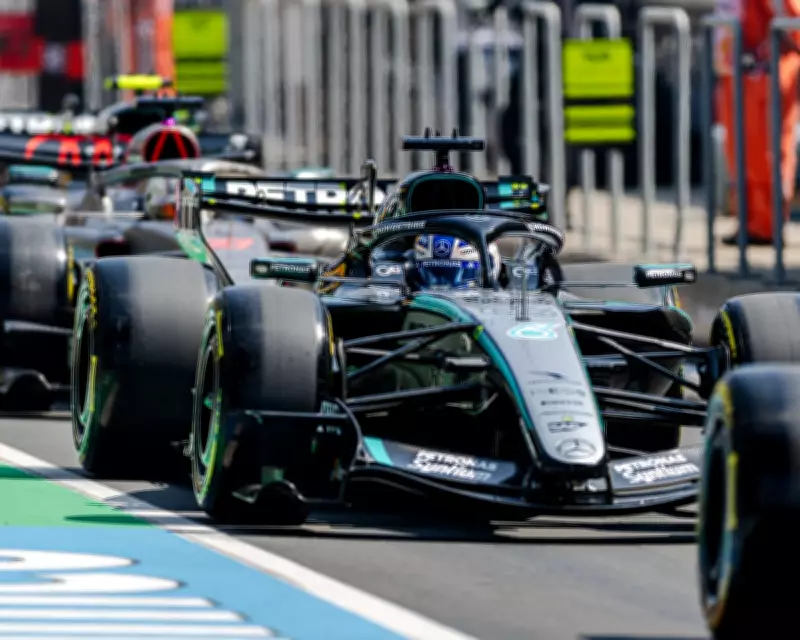
Mercedes Steals the March in F1 Season Opener with Strategic Dominance
Mercedes are poised to maintain their supremacy as Formula One heads into the second race of the season in Shanghai this Sunday. The team's formidable performance in the opening round in Australia, where George Russell and Kimi Antonelli clinched a commanding one-two victory, underscores their adeptness at mastering the intricate art of energy management under the sport's new regulatory framework.
Unrivaled Performance in Australia
In Australia, Russell demonstrated blistering pace, qualifying eight-tenths of a second faster than the nearest rival, Red Bull's Isack Hadjar. During the grand prix, he finished a staggering 15 seconds ahead of third-placed Charles Leclerc, even after easing off in the final stages. Antonelli complemented this with a strong showing, securing Mercedes a front-row lockout in qualifying for the sprint race in China. These performances have firmly established Mercedes as the class of the field, a sentiment echoed by their competitors.
To contextualise this dominance, last year's world champion Lando Norris qualified nearly a second slower in Australia and finished fifth for McLaren, over 50 seconds behind Russell. This gap is particularly striking given that McLaren utilises the same Mercedes engine, as per regulations requiring customer engines to be identical to those of the works team. Despite this parity, Mercedes is extracting superior performance, highlighting their advanced understanding of energy optimisation.

The Crucial Role of Energy Management
At the heart of Mercedes' advantage lies the critical, albeit controversial, role of energy management in modern Formula One. In an effort to attract new manufacturers, F1 has introduced engines with a near 50-50 split between internal combustion and electrical energy. With limited electrical energy available, its deployment and recharging have become paramount, often surpassing the importance of raw engine power. This shift has transformed the sport, making energy efficiency a key determinant of speed.
Albert Park in Melbourne, described as an "energy-starved" circuit due to its high speeds and few braking zones, exemplified this new dynamic. Here, Mercedes excelled by meticulously managing battery recharge, a skill that allowed their car to perform optimally. The team's extensive experience with their own engine development has given them a significant edge in software and strategy, something customer teams like McLaren and Williams are still adapting to, as noted by McLaren team principal Andrea Stella, who referred to it as "a new language and also a new way of thinking."
Driver Adaptation and Technical Superiority
Energy management now demands rapid driver adaptation, with Russell showcasing exceptional skill in this area. As Lando Norris has observed, drivers must focus intensely on how they "drive" the engine, with optimising power unit usage offering greater gains than car setup adjustments. Russell's advantage over Antonelli in identical machinery underscores this point, making energy management a pivotal weapon in a driver's arsenal.
Mercedes' technical prowess extends beyond energy systems to an exemplary chassis, while rivals like McLaren struggle aerodynamically, as admitted by Norris. However, the primary differentiator remains their mastery of the new energy regulations, which could define the season.
Looking Ahead to the China Grand Prix
The upcoming race in Shanghai presents a different challenge, being an "energy-rich" circuit with heavy braking zones and medium-speed corners. This will test energy recovery and deployment, particularly on the long back straight, offering a contrasting yet informative benchmark to Melbourne. Mercedes enters with a clear advantage, and their performance in China will indicate the extent of their dominance.
As the sport scrutinises these developments, discussions on potential rule changes regarding energy management are expected post-race. For now, Mercedes holds the whip hand, setting the stage for what could be a season of sustained superiority.