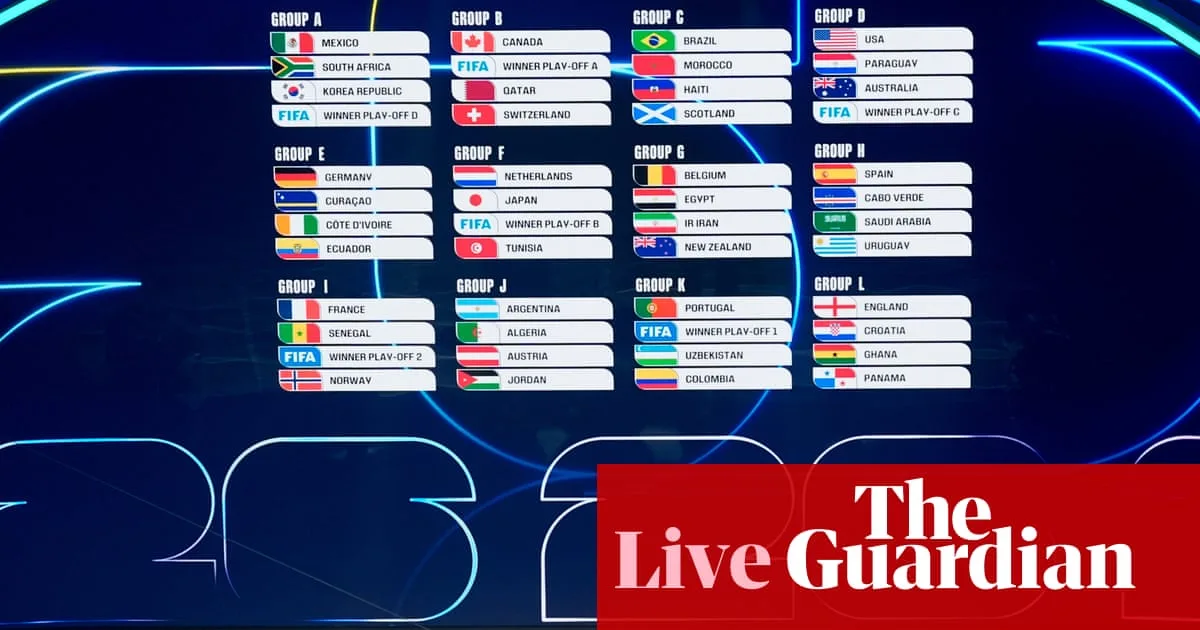
The draw for the 2026 World Cup took place in Washington DC on Friday, producing intriguing matchups including England versus Croatia and Scotland against Brazil. The ceremony, described as a surreal and prolonged affair, featured performances by Andrea Bocelli, Robbie Williams, and the Village People, alongside the presentation of the inaugural Fifa Peace Prize to Donald Trump.
England, managed by Thomas Tuchel, were placed in Group L alongside Croatia, Ghana, and Panama. Tuchel acknowledged the difficulty of the group, saying: 'Difficult group, difficult opener [against Croatia]... we are confident and we will be well prepared.' England will face Croatia in their opening match, a rematch of the 2018 semi-final.
Scotland, making their first World Cup appearance since 1998, were drawn in Group C with Brazil, Morocco, and Haiti. Wales and Northern Ireland could potentially qualify via Uefa pathway A, which also includes Italy and Bosnia and Herzegovina; if successful, they would join Group B with Canada, Qatar, and Switzerland.
The United States, co-hosts alongside Canada and Mexico, were placed in Group D with Paraguay, Australia, and a yet-to-be-determined team from Turkey, Slovakia, Kosovo, or Romania. US coach Mauricio Pochettino stressed respect for all opponents while expressing optimism about progressing.
France, Senegal, and Norway were drawn together in what many consider the 'Group of Death,' Group I, which also includes one of Iraq, Bolivia, or Suriname. Australia will face the USA, Paraguay, and one of the aforementioned European teams in Group D.