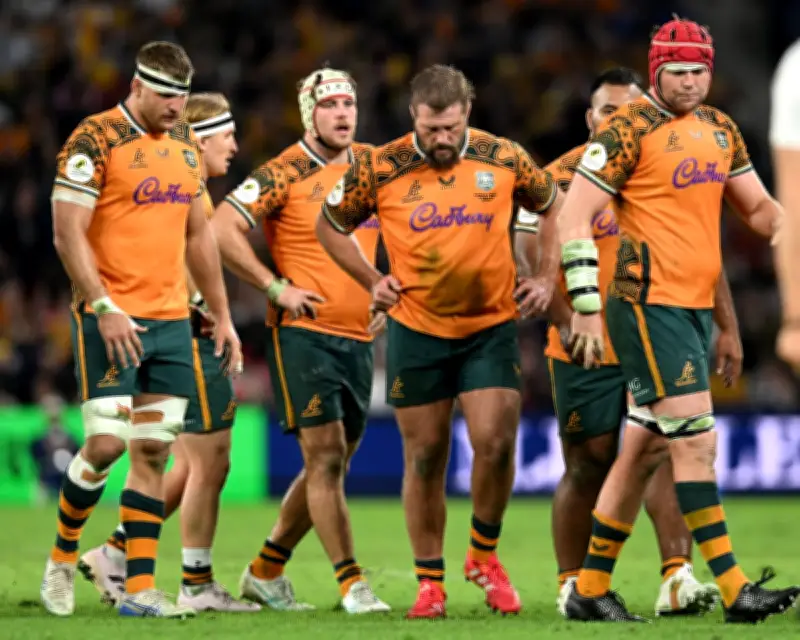
Australia's 42-26 Nations Championship defeat by France was their sixth in succession, a run not endured since the aftermath of the 2015 World Cup final. The result highlighted the widening gap between the Wallabies and rugby's top sides, with a home World Cup now looming large.
First-Half Promise Crumbles
Australia led 21-12 at half-time, playing with tempo, continuity, and simplicity. Brandon Paenga-Amosa scored from a clever short lineout after replacing Josh Nasser early. Fraser McReight burrowed over twice, first after the Wallabies chose a scrum while Emmanuel Meafou was in the sin-bin, then at the back of a maul marshalled by the impressive Josh Canham. McReight, who registered 25 turnovers last year, was everywhere, stealing the ball again early in the second half. Max Jorgensen later produced an almighty intervention on his own line.
Rob Valetini provided the most obvious attacking direction, melting Théo Attissogbe in one first-half carry and drawing the high tackle that sent Meafou to the bin. Tom Wright found a wind-assisted 50-22. For 40 minutes, there was enough heft, accuracy, and good fortune to make Australia appear capable of landing another blow against a heavyweight.
France's Bench Power Overwhelms
Then France unloaded their heavies from the bench. In this particular arms race, Australia arrived with a six-shooter and France brought a bazooka. France did not require anything especially elaborate to expose the difference. Yoram Moefana broke three tackles to launch one score. Romain Ntamack identified James Slipper defending the blindside and accelerated through the mismatch for another. Florian Verhaeghe finished a third after a sequence built on straight carries, quick ball, and defenders being forced into increasingly desperate decisions.
The contrast became painfully clear when Valetini left the field. Soon afterwards, Nick Champion de Crespigny spilled Australia's best attacking opportunity of the second half in contact. France removed giants and introduced more giants. Australia lost Valetini and became a lesser team.
Questions Linger for Schmidt's Successor
Coach Joe Schmidt moves aside after next week, and Les Kiss inherits a group capable of troubling almost anyone but not yet equipped to withstand the best teams for 80 minutes. According to analysis, the obvious question is how Australia closes that gap. The uncomfortable answer is that Schmidt's revival has shown no obvious way of doing so.
Do Australia continue trying to play like a heavyweight without heavyweight depth? Or do they recalibrate and lean more into a game built around their speed, breakdown threats, and willingness to embrace a little chaos? That may work occasionally, but it isn't cutting it against the top sides.
Home World Cup Looms Large
The home World Cup is approaching quickly enough that these are no longer abstract questions. Plucky defeats decorated with patches of excellence will not cut it. Nor will the familiar insistence that the Wallabies are closer than the scoreboard suggests. Australian rugby has spent years asking the public to believe in signs of progress. Next year it must offer something more tangible. If the Wallabies stink the place out at their own World Cup, the damage will stretch beyond another early exit. A generation already accustomed to looking elsewhere may decide this team no longer deserves its love. And from there the road back could be longer than any coach, however clever, knows how to travel.