The United States open their World Cup campaign on 12 June against Paraguay, entering a charged tournament with a pressing question: what is enough? Unlike most other countries, the US are playing the 2026 World Cup not just for themselves, but for the future of their voice in the sport.
Pochettino's Arrival and Hiccups
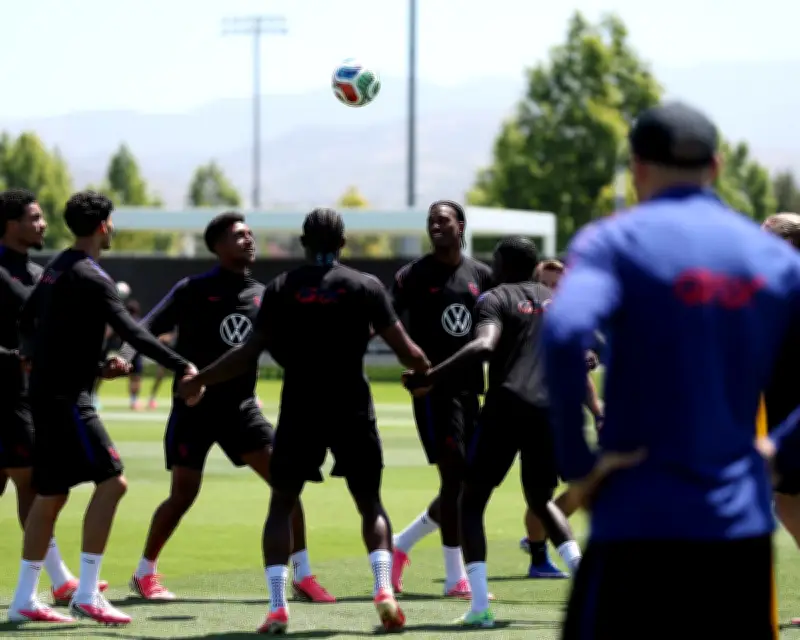
Mauricio Pochettino paused as the microphone signal flickered. He tried, for a second time, to address the 5,500 fans gathered in the sun at Championship Soccer Stadium in Irvine, California, for an open training session. Nothing. Then something. More choppy audio. By the time things came back online, he had developed a quip.
“We are in the greatest country in the world,” he said in his Rioplatense-accented English. “But the technology does not work.”
Pochettino’s adaptation to the US soccer scene has not been without hiccups. The Argentinian arrived on a $6m-per-year contract, the largest outlay for a coach in US Soccer history, with a résumé featuring some of the most famous clubs and players in the world. His job: to lead a nation more known for excellence in other sports to a historic finish at a World Cup they would co-host.
Results and Expectations
Over his 22 months in charge, the results – 15 wins, 10 losses, and a draw – are hardly indicative that a run of that magnitude is coming. His side have looked unsettled in their structure at various points, alternating brilliant passages with lackadaisical moments, full of fight one minute then meek the next. Yet Pochettino has fed into the hype, saying repeatedly that the US can win the World Cup. (“Why not?”, he is fond of asking.)
Many observers argue that it’s just as easy to see the team crash out in the group stage, or exit at the first knockout round, as they did at Qatar 2022. There are no pushovers in a group with Paraguay, Australia and Turkey. And the team have struggled against the type of quality sides they may face in the Round of 32, last 16, and beyond.
The Question of Enough
What is enough? It’s the uncomfortably vague question that looms over the US more than most at this tournament. The elite, like Spain, France, Brazil and Argentina, enter the World Cup knowing that anything less than winning the trophy will be a failure. Minnows – the likes of Curaçao, Jordan and Cape Verde – know that simply giving a good account of themselves will count for a whole lot.
The US performance, meanwhile, will be read as a referendum not just on a group of players considered to be the most talented in the history of the men’s program, but on the potential of American soccer itself.
“We want to do this for ourselves and for our own country,” Christian Pulisic, the team’s biggest star, told reporters earlier this month. “We have really good players playing in top clubs in the world, we have a good team. We’re going to do the best we can to prove ourselves right.”
Changing the Culture
The coach believes. The players believe. But what would be enough to make their country believe? The sport is no longer anathema here, but it is dominated by foreign powers – the Premier League, Mexico’s Liga MX and the Champions League all have a vice grip on what the public considers to be top-class soccer worth watching. What would be enough to make American soccer dominate soccer in America? To unleash an avalanche of attention that, for once, may match that given to baseball, basketball and American football? To hoover up an influx of commercial dollars that could be put to good use and help solidify a domestic soccer culture in the American mainstream?
“The first gift an Argentinian gets is a football; here, it’s a baseball bat, a basketball, an oval ball,” Pochettino told the Guardian. “Changing that’s not today or tomorrow. But there are almost 400 million people, 80 million Latinos, who already have that football DNA, and there’s space [for all sports]. What’s the problem? That people want results now.”
Connecting with Fans
Theoretically, a 2026 run that exceeds the previous modern high mark – the 2002 run to the quarter-finals – could lead to a boost in all these areas, if not instant results. But just as important, if not more so, is whether the public can truly connect with these players; from the trio of childhood friends (Pulisic, Weston McKennie and Tyler Adams) who form this team’s backbone, to the defensive anchor Chris Richards, to dual-nationals such as Antonee Robinson, Folarin Balogun, Alejandro Zendejas and Ricardo Pepi.
What would be enough to turn them into genuine household names?
That sort of work lies partially in events like Monday’s, where Pochettino addressed the crowd. Once the microphone was fully operational, he spoke of how proud he was to be based in Irvine, where the mayor’s office said more than 30,000 people applied for tickets to that open training. He thanked the fans for their support, and the thousands who won the lottery cheered, providing a pleasant counterbalance to the internet-fuelled negativity that can fester among this program’s diehards. They closely watched the team go through passing drills and took selfies in the autograph line as they congratulated the players on their success, asked about moments in their career, regaled them with stories of how long and far they had come to see them. To them, this team is already a ray of light in an otherwise dark world.
Political Undertones
Yet among some in the broader US soccer fandom, there exists a palpable sense of unease about this tournament, and what US success could represent, and who may co-opt it. The US players did not go to war with Iran, and they did not enact racist travel bans that have already seen a top referee barred from entering the country. They did not send federal forces to terrorize their own citizens, or systematically demonize anyone who comes to this country in search of asylum or a better life. They did not build a UFC arena on the White House lawn, essentially a middle finger of counter-programming of a world event that so many in this country have worked so hard to bring to life.
But the waving stripes and shimmering stars on the players’ kits represent the country, and the government, that did all those things. Will any amount of success, any number of indelible, joy-generating goals be enough to erase that? Or to move past it?
Pochettino has completely steered away from political discussions, and seems to have advised his players to do so as well. On Monday he told the Orange county crowd that he could not be prouder to lead the US, that their players, the fans and the federation have made him a better person and a better coach.
“Well, I don’t know if I could be made a better coach,” he quipped – a clear joke that nonetheless did not land, at least not until he apologized for his “Argentinian humor”. He closed his speech with what he clearly thought would be an automatic rouser – a short 1, 2, 3 countdown, and “USA!” The crowd couldn’t find the cadence Pochettino intended, and struggled to match the rhythm. He tried again. “I think you can do better,” he said. “1, 2, 3 …”
The entire crowd shouted “USA” in unison.