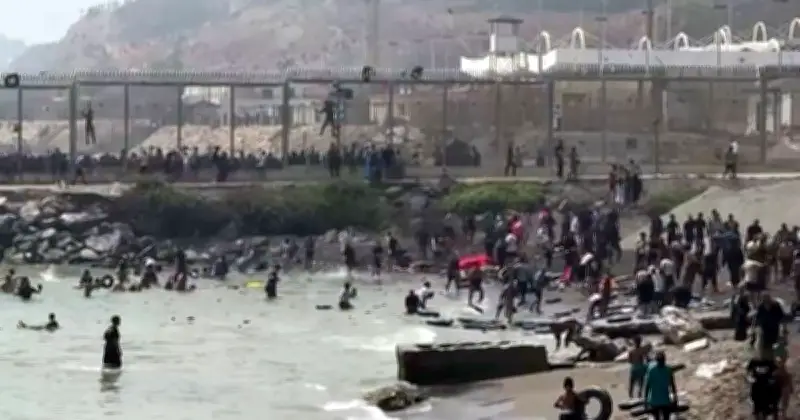
Spain has announced it will deploy troops to its North African territories of Ceuta and Melilla after border officials warned the frontier had "totally collapsed" following a surge in migrant crossings.
The move comes after thousands of migrants reportedly entered the European Union enclaves in recent days, with hundreds more believed to have crossed on Thursday alone.
Chaos at the border
Footage shared on social media appeared to show migrants, many of them seemingly young men, storming the border between Spain and Morocco, while Spanish officials appeared powerless to stop them. Fires were also reportedly started during violent clashes.
According to police sources, at least 17 people are understood to have died attempting the dangerous crossing after up to 2,000 migrants entered over the past 10 days.
Official reaction
Rachid Sbihi, head of the association representing Spain's Civil Guard officers policing the border in Ceuta, said: "The situation is absolute chaos."
"It's not possible to give precise numbers, but there are thousands of migrants crossing," he added. He also stated that the border had "totally collapsed."
Spain's Interior Ministry has rejected calls to declare a national emergency, saying the measure does not apply to migration crises. The ministry later announced that 60 members of the armed forces would be deployed to reinforce the border as local media reported clashes between migrants and police.
Background
Ceuta and the larger Spanish territory of Melilla, located around 400 kilometres (250 miles) further south, sit on the northern shores of the Mediterranean coast at the tip of Africa. The two autonomous cities belong to Spain and share the European Union's only land borders with Africa.
Ceuta has been under Spanish control since 1580. The territory is home to a mixed population of Christians and Muslims, as well as Spanish and Moroccan residents and cross-border workers who live in relative harmony. Morocco does not officially recognise Ceuta and Melilla as Spanish territory and often refers to them as occupied lands.