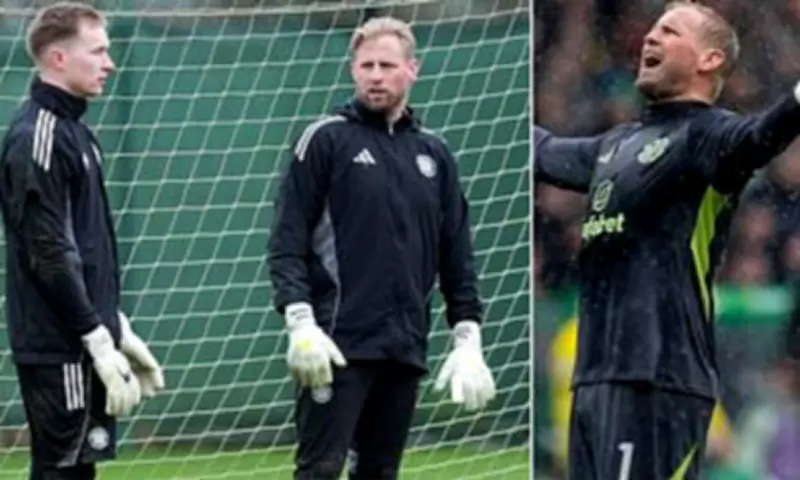
During his weekly press conference at Lennoxtown last Friday, Celtic manager Martin O'Neill provided his customary update on the club's injured players. Kasper Schmeichel had missed the previous four match day squads, but there appeared to be a reasonable chance the Danish goalkeeper might feature against Motherwell.
'He's much, much better now,' O'Neill stated. 'He trained today and didn't feel his shoulder. It's feeling much better after the injection.' However, as events unfolded, Schmeichel did not participate in the match against Motherwell.
Shocking Revelation on Television
Four days later, the veteran goalkeeper appeared alongside his father Peter as a pundit on CBS Sports Golazo. During the broadcast, the 39-year-old effectively acknowledged that his football career was over due to a shoulder injury requiring two surgeries.

'I was at a specialist yesterday and basically I'm going to need two surgeries now to fix my shoulder, which is a bit of a body blow,' Schmeichel revealed. 'It's a torn bicep, I've torn the rotator cuff, dislocated the shoulder, torn the labrum - torn everything.'
He added, 'To put it into terms you'd maybe understand, it's like an outfield player doing their ACL and their Achilles at the same time.' This description suggests catastrophic damage typically associated with serious accidents rather than sports injuries.
Contradictory Information and Unanswered Questions
The media and Celtic supporters had been told just days earlier that Schmeichel's condition wasn't particularly serious. This sudden shift from potential return to probable retirement within a few days raises significant questions about the accuracy of earlier assessments.
Is it possible that pain medication masked the true extent of the problem? Even if Schmeichel managed to ignore his discomfort, wouldn't Celtic's medical staff have detected such severe impairment during training? Given what we now know, it's bewildering that there was even consideration of his participation against Motherwell.
O'Neill must have relied on the goalkeeper's assurance that he was fit to play. The most perplexing aspect is why the full severity of the injury was only established this week, despite Schmeichel's physical condition being a concern for over a year.
Pattern of Performance Issues
Modern football clubs routinely conduct scans for even minor injuries, with medical departments taking precautions to prevent exacerbating existing problems. It seems extraordinary that such a significant injury could remain undetected for so long in a professional setting.
Schmeichel's form has been increasingly scrutinized this season as high-profile errors crept into his game. Professional athletes often play through minor injuries with pain management, but nothing comparable to what Schmeichel was evidently carrying.
Was he hoping to return to Celtic's lineup and potentially represent Denmark in the World Cup qualifiers? Or did he downplay his symptoms? There's a crucial distinction between playing through pain for team benefit and minimizing problems for personal reasons.
Fan Reaction and Professional Criticism
Many Celtic supporters have expressed disappointment that Schmeichel revealed his career-ending injury on television without acknowledging the club that pays his wages. Former player Chris Sutton described Schmeichel's behavior as 'selfish,' a characterization few have disputed.
The goalkeeper's troubles trace back to a Nations League match against Portugal a year ago, where he continued playing after injuring himself in extra-time despite Denmark having used all substitutions. Criticism in Danish media was severe, with one editorial using particularly harsh language about his performance.
Celtic's Goalkeeping Situation
At Celtic, Viljami Sinisalo initially covered during Schmeichel's recovery period last season. The Finnish goalkeeper performed well in seven matches but returned to the bench for the Scottish Cup final against Aberdeen.
Schmeichel's own goal during that final contributed to Celtic's penalty shootout defeat. His decision to extend his contract subsequently appeared questionable as performance issues persisted.

Manager Brendan Rodgers defended Schmeichel early this season when he began with six clean sheets, but problems soon resurfaced. Questionable performances against Braga, St Mirren, Rangers, Bologna, and Kilmarnock preceded a disastrous display against Stuttgart where some supporters booed him.
O'Neill publicly defended his goalkeeper and played him against Hibernian, but ultimately benched him for the return leg in Germany. Sinisalo's impressive performance secured his position, and he will start Celtic's remaining league matches and Scottish Cup fixtures.
Lingering Questions About Selection
Schmeichel is now effectively finished at Celtic and won't feature for Denmark in potential World Cup qualification under Brian Riemer. However, his removal from contention doesn't resolve all questions surrounding this situation.
The most significant remaining question concerns why four different managers - Brendan Rodgers, Martin O'Neill, Wilfried Nancy, and Brian Riemer - continued selecting Schmeichel for so long when mounting evidence suggested something was seriously wrong with his physical condition and performance.
This discrepancy between public updates and private reality, combined with the delayed diagnosis of a career-ending injury, creates a troubling narrative about injury management and player welfare at the highest levels of professional football.