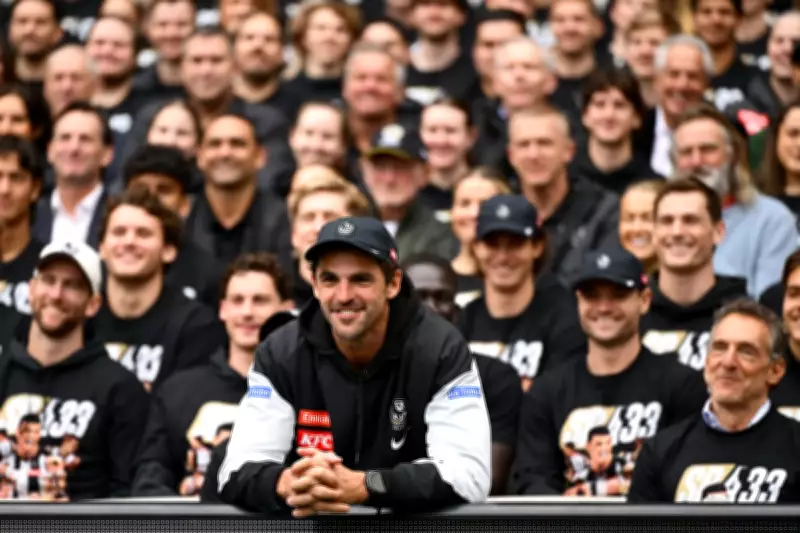
Even his most ardent admirers may admit to a case of Scott Pendlebury fatigue right now. So let us begin by setting aside a few familiar talking points: time, space, basketball, saunas, and ice baths. Let us also put aside some of the more tedious elements of the buildup to his record-breaking game—the gold-plated number, the multiple and lucrative costume changes, the signature wine range, the standing ovation at the 10-minute mark, and the debate over whether he should have been rested or not.
Emotionally, technically, and physically, Pendlebury shares much in common with his fellow 400-gamers who gathered at the MCG this week. All of them were wily enough to avoid grievous harm on the field. All of them were temperamentally sound, and not the type of personalities to let outside noise seep in. And all of them avoided the kind of vices and distractions that can curtail sporting longevity.
The Neurotic Genius of Dutch Football
David Winner’s book Brilliant Orange: The Neurotic Genius of Dutch Football examines the great Ajax and Netherlands teams, and Johan Cruyff in particular. The abiding image of Cruyff, Winner wrote, is not of him tackling, passing, or scoring. It is of him pointing, directing, and conducting. “It’s as though he was helping his colleagues realise an approximate rendering on the field to match the sublime vision in his head of how space ought to be ordered,” Winner wrote.

If Pendlebury is ever immortalised in bronze—and one would not put it past Collingwood this week—that is what he will be doing: pointing. I am always struck by the technical attributes he shares with great soccer players—the swaying of the torso, the dipping of the shoulders, the somehow still fast feet and, most importantly, the perfectly still head. All of these ensure an economy of movement that has made him so good.
The Key to Longevity: Temperament
But the key to his longevity is not his technique or his footballing IQ. It is his temperament. Being a professional footballer, especially playing for Collingwood, and especially under coaches like Mick Malthouse and Nathan Buckley, would be a stressful and taxing experience for many. But Pendlebury has maintained an even emotional keel, even in moments of great disappointment. No footballer has met the impostors of triumph and disaster with such equanimity. No footballer has more enthusiastically embraced the crushing boredom of saunas, cold plunges, mobility training, and recovery.
In the immediate aftermath of the 2018 grand final, the coach was sobbing, the president was apoplectic, and the players’ eyes were spinning like one of Laurie Connell’s racehorses. In the rooms, Pendlebury calmly ran through the events of the day—what had worked, and what had gone wrong. He was asked a few years later if the loss had left scars. Not at all, he laughed, it was just one of those things. All that concerned him was the next recovery session, the next contest, the next flag.
Unchanged Through the Ages
With that attitude—whether Collingwood has been the most exhilarating team in Australia or the most unwatchable—he has not deviated. His career spans Mark “Bomber” Thompson’s kamikaze handball game, Mick Malthouse’s forward press, Alastair Clarkson’s cluster, Ross Lyon’s era of asphyxiation, and Damien Hardwick’s Dimma Ball. It spans the shift from monster midfielders like Nat Fyfe and Patrick Cripps to an era where onballers resemble soccer players. The game changed, the bodies changed, the modes changed, the methods changed, and Collingwood changed. But Pendlebury did not change. He has remained the same player, with the same temperament and the same output. There have been no distress signals and no drop-offs.
Greatest Ever Collingwood Player?
Shannon Gill and Gerard Whateley’s excellent Know Your History segment on SEN recently devoted an episode to whether Pendlebury is the greatest ever Collingwood player. When club historian Michael Roberts ranked the champion Magpies, Pendlebury came in at 10th, with Bob Rose, Nathan Buckley, and Syd Coventry on the podium. But that list was compiled in 2017. Since then, Pendlebury has played nearly 200 more games, been runner-up in the best and fairest three times, won a second premiership, and nearly won another.

It comes down to how we define greatness in an athlete, and what we value in footballers. At a club like Geelong, there is a futility in comparing the careers of Gary Ablett Sr, Gary Ablett Jr, and Joel Selwood. Such comparisons often splinter into who was the most brilliant, who was the most valuable, and who best personified the spirit of the club.
For Collingwood supporters, if you just wanted to go to the footy and watch for pure joy, you would choose Peter Daicos, or maybe even Phil Carman. If you wanted someone to haul a struggling team on his back and drag them to relevance, you would choose Buckley. For someone who lived the full Collingwood experience, you would choose Rose. But if you wanted someone as reliable as a bank cheque, someone who would tick every box and meet every challenge, there can only be one choice. No footballer has been more consistent or more durable than Pendlebury. And no other player has made football look so simple. But as Cruyff said, “There’s nothing more difficult than playing simple football.”