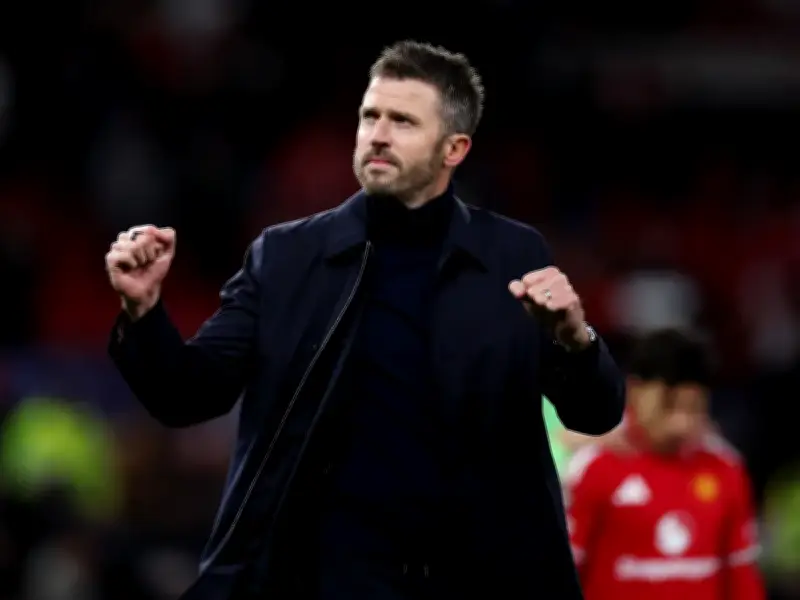
Michael Carrick finally savoured another Manchester United victory on Tuesday night, as a 3-2 comeback win over Roma at Old Trafford ended a 54-day, nine-match run without a win that had brought him perilously close to being sacked.
At half-time, Carrick's time in charge looked to be over. United had produced an error-strewn and tactically naive first-half performance and were on course for a fourth straight defeat. Had they lost, it would have been a case of when rather than if the head coach was dismissed.
The club's decision-makers had resolved to give him until the international break last week, when they came close to wielding the axe after the 3-0 defeat to Bournemouth. Following up that reprieve with losses to Chelsea and Roma would have signalled the end, probably regardless of what happened against Aston Villa on Sunday.
Questions remain despite comeback
Instead, United conjured one of those famous Old Trafford European nights, and Carrick now has some breathing space. But the night raised as many questions as answers. Carrick soaked up the acclaim from the Stretford End at full-time, yet at the break much of the catastrophe felt on him.
Diogo Dalot took the wrath of supporters, but Carrick's tactical call to push him so high up the pitch left the left flank exposed, and both of Roma's goals came from Soule using the space behind Dalot. Dalot was out of position as a left-back and asked to play in the forward line, covering acres of space down the wing. The inexperienced Ayden Heaven, as the left-sided centre-back, was left patrolling one side of the pitch.
Carrick only changed it after United had been exposed twice, tilting the balance so that right-back Leny Yoro pushed on, only for Roma to almost get in twice down that side before half-time. This was not a tactical approach United had used earlier in the season, and it smacked of desperation to try new things.
Emotional comeback and Solskjaer parallels
Rather than succumb to the inevitable, Carrick kept his cool at half-time, reminding the players how games at Old Trafford can change on one goal. Once Bruno Fernandes scored his penalty, the atmosphere switched from mutiny to support.
A possessed Matheus Cunha took matters into his own hands, and the manic intensity and aggression he played with in the second half summed up the unsustainable nature of the comeback. It felt like a result driven by emotion, with the players embracing the chaos.
Carrick has tried and failed to build a team that controls games, then watched the players save his job with a 45 minutes that feels unrepeatable. Backed into a corner, the squad finally came out fighting, but replicating that from the off against Villa this weekend is difficult, and sustaining it over a long season while playing twice a week is impossible.
What happens next
All eyes will be on Old Trafford on Sunday to see if the United of the second half turn up again or revert to the ways of recent weeks. The greater body of evidence suggests the latter. If so, Carrick might still find his job at risk during the international break.
That is the moment for chief executive Omar Berrada, director of football Jason Wilcox and the club's under-fire owners to act, otherwise the schedule hardly allows time to come up for air until the New Year.
The 45-year-old has been compared to Ole Gunnar Solskjaer ever since he took the job in January, and there were parallels again on Tuesday. Just over five years ago, Solskjaer's United came from 2-0 down at half-time against Gian Piero Gasperini's Atalanta to win 3-2 in the Champions League. Gasperini has seen lightning strike twice, but will Carrick?
That win turned out to be a false dawn. Four days later, United lost 5-0 to Liverpool at Old Trafford, and a month after an iconic Old Trafford comeback, Solskjaer was gone. Carrick was on the coaching staff then and will be well aware that last night's win, while a moment to savour, could just as easily be one last magical night for him as it could be a turning point in his tenure.