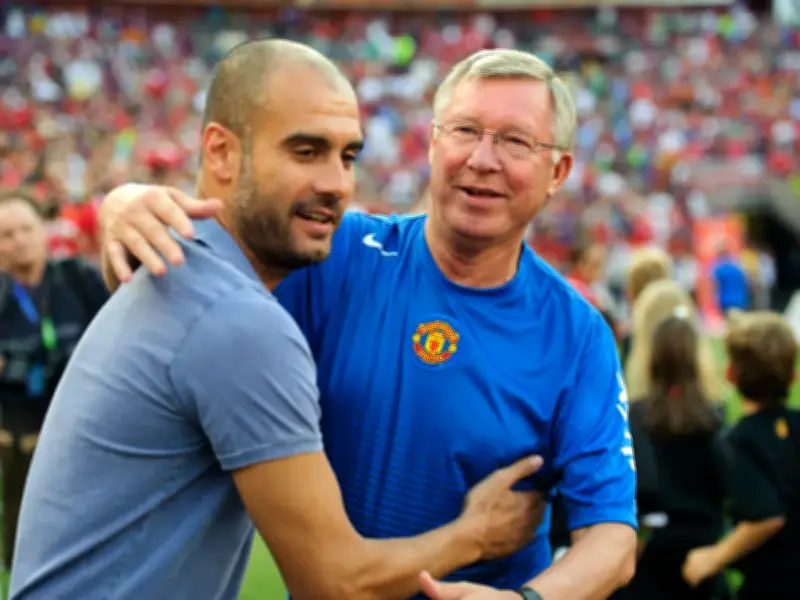
The independent commission's verdict in the Premier League's case against Manchester City has reinforced Sir Alex Ferguson's status as the greatest manager to ever occupy a dugout in this country. Ferguson's greatness has never been in doubt, but the verdict has shed new light on the success Pep Guardiola delivered at the Etihad.
Guardiola's trophies tainted
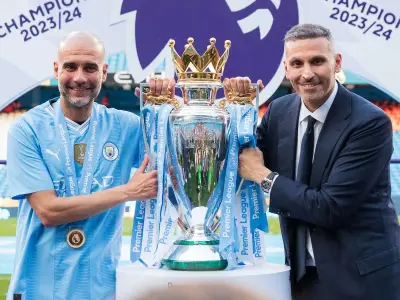
The damning verdict of "sham" commercial contracts and inflated revenues makes for grizzly reading for those involved in a remarkable era of dominance at City. Guardiola may have matched Ferguson's treble and gone one step better by winning four league titles in a row, but none of the Scot's trophies at Old Trafford come with an asterisk attached to them.
All of Guardiola's at the Etihad do, and while the Catalan is a modern-day genius, there is no escaping that the success at City is now tainted. If it's a good time to be reminiscing about what made Ferguson so great, then the release of a new book on his United dynasty is well-timed.
Fergie: The Lost Tapes
Wayne Barton's tome Fergie: The Lost Tapes draws on hundreds of hours of unheard interviews between former Piccadilly Radio reporter Tom Tyrrell and Ferguson himself. It tells the story of his difficult early years at Old Trafford through to an era of unmatched success and his departure in 2013, but in the wake of the reappraisal of Guardiola's success at City, and the huge finances involved in building that winning machine, it's a reminder that Ferguson had to fight much harder to deliver success at United.
This was about the gradual turnaround of one of the biggest football clubs that had lost its way, achieved through mindset and mentality and hundreds of incremental gains until United were ready to win again, and then they barely stopped winning.
Ferguson's early struggles
One passage in the book focuses on Tyrell's interview with Ferguson a few days after United were beaten 5-1 by Manchester City at Maine Road in September 1989. There was already a view that Ferguson's time at the club was going nowhere and he was facing fierce criticism, both from the media and supporters.
"I don't think it's personal, it's just because I'm manager of Manchester United," said Ferguson. "Managers at United have always been whipping boys for the press. If they've nothing to write about, a story about United will sell papers. It has a lot to do with that."
"Also, it's the climate of modern journalism, there's not a lot of morals in journalism now, in particular the tabloids. And I have to expect and handle that criticism you're reading. This is disgusting. We know that, but you can't do anything about it. And I'm just going to have a smile on my face."
"I know I'm doing my job properly. And I'm doing it honestly. There's no manager in this country who could do the job better than me. I know that and people in this club know that. That's probably why our directors have given me a new three-year contract. They recognise what's been achieved."
"And it's not a blow your trumpet situation. The facts are the facts. It's a hard job. And we're doing it to the best of our abilities."
"Of course [my family gets upset with the headlines]. Everyone gets upset, but we keep together in the family and we just have to get on with life. I'm still walking in here as manager of Manchester United every morning, it's the greatest day of your life, every day. You're working for a great club with great support. And a good bunch of lads, the right spirit."
"The spirit in our place is marvellous just now. Okay, we had a disaster last week. Sometimes maybe you need it, this may be the watershed, this might be a great thing for our players. We'll see how they react."
"We're going to show the passion that we expect in United players, and everything will come right for them, they deserve that because they are working hard. It's not designed to be fighting talk. I'm putting it in perspective. I've got great respect for the [players]. They're playing their heart out for the club."
A moment of vulnerability
It is one of many revealing passages in the book, particularly in those early years, and it is an interview that caught Barton's attention, particularly the moment Ferguson switched from talking about his family to insisting he was the right man for the job.
"There's a really good passage in the book, where Tom sort of questions him, pushes him on it, he says, 'There's been criticism, how's it affecting your family?' And he starts off, he goes off, 'Yeah, it does, it does get us down, it does affect the family.'"
"And then he switches mid-sentence to go, 'But I come in here every day as manager of Manchester United and it's the greatest day of my life.' The conviction turns mid-sentence and you can hear him, it's almost like you can hear the cog click in his head that he's going, 'Yeah, I can show vulnerability, or I can show strength, from a position of ultimate weakness, really.'"
"And he did that, and I think that's one of the most compelling parts of it, because you know when you can actually hear that change. Obviously, you couldn't hear it in later years because he was so autocratic and so powerful that he was always speaking from that position of power even if we lost, but that was his moment of vulnerability and he just came through it."
"He was like, 'No, I'm going to choose to be strong.' And it was so inspiring in a way to listen to."
The long road to success
It is always a debate whether Ferguson would have had the time he needed to turn United around in the modern era. Having been appointed in November 1986, the first silverware only arrived with the FA Cup in 1990, before a first league title in 26 years followed in 1992/93.
"I think that it also shows you how long it took to do that, that it's a process, that it's not necessarily something you go in there and you can just deliver an inspiring speech," said Barton.
"It's almost like a matter of weeding out individuals, knowing who's going to respond to certain things in certain ways, trial and error with the way that you deliver things. You can feel that process as it goes along with it, and the sort of wobbling and the strength that comes along with that as well."
"I think the modern era, you think because so much money was spent in the Guardiola era and he got it right so quickly, that you think that it's a comparable thing and it's really, really not. And I think that's the value of learning about those first few years of Ferguson, is how he did it and why he became so strong, and why he merits that description of being the greatest."
Fergie: The Lost Tapes - Manchester United's Greatest Era Retold by Wayne Barton is out now.