Guardiola's Shadow: How Pep Defined Carrick's Career & Man United's Modern Struggle
How Guardiola's Era Defined Carrick and Haunts Man United

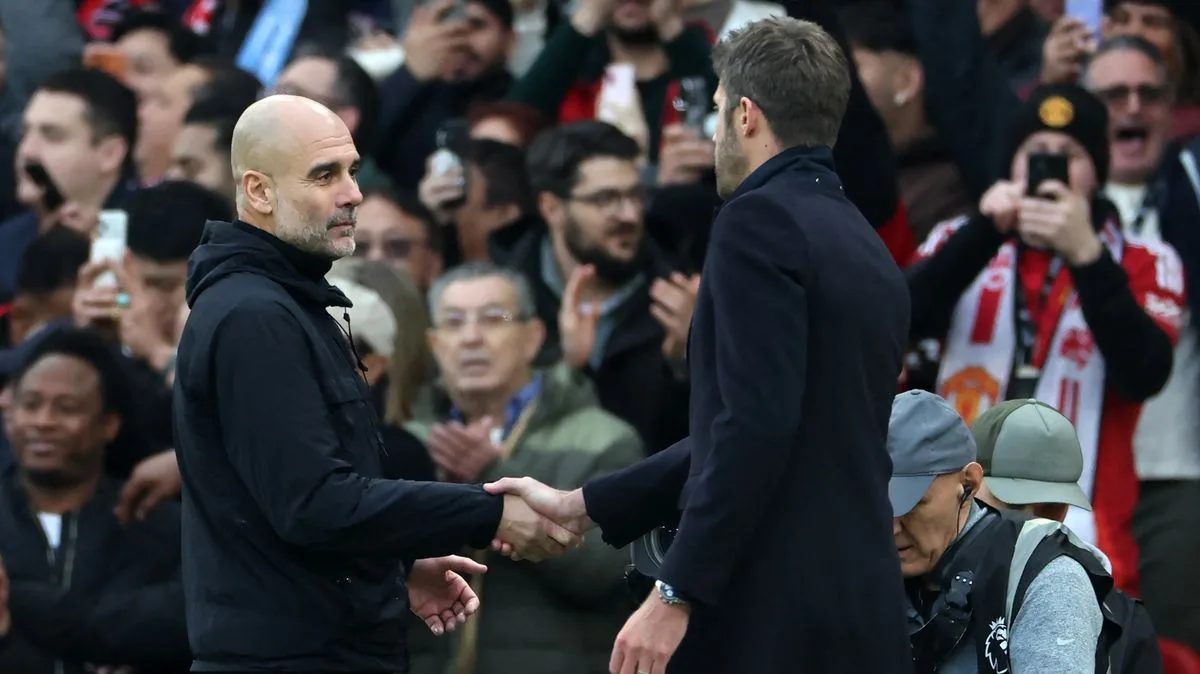
When Michael Carrick leads Manchester United out at Old Trafford for his first derby in permanent charge this Saturday, he will stare across the technical area at the man who, perhaps more than any other, came to define his playing career and his club's modern identity: Pep Guardiola.

The Admiration and The Agony

It is a fascinating clash of deep-lying midfield thinkers from different generations. Carrick, the Englishman with the Spanish-style passing game, once earned high praise from his upcoming opponent. In 2017, Guardiola called him "one of the best holding midfielders I've ever seen in my life". Yet, but for Guardiola's Barcelona, Carrick might have finished his career as a triple Champions League winner.

Carrick played and scored in the shootout when United beat Chelsea in the 2008 final. The subsequent meetings with Guardiola's Barcelona in 2009 and 2011, however, were a different story. United were comprehensively out-passed, out-manoeuvred, and outwitted on both occasions.

Wide Pickt banner — collaborative shopping lists app for Telegram, phone mockup with grocery list

The 2009 final in Rome was personally chastening for Carrick, who gave the ball away in the build-up to Samuel Eto'o's opener. He later admitted to being depressed for two years afterwards. The 2011 final at Wembley provided a statistical monument to the gulf. Carrick attempted 35 passes for United. Barcelona's Xavi attempted 148, completing 141. Tactically, United were overwhelmed, with Carrick and a 37-year-old Ryan Giggs up against Sergio Busquets, Andres Iniesta, and Xavi.

A Club Stuck in the Past

There is a compelling argument that Manchester United have never fully recovered from the philosophical shock administered by Guardiola's Barcelona, and later, his Manchester City. The 2008 final now looks like a turning point, the moment Sir Alex Ferguson's brand of dominant, front-foot football began to look outdated on the very biggest stage.

Ferguson's insatiable will to win kept United competitive domestically, but he lacked the codified philosophy that defined Guardiola. When former players now urge United to return to a style of wingers and rapid breaks, they are harking back to a pre-2008 ideal. In the modern era, United have often been forced into becoming a counter-attacking side because teams like Guardiola's simply monopolise the ball.

Ole Gunnar Solskjaer's revival project channeled the spirit of Ferguson and found some success against City, but it was based on the break. It wasn't the controlling, assertive football of old. Part of the problem is that United have never truly replaced Carrick the distributor, a failure that symbolises a wider struggle to adapt.

Subsequent managerial appointments read like a series of failed reactions to Guardiola's influence. Louis van Gaal's sterile possession, Jose Mourinho's anachronistic pragmatism, and even Ruben Amorim's flawed 3-4-3 all fell short. The decline in output is stark: United scored 86 league goals in Ferguson's last season in 2013. They have not topped 73 since and hit a low of 44 last year.

The Enduring Gulf and a New Challenge

Even as Guardiola himself evolves—City's average possession of 58.9% this season is his lowest at the club—the gulf remains. Last season, in what was considered an off-year for City, they still finished 27 points ahead of their local rivals.

Carrick becomes the sixth United manager to face Guardiola in the dugout. While the Catalan may be relieved not to see his unlikely nemesis Solskjaer, the challenge is immense. Amorim had a mixed record against him, and Erik ten Hag did win an FA Cup final, proving United can occasionally win battles. But City, under Guardiola, have consistently won the war.

If Guardiola sees out his contract, Carrick is unlikely to be the last United boss he faces. When the Catalan eventually retires, the 2011 Champions League final will stand as irrefutable evidence of his footballing genius. It may also long remain the last time Manchester United played in one. For Carrick, Saturday is not just another derby. It is a personal and professional reckoning with the defining influence of his career, and a stark reminder of the shadow that still looms over his club.

Pickt after-article banner — collaborative shopping lists app with family illustration