Chelsea's Crisis Deepens as BlueCo Project Faces Fan Mutiny After Historic Low
Chelsea supporters might seek perspective for their own mental wellbeing. Unlike their north London rivals, the club is not confronting the genuine threat of relegation—matters could indeed be far worse. However, the stark reality is that Tuesday night's feeble performance at Brighton plunged Chelsea to a depth not experienced since the Titanic's sinking over a century ago. This is unequivocally a club in profound crisis.
Anguish at the Amex and a Cataclysmic Collapse
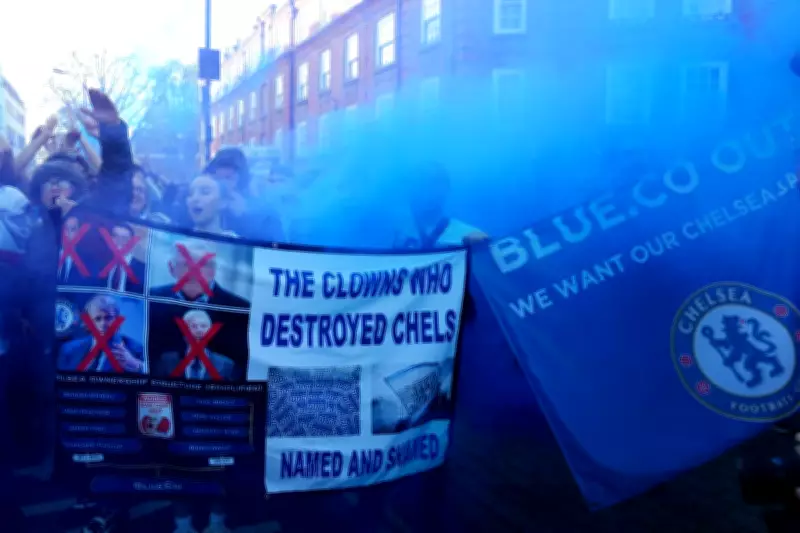
The distress witnessed at the Amex Stadium represents merely the latest setback in a disastrous sequence of results, unfolding at the season's most critical juncture. A streak of five consecutive league defeats, all without scoring a single goal, has virtually extinguished the Blues' aspirations of securing a top-five finish. This alarming decline under manager Liam Rosenior in recent weeks has aligned with escalating fan demonstrations against Chelsea's ownership, BlueCo.
"This is not about short-term results," a spokesperson for the Chelsea Supporters' Trust emphasised. "It is about trust, and at this moment in time, that trust has not been earned." The fractures within a squad that has absorbed £1.87bn in investment since BlueCo's arrival four years ago are now more pronounced than ever. Key players are contemplating departures as the club approaches another disappointing conclusion in this widely criticised era, which has yielded Champions League qualification only once.

Assessing the Blame: Ownership and Strategy Under Scrutiny
When examining Chelsea's failures in recent years, most observers direct blame squarely at the top. BlueCo's strategic approach has been nothing short of calamitous since their takeover, initially evidenced by on-pitch performances alone. A team once labelled the "blue billion-pound bottle jobs" is perilously close to becoming the two-billion-pound equivalent. Despite colossal investment in players, Chelsea should theoretically be contesting for the title; yet after four years, they still cannot reliably secure a place at European football's elite table.
Central to these transfer missteps is an overwhelming focus on acquiring youthful talent. Over £1bn has been expended on players aged 24 and under, with more spent on teenagers than the rest of the Premier League's "big six" combined. This tactic, familiar to many FIFA Career Mode enthusiasts—purchasing footballers with high potential under the assumption it will be realised—has proven largely ineffective in the real world under BlueCo's stewardship.
Transfer Hit Rates and Financial Mismanagement
Of the 52 signings authorised by Todd Boehly since summer 2022, merely four have become indispensable: Moises Caicedo, Enzo Fernandez, Marc Cucurella, and Cole Palmer. Brazilian prodigy Estevao appears poised to become a fifth rare success story once fully integrated, though the 18-year-old's minutes are currently being managed. This modest success rate hardly justifies the five sporting directors—primarily Paul Winstanley and Laurence Stewart, supported by Joe Shields, Sam Jewell, and Dave Fallows—who orchestrate the club's recruitment.
Conversely, a slew of expensive signings have become peripheral figures, highlighting recruitment flaws rather than player deficiencies. For instance, Wesley Fofana and Romeo Lavia—signed for a combined £124m—almost immediately became permanent fixtures in the treatment room, raising serious questions about their medical assessments. Regarding the youth investment, most are dispatched without making any meaningful impact on the first team; their primary effect has been collective, as managers grapple with an excessively bloated squad—a issue Enzo Maresca highlighted, leading to the creation of a "bomb squad."

While some youngsters are sold for profit despite minimal playing time, which could be construed as astute business, a closer examination of the finances offers little credit to BlueCo. A report by The Athletic reveals that Chelsea's operating losses under BlueCo over the past three years total £689m—equating to £692,000 daily. BlueCo has assumed £1.39bn in debt to fund its operations. Crucially, the return on investment appears absent both on and off the pitch; Chelsea's commercial income of £200.9m lags behind their nearest "big six" rival by over £60m.
Player Conduct and Managerial Uncertainty
The shortcomings of Chelsea's operations validate the protests that have intensified recently. Undeniably, this is the fundamental cause of their long-term issues. However, for this specific performance crisis, other individuals must also be held accountable. Certain top stars have not aided the cause with their off-field behaviour. Fernandez received a two-match internal ban for publicly flirting with Real Madrid in an interview. The Argentine, who cost £106.8m and may depart for considerably less this summer, returned to the squad but appeared disheartened by the club's predicament after the Brighton defeat, shrugging his shoulders to away fans as if asking, "What more can I do?"
Cucurella has openly questioned the project, particularly the mid-season dismissal of Maresca, and now faces further scrutiny after reports that his barber leaked team news for the Brighton match. Meanwhile, blame must also reside in the dugout. Rosenior, at 41, is a young manager who seems a victim of being groomed for this role by BlueCo—from the outset, this promotion appeared premature. Thrown into the deep end due to his predecessor's petulance, with Maresca's press conference rants creating instability, Rosenior's inexperience has been exposed by his team's response to adversity.
Recent weeks have been characterised by confused tactics and a lack of resilience. Speculation now abounds that he has lost the dressing room, possibly coinciding with his abandonment of a policy to defend his players unconditionally. "To be even accused of throwing the towel in is unacceptable," he fumed after the Brighton loss. Whether Rosenior remains at the helm next season seems highly uncertain, given Chelsea's history of ruthlessly dismissing managers.
Breaking Point and Brewing Mutiny
Ultimately, Chelsea's predicament stems from their owners' decisions. This is their creation, their fault—and the project has reached a breaking point. BlueCo is already embroiled in a civil war with an incensed fanbase at Strasbourg, where supporters despise their perceived "pawn of Chelsea" status under multi-club ownership. A similar mutiny is now fermenting at Stamford Bridge, with the club's future hanging in the balance as fan discontent reaches fever pitch.