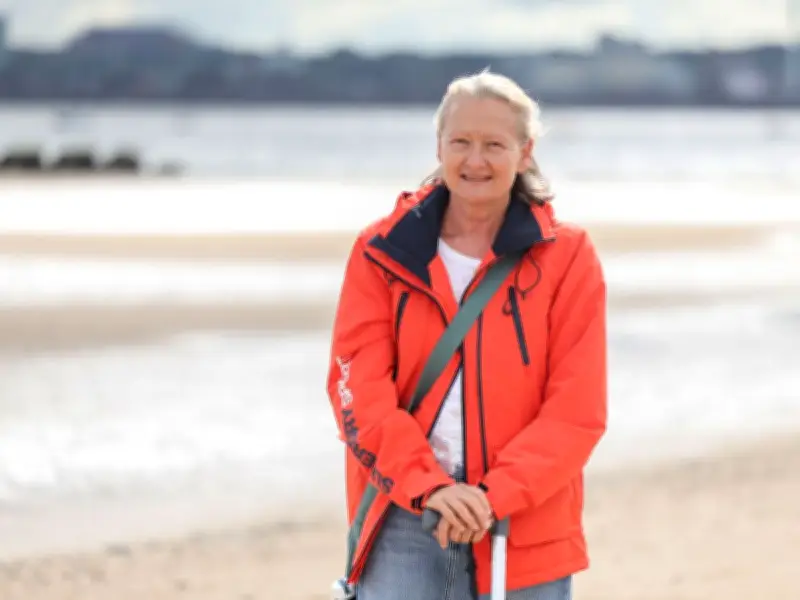
A mother-of-two competing in a swimming race off New Brighton was rescued by two rivals who happened to be trained RNLI lifeguards. Myka Heard, 59, was taking part in the Mersey Aquathlon 2024 when strong waves battered her, leaving her disorientated and swept out to sea.
“When we got to the beach we could see the sea was very, very rough. We decided it was OK to go ahead, we were all competent swimmers, we all do triathlons and we’re used to swimming in open water,” she said. “We set off and very quickly it became apparent it was going to be very difficult getting out to the buoys. Once I got there I thought getting back in would be the easy part, but as I started swimming I just kept getting tumbled and hitting my face on the sand on the bottom, and I was getting pulled back out.”
Rescued by Fellow Competitors
Heard could not see which way the beach was. “One of the times I tumbled and two arms pulled me up and it was two of the lifeguards either side of me.” Several lifeguards had been swimming in the race and noticed she was in trouble. “They were very calm and reassuring. There were more powerful waves coming in, and they brought me in a bit more, and by that time I was able to see better.”

Back on dry land, she felt shocked. “I knew it would be a difficult swim but never thought I would get to the point where I couldn’t actually get myself in.” She added: “I was a good, competitive swimmer at the time, but you can still get into difficulty really quickly, and I think it highlights how important it is to be aware of lifeguards. They’re out in all weathers doing a job that basically risks their life. The conditions out there can be bad and they’re prepared to face them every time. I think its fantastic what they do.”
Representing Lives Saved
Heard joined 41 other people on New Brighton beach on July 30, representing the number of lives saved by lifeguards since the service was first introduced in the North West. The service started in Cornwall in 2001, rolled out in Sefton in 2010 covering Formby, Crosby, Ainsdale and Southport, and expanded to Wirral in 2015. Since then, RNLI lifeguards in Sefton have attended 7,303 incidents, aided 45,955 people and saved 23 lives. In Formby, they have attended 1,325 incidents, aided 9,221 people and saved one life.
Sefton is home to the only beach across the RNLI watched over 365 days a year, with lifeguards on duty at Crosby Beach on all major holidays, including Christmas Day. On Wirral, RNLI lifeguards patrolling West Kirby, Moreton, Harrison Drive, Leasowe Bay, The Plateaux, and New Brighton have attended 3,515 incidents, aided 16,368 people and saved 18 lives.
Lifeguards’ Experiences
Senior lifeguard Richard Webster, who joined 10 years ago at age 50, said: “Growing up on the coast and always living near the sea meant I had knowledge of the RNLI from a very early age. It wasn’t until I reached 50 that I found I had the time in my life to fulfil with a different role, lifeguarding always appealed to me. In lifeguarding you have to work together as a team and be there for each other. For me, one of the most rewarding aspects of lifeguarding is being a part of the education, safety talks to young children. Having the opportunity to teach water safety to children from a young age, is really important as it may one day save a life.”
Senior RNLI lifeguard Sarah Abbott, 24, joined in 2019 at age 17 and has completed seven seasons. She said: “Over the last couple of years I’ve found people are a lot more informed on the risks at the coast, even those unsure on specific risks or the local area know to ask a lifeguard to avoid getting into trouble. The best thing about being a lifeguard is the opportunities it provides, the people you meet on the way and the confidence you develop.” Lifeguards spend much time on preventative actions: RNLI beach lifeguards in Formby have carried out 173,573 preventative actions, Sefton 1,026,400 and Wirral 817,353. Abbott added: “While you may not always see us actively saving lives, a lot of dedication and training goes on behind the scenes, accompanied by preventative actions throughout the season, reducing the risk for many people visiting the beaches before they find themselves in an emergency situation.”