This week marks 150 years since one of the world's most notorious military disasters, popularly known as Custer's Last Stand. The Battle of Little Bighorn in 1876 saw Native American warriors wipe out a professional force of the US Army's 7th Cavalry, a surprise defeat that shocked the nation. Here we reveal what happened and examine other terrible defeats in the history of warfare.
The Battle of Little Bighorn: Custer's Last Stand
Lieutenant Colonel George Armstrong Custer has often been portrayed as a dashing tragic hero, especially by Errol Flynn in the 1941 movie They Died With Their Boots On. But modern historians believe the US 7th Cavalry commander made a series of blunders leading to a sickening slaughter. The battle took place on June 25, 1876, during the Great Sioux War, when the Lakota, Northern Cheyenne, and Arapaho tribes united under Chief Sitting Bull to oppose US government displacement efforts.
Custer, 36, led his 600 men into the valley of the Little Bighorn River in Montana, aiming to attack the Native Americans. Instead of waiting for reinforcements, he launched an immediate assault, splitting his force into three. He underestimated enemy numbers: his 210-strong unit faced 2,000 warriors, including the legendary Crazy Horse. His men were forced to retreat, surrounded, and wiped out. Custer received a fatal shot to the head. Interestingly, over 60 of those killed with the US cavalry were born in Britain or Ireland.
Lost Legions: The Battle of the Teutoburg Forest
Roman armies are often thought invincible, especially as depicted by Russell Crowe in Gladiator (2000). But in 9 AD, the Battle of the Teutoburg Forest saw the Romans lose three legions—an incredible 10% of their entire army. Commanded by General Quintilius Varus, the Romans aimed to suppress rebellious Germanic tribes but were deceived by Arminius, a double-crossing local chief turned Roman citizen and adviser. He led them into a trap in dense woodland in Lower Saxony, where the Germans ambushed them. The terrain prevented Roman formation, leading to annihilation. Some 20,000 died, with only a handful of survivors. Many of the dead's heads were nailed to tree trunks, and Varus committed suicide. Emperor Augustus cried: “Quintilius Varus, give me back my legions!” After this debacle, the Romans never completed their conquest of Germania.
Nightmare in Nam: The Battle of Dien Bien Phu
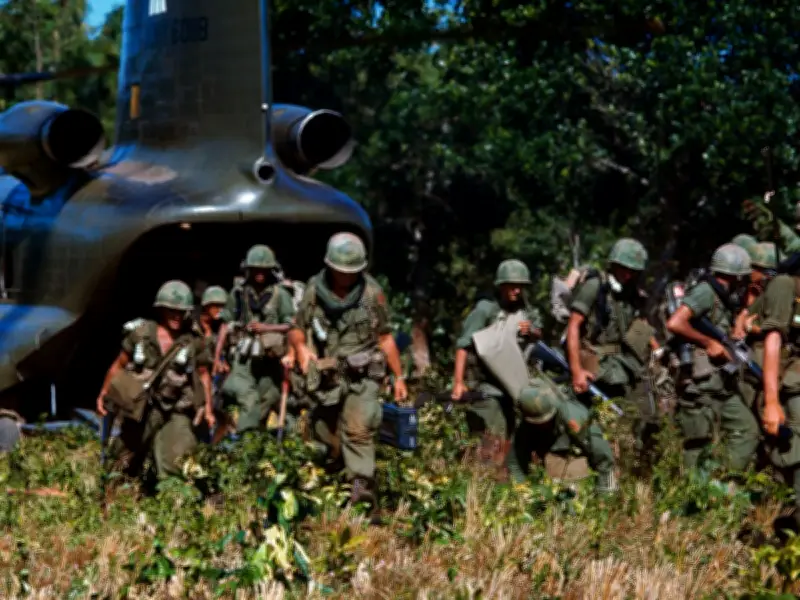
The US famously withdrew from Southeast Asia after losing the Vietnam War and 58,000 troops. But until 1954, the French were the colonial power, and the disastrous Battle of Dien Bien Phu forced them to quit. The French established a base in the remote northern city of Dien Bien Phu to cut off supply lines of the communist Viet Minh forces led by Ho Chi Minh. The move backfired for French General Henri Navarre. Instead of open battle, the Viet Minh surrounded the city with 50,000 men and bombarded the French with artillery from the mountains. After two months, the French garrison was overrun, with 3,000 soldiers killed and 10,000 taken prisoner. The defeat crushed French morale, leading to a treaty and French withdrawal from Vietnam.
Zulu Massacre: The Battle of Isandlwana
The 1964 movie Zulu, starring Michael Caine, tells the true story of 150 British troops holding off 4,000 Zulu warriors at an outpost in South Africa in 1879. This action saw many Victoria Crosses awarded but was a sideshow to the calamitous Battle of Isandlwana earlier that same day, January 22. It was sparked when Lord Chelmsford invaded Zululand after King Cetshwayo refused to disband his army. Chelmsford unwisely split his red-coated force into two. Some 20,000 Zulus, armed with spears, made a surprise attack on the British segment camped at Isandlwana, who were armed with rifles. Nearly all 1,300 British soldiers died, along with over 2,000 Zulus. The episode was made into the 1979 film Zulu Dawn, starring Peter O'Toole as Chelmsford.
Friendly Fire: The Battle of Karansebes
Some armies are defeated by overwhelming odds, poor tactics, or bad weather, but in 1788, an Austrian force was routed by itself. The Austrians, commanded by Hapsburg Emperor Joseph II, were at war with the Ottoman Empire. On the night of September 21-22, a large part of their army camped near Karansebes in modern-day Romania. A group of scouting Austrian cavalry ended up drinking local schnapps. When some infantry arrived and refused to share, a row broke out and shots were fired. In the confusion, someone shouted “Turks! Turks!” The cavalrymen bolted back to camp, but miscommunication led the artillery to believe Ottoman cavalry was advancing and opened fire. Some reports say 1,000 Austrians were killed in the ensuing melee. Joseph ordered a withdrawal, and Turkish forces arrived two days later, taking the town without resistance.
Gun-believable: The Charge of the Light Brigade
Victorian poet Alfred, Lord Tennyson wrote in a romanticized poem, “Into the valley of death rode the six hundred.” This referred to the suicidal blunder where British cavalry armed only with swords charged enemy cannons during the Crimean War (Britain, France, and Turkey vs. Russia). On October 25, 1854, during the Battle of Balaclava, orders from Commander Lord Raglan were misinterpreted due to vague instructions from his messenger, Officer Louis Nolan. Instead of attacking Russians taking British guns from a fortification, Lord Cardigan led his 600-strong Light Brigade head-on into massed Russian artillery. The vain attack saw 278 killed or wounded and nearly 400 horses killed. Nolan was among the dead. In the 1968 film The Charge of the Light Brigade, Trevor Howard played Cardigan, who survived the fray.