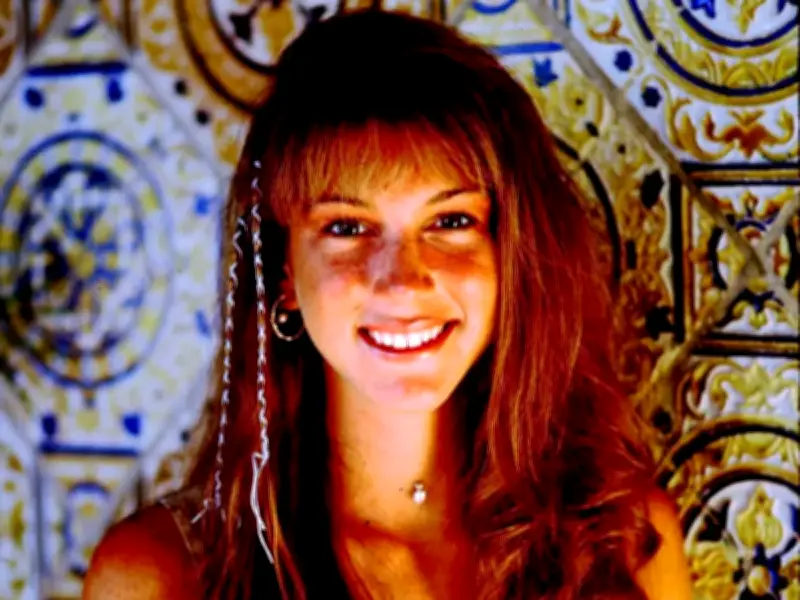
Monique Viele, once dubbed the 'Britney Spears of tennis', was a teenage prodigy managed by Donald Trump's agency who secured her a $1.8m Fila deal, yet she never won a single professional match.
Before she was old enough to drive, Viele was presented as the next big thing, attracting the attention of major coaches, sponsors and celebrities. She could serve at 180km/h with either hand, had a singing voice good enough to perform in front of huge audiences and was once labelled the 'Britney Spears of tennis'.
A Childhood of Extraordinary Promise
The hype surrounding the American teenager became impossible to ignore. Nick Bollettieri, one of the most celebrated coaches in tennis history, took an interest in her development, while IMG signed her as a client. Rick Macci, who would later work with the likes of Serena Williams, Venus Williams, Andy Roddick and Maria Sharapova, was also involved.

Then Donald Trump arrived. His T Management agency took over Viele's career and helped secure a $1.8million sponsorship agreement with Fila. Suddenly, a girl who had only recently been competing in junior tournaments was being treated as a sporting and commercial phenomenon.
But there was a remarkable twist to the story. Despite all the expectations, publicity and investment, Viele would never win a professional tennis match.
Rapid Rise and Growing Pressures
Her introduction to tennis was far less glamorous. Viele was seven when she finally persuaded her father to teach her how to play, and it quickly became apparent that she had an unusual natural ability. Within a year, she was collecting titles across several age categories. "I could bring home 10 trophies in three weeks," she told L'Equipe.
Her schedule was relentless, with Viele sometimes playing three or four matches in a day. Yet her rapid rise also made her a target. Older competitors would shove her during changeovers and insult her on court, with Viele eventually understanding that her opponents simply hated the idea of losing to a nine-year-old.
Her father's advice was straightforward: "Just be stronger. Let your racket do the talking."
Trump's Agency Takes Over
The youngster's reputation continued to spread, eventually catching the attention of Bollettieri after a television report featured her. At nine years old, she signed with IMG, and her family relocated from Colorado to Florida so she could train at the renowned Nick Bollettieri Academy.
By the time she reached 13, Viele had become a dominant force in Florida's junior circuit. She won the Florida Under-18 Open despite being considerably younger than many of her opponents, convincing her parents that she was ready to make the jump towards professional tennis.
The commercial opportunities were already arriving, too. IMG had landed major sponsorship deals, while Viele's profile stretched well beyond the tennis world. She appeared on television, sang the national anthem at baseball games and featured on the Discovery Channel programme The Ultimate Athlete.
Her ambitions matched the scale of the attention around her. Viele wanted to become world No. 1. But fame brought an increasingly troubling side effect. Reporters began turning up at her academy, while stalkers and death threats became part of her existence. That was when Trump got involved.
T Management, Trump's modelling agency, was seeking to expand into sports management and had been alerted to Viele's potential. The company subsequently took charge of her career, taking the teenager into an even more extraordinary world of celebrity and publicity.
Viele modelled in New York, served as a judge at the Miss Teen US pageant and performed at a New Year's Eve celebration at Mar-a-Lago.
A Devastating Debut and Final Years
Yet there was a major obstacle standing between her and the professional tour. Viele was refused a wildcard for the 1999 US Open because the WTA's Capriati Age Eligibility Rules prevented players under the age of 15 from competing professionally. The restrictions had been introduced after Jennifer Capriati, a three-time major champion, turned professional at just 13 before later stepping away from tennis for 14 months amid the enormous pressures surrounding her career.

Viele's father challenged the rules in court, eventually helping force changes to the restrictions. The regulations were subsequently eased, allowing Viele to enter a limited number of professional events.
Her first opportunity arrived at the Princess Cup in Tokyo, where she was 14 years and 11 months old. Even before she stepped onto court, the occasion had become a spectacle. At the tournament launch, Viele was unexpectedly asked to stand in for a Japanese singer and perform Britney Spears' "Baby One More Time".
The next day, she walked out onto Centre Court in front of 10,000 spectators for her professional debut. Waiting for her was Jane Chi, the world No. 69 at the time. It was a completely unfamiliar environment for Viele, and the enormity of the occasion quickly became apparent.
Chi won 6-3, 6-1, while Viele struggled physically and mentally. She found it difficult to breathe and felt as though her legs would not move. According to Viele, the reaction afterwards from Macci was particularly devastating. She says he told her she was "the biggest disappointment in the world" and had cost him a lot of money.
Viele then moved down to the secondary tour, determined to establish herself without relying on wildcards. Away from the packed arenas and constant media attention, she began to discover a version of tennis that felt far more ordinary.
But the experience of being pushed into the spotlight at such a young age had already taken its toll. "At that age, you don't really know how to express yourself. You listen to the adults. You tell yourself, 'The grown-ups know what they're doing'... But in reality, they don't," she said.
Then came another devastating blow. When Viele was 16, her father was diagnosed with stage four colon cancer. He underwent three operations and fought the disease for six-and-a-half months before dying in 2002 at the age of just 47.
The tragedy also created a huge financial burden for the family. Medical costs left them facing almost $1million in bills, meaning much of the money Viele had made from tennis was used to help cover the cost of his treatment.
"Sometimes I tell myself that things happen for a reason. If I hadn't gone through all that, if I hadn't earned all that money, we never would have been able to pay for his care," Viele said.
She carried on playing for a little longer, but tennis no longer felt the same. Injuries to her wrist began causing further problems, while the motivation that had driven her during her childhood had largely disappeared.
Her final appearance on the secondary tour came in September 2002. Viele had reached a career-high ranking of No. 817, with 12 victories and 23 defeats on her professional record. But there was one figure that stood out above all the others. Zero. She had never won a match on the WTA Tour. Not long afterwards, Viele walked away from professional tennis.
Looking Back Without Regret
Now 41 and a mother, she can look back on one of the strangest and most intense teenage careers the sport has ever produced. Yet rather than harbouring resentment over what happened, Viele views those years as one part of a much larger life story.
"I like to think of life as a book with several chapters," she said. "The intense period of my teenage years was just one of them. It's funny, because it all feels so long ago now. But I have no regrets, no grudges, not even against Rick Macci. My parents weren't perfect, but then, who is? I'm a mother myself, and I'm sure I make mistakes every day."
And perhaps, with the benefit of hindsight, Viele's biggest regret is not that her career failed to match the extraordinary predictions made about her. Instead, it is that so much of her childhood became a public spectacle.
She added: "In an ideal world, it would have been just my father and me, quietly making the rounds at tournaments and letting my results speak for themselves. I would have preferred that, but if my story helped bring about change, then it was worth it."