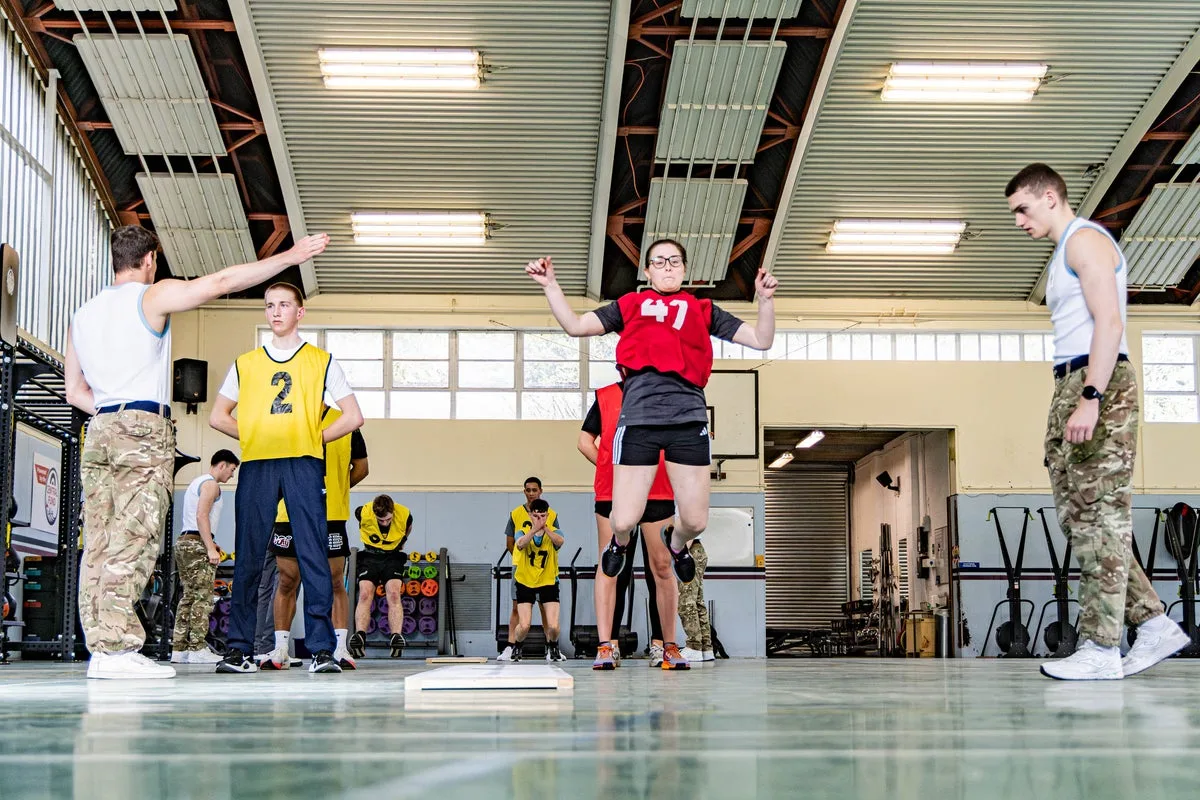
Dressed in a tight white vest tucked into camouflage trousers, the sergeant who greets me at RAF High Wycombe cuts an imposing figure. Broad shoulders and a vice-like handshake cement this status. This is the man who will be overseeing my RAF fitness test.
The assessment is split into three parts, with the first being the multistage fitness test – better known as the bleep test. This gruelling challenge involves running 20-metre shuttles between two cones in time with a shrill beep. The further you go, the faster the beeps become – participants continue until they cannot keep up.
The pass mark for my age group – men aged 17-29 – is level 9.1. Women in this age group are required to hit level 7.2. The test starts incredibly slowly, lulling me into a false sense of security. On my first shuttle, a light jog takes me to the second cone with time to spare, then I stand there waiting for the next beep to sound.
As we pass level 10, the speed ramps up considerably. My early plodding evolves into a purposeful stride, and my cheeks progress along the Dulux paint chart until they reach an aggressively deep red. By level 11, I’m struggling to keep pace. My legs are leaden, my breathing is ragged and sweat soaks my forehead. I make 11.1, 11.2, 11.3, 11.4 – then the wheels fall off. Roughly 10 minutes and 2km in, I’ve hit the point of no return. My body can no longer supply my muscles with the fuel this intense test demands, and I bow out.
The second part is a grip strength test using a dynamometer. Grip strength has been identified as a reliable indicator of overall upper body strength, as well as being linked to greater health and longevity. The pass mark is 39kg. I scrape a pass with a score of 41.4kg on my left hand, but record a weaker score on my favoured right hand.
The final part is a chest press test on a rubber mat. I manage to complete the required number of presses and earn an overall pass. Despite the humbling experience, I leave with a newfound respect for the physical demands of RAF service.