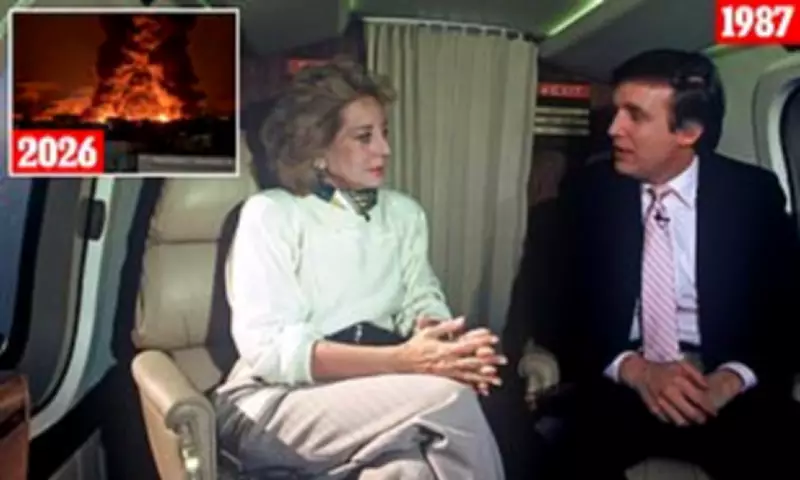
Unearthed 1987 Footage Reveals Trump's Early Iran War Predictions
Remarkable archival footage has surfaced showing a 41-year-old Donald Trump outlining detailed plans for military action against Iran and predicting the current Middle East crisis during a 1987 interview with the late journalist Barbara Walters. The prophetic conversation, recorded for ABC's 20/20 programme in December 1987, demonstrates how Trump's strategic thinking about Iran has remained remarkably consistent over nearly four decades.
Trump's Detailed War Strategy for Iran
During the interview, Trump presented a clear military strategy for dealing with Iran, stating emphatically: 'The next time Iran attacks this country, go in and grab one of their big oil installations and I mean grab it and keep it and get back your losses because this country has lost plenty because of Iran.' This direct approach to seizing Iranian oil assets foreshadowed policies that would emerge decades later during his presidency.
Trump dismissed concerns about potential Soviet intervention, showing greater concern about Iran's then-leader Ayatollah Ruhollah Khomeini, whom he described as 'something like nobody's ever seen.' His chilling prediction that 'You're going to have a war, and it's going to start in the Middle East' has proven tragically accurate in recent years.

Parallels Between 1987 Comments and Current Conflict
The unearthed interview reveals striking similarities between Trump's 1987 statements and current military developments. Four decades after his predictions, the United States and Israel have launched devastating military campaigns against Iran that have already resulted in significant casualties, including the death of Iran's current supreme leader, Ayatollah Ali Khamenei.
Today, as Iranian drones target the strategically vital Strait of Hormuz and oil prices surge due to Persian Gulf hostilities, the Pentagon is once again considering deploying the US Navy to protect oil shipments - exactly the scenario Trump discussed with Walters. The current administration's demands for NATO allies to contribute warships to police the Strait of Hormuz directly echo Trump's 1987 call for greater financial and military support from European allies.
Trump's Early Political Positioning Revealed
The footage includes excerpts from Trump's appearance at New Hampshire's Portsmouth Rotary Club in October 1987, where he tested political waters before any potential presidential run. His statement that 'I'm personally tired of seeing this great country of ours being ripped off' foreshadowed the populist rhetoric that would characterise his future political campaigns.
Historians now recognise this event as Trump's 'first campaign speech,' establishing themes that would dominate his political career, including demands for European nations to increase defence spending and take greater responsibility for regional security.
Oil Strategy and Financial Demands
Trump's 1987 interview revealed sophisticated thinking about international oil politics. He criticised the United States for protecting foreign oil tankers in the Strait of Hormuz without compensation, having previously spent thousands on newspaper advertisements condemning this policy. His solution was characteristically transactional: 'I would have said, "hey folks, let's get together, how much you're gonna pay for this?" and, you know what, give you a little secret, Barbara, they'll pay a ransom.'
This approach to making other nations pay for American military protection of global oil shipments has resurfaced in recent demands for Britain, France, and China to deploy ships to secure the Strait of Hormuz. Trump's current insistence that 'people who are the beneficiaries of the Strait will help to make sure that nothing bad happens there' directly reflects his 1987 thinking.
Military Implementation and Current Actions
While Trump declined to provide Walters with specific operational details about how he would seize Iranian oil fields, elements of his proposed strategy appear to be unfolding in real time. The United States military has already conducted bombing raids on Iran's most significant oil facility, the Kharg Island oil terminal, which handles approximately 90 percent of Iran's crude oil exports.

Significantly, US forces have reportedly avoided destroying the oil facilities themselves during March 2026 strikes, instead targeting military installations while preventing a complete shutdown that could cause even greater spikes in global oil prices. This careful approach reflects the strategic balancing act Trump hinted at during his 1987 interview, where he advocated aggressive action while acknowledging economic consequences.
The remarkable consistency between Trump's 1987 predictions and current Middle East developments provides unprecedented insight into the strategic thinking that has shaped American foreign policy toward Iran for nearly four decades, with oil security and military response remaining central concerns throughout this period.