Russia's World War II victory celebrations are notably subdued this year as the ongoing war in Ukraine weighs heavily on President Vladimir Putin. Tensions are high as the country prepares for its most important secular holiday on Saturday, with security concerns and signs of domestic discontent casting a shadow over the annual parade in Moscow's Red Square.
Ceasefire Collapse
A unilateral ceasefire announced by Russia for Friday and Saturday quickly unraveled. Moscow and Kyiv traded blame for continued fighting, mirroring the collapse of Ukraine's own ceasefire earlier in the week. These accusations underscore the deep mistrust between the two sides more than four years after Russia's full-scale invasion, hampering U.S.-led diplomatic efforts to broker peace.
Ukraine's new drone and missile technology has enabled frequent and accurate strikes deep inside Russia in recent months, particularly targeting major oil facilities.

Domestic Discontent
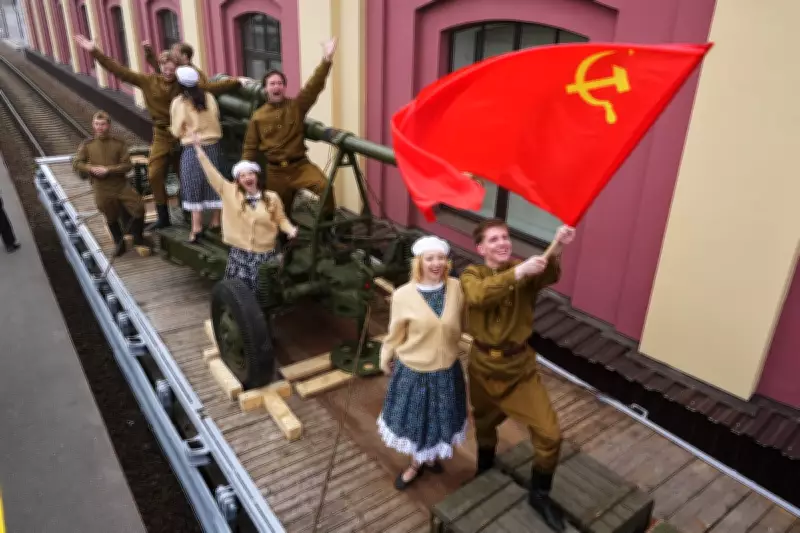
Meanwhile, rumblings of unhappiness with some of the Kremlin's wartime policies have put the spotlight on Putin, who is scheduled to deliver a speech on Saturday for Victory Day. The holiday commemorates the defeat of Nazi Germany 81 years ago and has historically been a display of national pride and military might. This year, however, the atmosphere is different.
The Russia-Ukraine war continues unabated. The Russian Defense Ministry claimed on Friday that its forces had completely ceased combat operations from midnight, adhering to Putin's ceasefire. However, it accused Ukrainian forces of continuing to strike Russian positions and civilian infrastructure in border areas of Belgorod and Kursk regions. The ministry reported that air defenses shot down 390 Ukrainian drones and six Neptune long-range guided missiles targeting Russia after midnight.
A Ukrainian drone strike hit the administrative building of the Southern Russia Air Navigation branch in Rostov-on-Don, forcing 13 airports in southern Russia to suspend operations, according to Russia's Transport Ministry.
Ukrainian President Volodymyr Zelenskyy offered a different account, stating that Russian forces continued attacking along the front line overnight. He claimed Ukrainian air defense forces shot down 56 Russian drones. "All this clearly shows that there was not even a pretense of a ceasefire attempt from the Russian side," Zelenskyy said. He also announced another Ukrainian long-range strike on a Russian oil facility in the Yaroslavl region, over 700 kilometers from the border, without specifying the timing.
Threats of Retaliation
Russian officials have repeatedly warned of decisive action, including a potential mass strike on Kyiv, if Ukrainian attacks disrupt official events scheduled for Saturday. "We have strengthened our focus on the possibility of retaliatory measures," presidential aide Yuri Ushakov told journalists on Thursday. Russia's Foreign Ministry advised foreign embassies and international organizations in Kyiv to evacuate their offices, and the Defense Ministry urged civilians to leave the city as well.
Zelenskyy expressed surprise that foreign dignitaries would attend the commemorations in Moscow. Among those expected are Malaysia's King Sultan Ibrahim Iskandar, Laos President Thongloun Sisoulith, and Belarusian leader Alexander Lukashenko. Slovak Prime Minister Robert Fico, a European Union member, was set to meet with Putin and lay flowers at the Tomb of the Unknown Soldier but would not attend the Red Square parade.
Difficulties for Putin
Putin, who has ruled Russia for over 25 years, has leveraged the Soviet Union's World War II victory to rally support for himself and the war in Ukraine, as well as to project Russia's global influence. Surprisingly, this year's parade will proceed without tanks, missiles, or other military equipment for the first time in nearly two decades, aside from a traditional flyover by warplanes. Officials attributed this to the "current operational situation" without further explanation.
Russia's larger and better-equipped army has been engaged in a slow, grueling campaign in Ukraine. The February 2022 invasion, initially expected to be a quick victory, has turned into a protracted conflict. Ukraine's long-range attacks deep inside Russia are rattling the Kremlin, targeting oil production, manufacturing plants, and military depots.

Some Russians are discontented with internet censorship and government control over online activities, including the blocking of the popular messaging app Telegram. The Ministry of Digital Development announced that all mobile internet access and text messaging services would be restricted in Moscow on Saturday to ensure public safety. These restrictions will apply to websites on the government's "white list," a set of state-approved online services kept available during connectivity blackouts. Home internet and Wi-Fi will remain unaffected.