
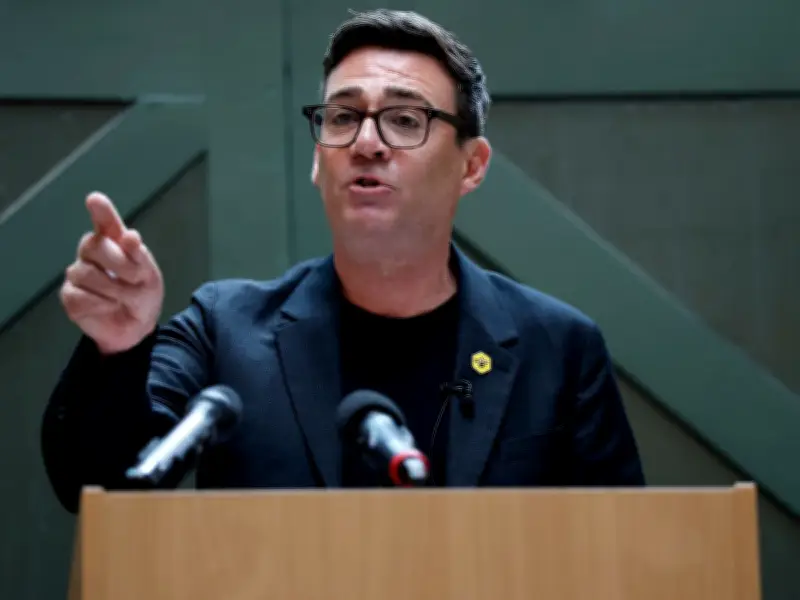
Andy Burnham used his first major speech since Sir Keir Starmer announced his resignation to promise a "new direction" for Britain, saying Westminster is "broken" and the country is "stuck in a rut". Speaking at Manchester's People's History Museum on Monday (June 29), the former Greater Manchester mayor and new MP for Makerfield unveiled plans to radically reshape how Britain is governed if he becomes Prime Minister.
Biggest Transfer of Power Out of Whitehall
Burnham pledged what he described as "the biggest rebalancing of power this country has ever seen", arguing Britain is one of the most centralised countries in the world. He said power would be taken "out of the centre" and put into "the hands of people and places that can use it best", giving councils and regional leaders greater control over economic development, housing, transport and public services.
Creation of a 'No 10 North' in Manchester
The headline announcement was the creation of a "No 10 North" – an extended Prime Minister's Office based in Manchester. Burnham said it would become the "nerve centre of a rewired Britain", driving regional growth while ensuring power flows out to every nation and region rather than remaining concentrated in Whitehall.
10-Year Plan to Raise Living Standards
Burnham announced a decade-long mission focused on improving living standards through three priorities: reform of essential utilities, reindustrialisation and the regeneration of places. He said the country "cannot go through another decade like the one we just have".
More Public Control Over Essential Services
He also said regions should have greater control over services including water, energy and transport. Burnham said this would help bring down household costs while giving local leaders more influence over how services operate. It would mean regions being able to take "greater public control of essential services like water, housing, energy, and transport".
Major Industrial Strategy
Burnham pledged to rebuild British manufacturing, saying every region would set its own industrial ambitions. He said Whitehall would also be required to change its culture to back British industry when spending taxpayers' money. "For too long, UK public procurement policy has been based on chasing cut-price deals around the world rather than helping our own British-based suppliers become more stable and competitive," he said. "No more. From here on, every pound raised from taxpayers will work harder for them, and that approach will apply fully to the defence investment plan." He added that he will "back our scientists, technologists, entrepreneurs and creatives".
Major Council House Building Programme
Burnham pledged what he described as the "biggest council housing programme" since the post-war era. His plans include using vacant public land to reduce building costs while adopting a national housing-first approach. He said: "Let me just take you back to the 1970s… when we were growing up here amongst the friends we had at school, there were two things that were the foundations of working class aspiration: a council home, a secure home that was the foundation for everything, and then good technical education. Those things have been taken away in the decades since, so no wonder so many young people struggle to make it work… don't blame them, blame ourselves."
Complete Rethink of Education
Calling for a "complete rethink" of education, Burnham said universities remain important but argued more attention needs to be given to young people who want different career paths. He promised every young person a "clear path into reindustrialised Britain" through stronger vocational education and skills training – and said he will bring to an end "the days of a school system configured entirely around the university route". He added: "University is great for those who want it, but when are we going to focus on the life chances of those kids who want something different? The country hasn't done that for a long, long time."
Reforming Business Rates
Burnham also repeated plans to slash business rates to support struggling high streets, pubs and independent businesses as part of wider efforts to revive town centres. During his Makerfield campaign trail, he told pubs and small businesses across the constituency he is "on their side" as he promised to cut business rates. He called for a 20 per cent business rate cut for all pubs and clubs – and independent shops, restaurants and cafes taken out of paying business rates altogether.
Rejection of Trickle-Down Model
Burnham said his plan was a "rejection of the trickle-down model" of economics as he promised "good growth in every British postcode". He promised "the stability that comes from sound public finances" and "the discipline of our current fiscal rules". With Burnham under pressure to seek his own mandate at a general election, he insisted his plans were consistent with the manifesto Labour campaigned on in 2024. "The change will be the biggest change in our lifetimes to the way the country is run and it is consistent with the 2024 manifesto," he said.
Different Approach to Politics
Burnham said he wanted to end "politics as usual" by creating a more collaborative political culture. He pledged to build an inclusive Cabinet, allow MPs greater freedom to represent their constituents and "reach out to other political parties" to find common ground in what he described as a fragmented Parliament. He argued Britain's problems could not be solved without changing how the country is governed. "My generation of politicians must take responsibility," he said. "We need to change politics and we need to do it now." He said his vision would put "place before party, problem-solving before point-scoring and long-term thinking over short-term politics".




