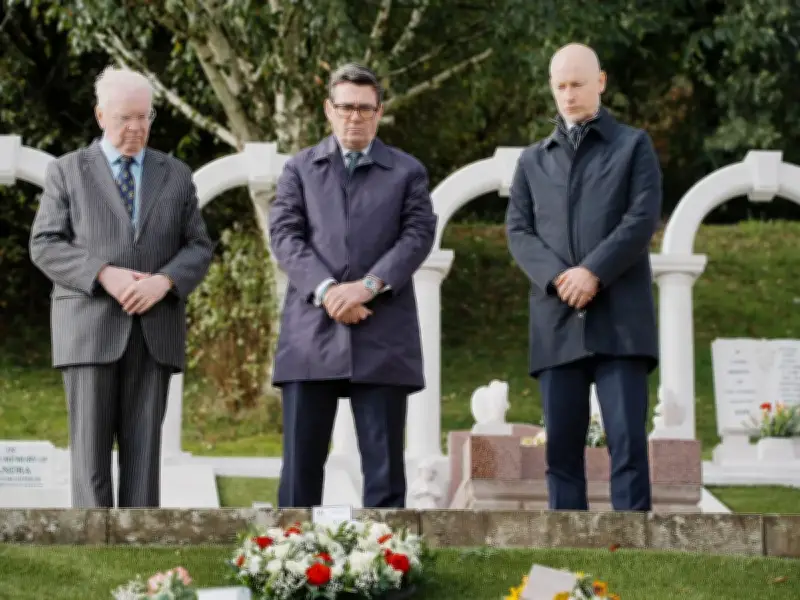
Prime Minister Andy Burnham has described the Aberfan disaster as "one of the most horrifying tragedies this country has ever seen" as he marked the 60th anniversary of the landslide that claimed 144 lives, including 116 children.
Mr Burnham laid a wreath in the South Wales village and met survivors and families of those killed when a colliery spoil tip collapsed in October 1966. Heavy rain caused the coal waste to spill downhill in a deadly slurry, destroying Pantglas Junior School, part of the neighbouring County Secondary School and 18 houses.
PM's tribute to community strength
Speaking in the community centre, Mr Burnham said: "It's been 60 years since one of the most horrifying tragedies this country has ever seen. All of those children lost. It was something that my mum and dad spoke to me about as I was growing up."
He added: "So here to recognise the community, what the community has been through, but just in the community centre to thank them for being there for each other. The strength of the community today is something to see and something to feel."
Mr Burnham also said: "To say also to them, I don't think Aberfan was treated properly by the authorities and that also needs to be recognised. Because at a moment like this, I think all of those things need to be said and it's right that the Prime Minister is here to say that to them."
Coal tip safety concerns
The anniversary comes amid concerns that more must be done to prevent similar tragedies six decades later. New research suggests one in 10 families in Wales are still living near 'high risk' coal tips that are becoming unsafe due to climate change.
Campaign group Round Our Way estimates 350 coal tips in Wales are high risk. Mr Burnham said: "Obviously, it's of critical importance that we make sure that all of the remaining tips around Wales are safe indeed across the country."
He continued: "I represent a former mining community myself, so I fully understand the importance of these issues. The UK Government is providing around £140 million to the Welsh Government and they are adding some extra funding themselves. The funding is there."
He added: "I can give you that commitment that, of course, we will make sure that all the right things are done to make all communities across Wales safe."
Survivor's account
Survivor Jeff Edwards, who was at school when the tragedy unfolded and stood alongside the PM as he laid the wreath, told The Mirror: "There was a sort of rumbling noise. And that rumbling noise got louder and louder. The ground started to shake... and the teacher said to us, 'don't worry, it's only thunder.'"
He recalled: "And the next thing I remember was waking up with all this material over me. My right leg was under a radiator with hot water coming out of it. On my left shoulder was a dead girl and I couldn't get away from her because I was stuck, the desk was against my stomach."
He said: "And I could see right above me a small aperture of light coming in and I could see the sky there. The only reason I survived was that I had a pocket of air around me which enabled me to breathe."
He added: "The majority of children who died in the disaster either died of physical trauma as a result of the tip material or the roof collapsing, or they died of asphyxiation, they were buried and smothered in this material and there was no pocket of air for them to survive."
Edwards, now 68, said the psychological scars remain: "The effect on you of seeing the scenes that you'd seen as a young child, particularly the girl on my shoulder, would give me constant nightmares. Any noise, particularly thunder, would make me extremely frightened. I didn't want to go to school because I was afraid that the tip would come down again."