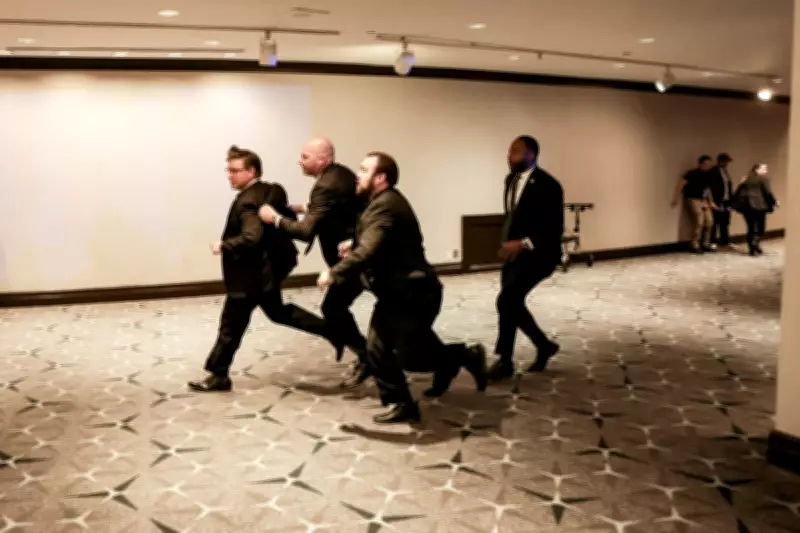
The attempted assassination of President Donald Trump at the White House Correspondents' Dinner has intensified pressure on Speaker of the House Mike Johnson and House Republicans to fund the Department of Homeland Security, which has been shut down since January.
Political Fallout from the Shooting
Washington is still reeling from Saturday's attack, when a gunman opened fire at the annual dinner. The coming weeks are expected to see a political tit-for-tat, with Republicans already blaming Democrats. Some have pointed to House Minority Leader Hakeem Jeffries' vow of "Maximum warfare all the time," though as commentator Jamie Dupree noted, Jeffries borrowed the phrase from an aide close to the president.
Regardless, the fact remains that a gunman got dangerously close to President Trump less than two years after a bullet grazed his ear. Many observers across the political spectrum have highlighted how close the assailant came to the president and how few security protocols were in place. Congress is expected to launch multiple inquiries into the Secret Service, security staff, and the Washington Hilton. FBI Director Kash Patel, who was already under scrutiny and attended the dinner, now faces a make-or-break moment for his leadership of the bureau.

The DHS Shutdown Crisis
At the forefront is a major challenge for Speaker Johnson: finding a way out of the Department of Homeland Security shutdown. In January, Democrats and Republicans funded the rest of the government but excluded DHS after an Immigration and Customs Enforcement official shot and killed Renee Good, and Customs and Border Protection officials shot and killed Alex Pretti in Minneapolis. Negotiations on safeguards for ICE and CBP never came to fruition, leading to the shutdown.
The consequences have been severe, with long lines at airports as Transportation Security Administration agents went unpaid. The Senate eventually passed a Homeland Security spending bill without funding for ICE and CBP by unanimous consent. Senate Majority Leader John Thune and other Republicans hoped to fund the two agencies via budget reconciliation, which requires only a simple majority. However, Johnson rejected the Senate bill, calling it "a joke." At the time, it was described as "the dumbest shutdown" — a characterization that still stands.
Days later, Johnson surprisingly embraced Thune's initial plan with Trump's blessing. Yet he has refused to bring the Homeland Security bill to the floor, arguing that Republicans must first agree on the reconciliation bill and its contents. Hardline conservatives like Rep. Chip Roy of the House Freedom Caucus are demanding that money for Trump's proposed ballroom be included in the reconciliation bill. Given the president's strong desire for the project, it is hard to imagine that funding will be omitted.
Democratic Blame and Republican Ownership
Democrats also share some blame. They leveraged their limited minority power to push for ICE and CBP reforms but failed to secure any. Notably, ICE and CBP received billions of dollars in the One Big, Beautiful Bill and were unaffected by the shutdown, now poised for another massive funding boost. However, Johnson now owns the DHS shutdown every day he does not put the Senate bill on the floor. With the attempted assassination, Republicans face even greater pressure to fund the initial package and then pass the reconciliation bill.
Johnson will likely encounter resistance from conservatives who oppose funding DHS without ICE and CBP or without parts of the SAVE America Act, which would require proof of citizenship to vote. This may force Johnson to rely on Democratic votes to pass the bill. But Democrats may be unwilling to help given the lack of safeguards for ICE. By refusing to work with Democrats, Johnson has boxed himself into a corner. It is now his responsibility to fix the problem — for Trump and for the country.