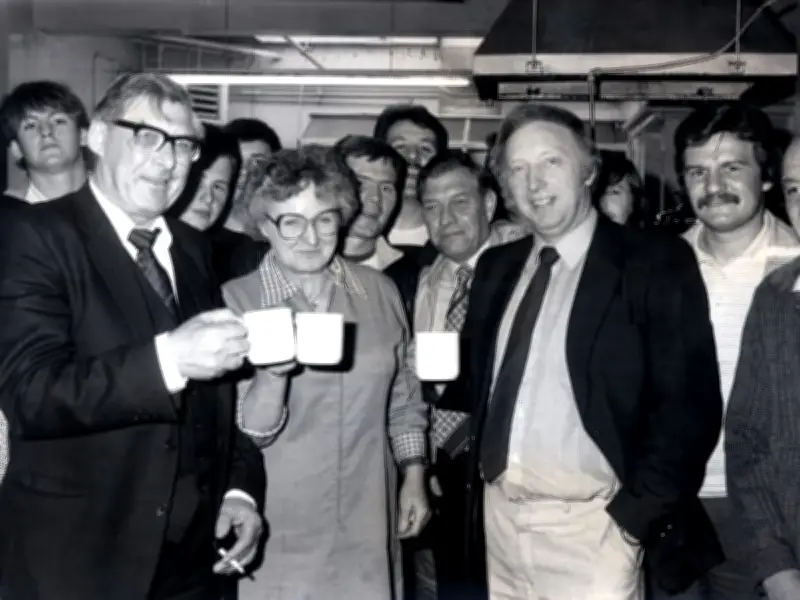
A new book has revealed that Margaret Thatcher's government pioneered the 'brute force' used to crush trade unions in the 1980s by closing Lanarkshire's last coal mine.
Glasgow-based historian Ewan Gibbs said the bitter industrial dispute at Cardowan colliery in 1983 saw the first use of many of the tactics used in the nationwide Miners' Strike the following year.
Pivotal event before 1984-85 strike
The pit near Stepps had provided fuel for Lanarkshire's steel industry for more than 50 years when the National Coal Board (NCB) abruptly announced it would be closed.
Gibbs told the Record: "The closure of Cardowan colliery was a pivotal event in the lead up to the 1984-85 miners' strike. Generally, closures had been quite carefully organised from nationalisation in the 1940s through to the 1970s. Miners were often found jobs elsewhere."
"In the 1980s, closures were used as a blunt instrument to weaken trade union power in the context of escalating unemployment under the Thatcher government. These tactics were pioneered in Scotland before they were used in England and Wales after the 1984-85 strike concluded in a decisive defeat for the miners."
Closure imposed without union discussion
Gibbs, a lecturer in social history at the University of Glasgow, added: "Closure was imposed upon the Cardowan workforce without the pattern of discussion with trade unions which had been typical before."
The director of the NCB's Scottish Area, Albert Wheeler, said that he was uninterested in meeting with trade union representatives. "Instead, he made what he termed an 'offer' to the entire workforce, which numbered more than 1,000 miners. Rather than a well organised exercise in protecting cohesion, like previous closures, at Cardowan closure was a deliberate attempt to stoke division."
The NCB urged workers to accept lucrative offers of redeployment to other Scottish pits, in turn stoking fractious strikes there. They were also waving very large redundancy payments and pensions in the faces of older men.
Tensions boil over in summer 1983
Tensions boiled over in the summer of 1983 when Wheeler addressed a meeting of Cardowan miners and their families.
"A melee ensued after he attempted to delivering a domineering speech instructing miners not to oppose the closure by staying down the pit," Gibbs continued. "Reports of physical opposition vary from the violent to the comical, but he at least had an ice cream cone smashed on his suit."
Gibbs said the closure signified "the end of a world where mining employment offered security and a dignified voice for unions". He added: "Instead, brute force was to be used to defeat the miners and their union along with the communities which the nationalised industry had promised to support."
New book traces working-class transformation
The story of Cardowan is just one of several in Gibbs' new book, An Injury to All: The Unmaking of the British Working Class.
The social history asks how the working class has been pushed from the centre of political life to its margins, and traces the transformation of a class forged in mines and shipyards into one scattered across call centres and gig economy apps.
Gibbs added: "By the mid 20th century, a well-organised working class was both politically and economically powerful. But by the early 21st century, the very idea of class politics was widely held in derision."
"This change came after decades where traditional areas of working-class power and influence such as trade union organisation, nationalised industries and council housing had been deliberately decimated by government policy."
"My book sets out to tell these stories through the voices and experiences of the people who were at the sharp end of these major upheavals."
"This not just a story of government decisions or the deployment of police forces against striking factory workers and miners. It's also a history of the choices ordinary people who lost faith in trade unionism, left industry for jobs in services or self-employment or who bought their council homes."
"The unmaking of a form of Britishness is also important, not least of all in Scotland, where a Scottish rather than British identity has often become political predominant, particularly on the left."