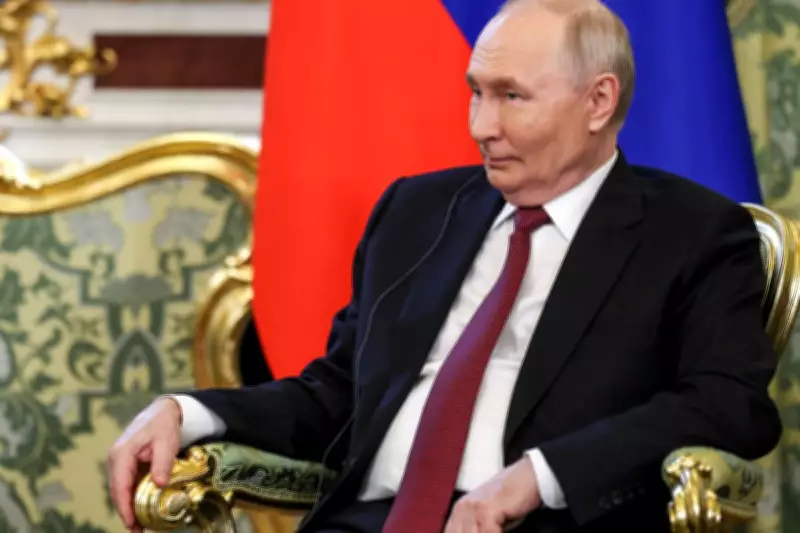
Bill Browder, who has spent twenty-six years studying Vladimir Putin as his number one foreign enemy, says he believes the Russian leader is about to crack. In that time, Browder has learned one thing above all others: whenever Putin is in trouble at home, he starts a war abroad. It has worked every time. It is not working now, and a frightened Putin is a far more dangerous, and far more revealing, creature than a confident one.
Putin's approval ratings plummet
Look at the polling. Putin's approval rating fell by 12.2 percentage points between late December and late April, reaching 65.6 per cent — the lowest level recorded during Russia's full-scale war against Ukraine, according to Russia's state-controlled polling agency VTsIOM. That was such a sharp decline that the Kremlin’s favourite pollster announced on 15 May it was changing the methodology with which it conducted its polls. Naturally, they then rose slightly. But it shows his favourite trick is a busted flush.
The Levada Center, Russia’s only independent pollster, has tracked Putin’s approval ratings since the day he appeared on the scene. Browder would not put much faith in the honesty of ordinary Russians answering a pollster in a police state, but the shape of the chart tells a story you cannot ignore. In 1999, when Putin became prime minister, nobody had heard of him and his ratings were close to zero. So he launched a full-scale war in Chechnya, after a series of apartment bombings he conveniently blamed on the Chechens, and his numbers shot past fifty per cent. He was elected president.

A pattern of using war for popularity
He has run the same play ever since. When his popularity sagged around the 2008 financial crisis, he invaded Georgia, and his ratings jumped. When they sagged again in 2014, he annexed Crimea and marched into eastern Ukraine. And when the political hangover from Covid set in, he launched the full-scale invasion of Ukraine. There is no question in Browder's mind. Putin uses war as a tool. It keeps his own people from looking too closely at his failures.
But for the trick to work, one rule has always applied. The war has to be far away. It must never touch the ordinary Russian. His first three wars passed that test easily. The fourth was a much bigger gamble, and Putin knew it, so he went to extraordinary lengths to keep it at a distance. He refused even to call it a war. It was a “special military operation,” and he was so insistent on the phrase that any Russian who called it a war could be jailed for eight years. He made sure the men doing the fighting were not the ones who mattered to him. He offered prisoners amnesty in return for the front line. He handed the hardest battles to mercenaries like the Wagner Group. He paid hundreds of thousands of poor men from Russia’s poorest regions to go and die. He even shipped in North Korean soldiers and African mercenaries. The point was always the same: make sure the average Russian feels no sacrifice at all.
Why Putin fears the war coming home
Why does this matter so much to him? Because the Russian people are, Browder argues, among the most selfish on the planet. He does not say that as an insult. He says it as a description of what the system has done to them. For decades under communism, and for decades since, anyone who was civic-minded, who cared about the common good, who thought beyond his own front door, was punished for it. Under the Soviets they were sent to the gulag. Under Putin they are jailed and ostracised. Train a population for two generations to care about nothing but itself, and you get a country that is easy to rule, right up to the moment its own narrow self-interest is touched.
We are now four years into this war, and every wall Putin built to keep it away from his people is coming down. The cost has been staggering. Western intelligence services and think tanks now put total Russian casualties, killed and wounded, at somewhere between 1.2 and 1.5 million men. Ukraine is killing Russian soldiers faster than Russia can replace them. And the Kremlin is running out of money to pay the mercenaries and contract soldiers it depends on.

Most important of all, Ukraine has worked out how to bring the war home to Russia. Ukrainian drones now hit Russian oil refineries and export terminals, military bases, and targets inside Moscow itself. They have built drones that reach more than six hundred miles into Russian territory, something Ukraine could not dream of in 2022. The insulation Putin spent four years building is being torn away, one refinery at a time.
Signs of a cornered leader
You could see how rattled he is at this year’s Victory Day parade. The Kremlin was so worried about Ukrainian drones over Red Square that a ceasefire had to be arranged first. The man who casts himself as the heir to the Soviet victory over Hitler could not guarantee the safety of his own parade. The signs of a cornered man are everywhere. Putin spends much of his time in a bunker, terrified of being assassinated by a Ukrainian drone. He has cut mobile internet in Moscow and St Petersburg. He has even moved against Telegram, the app every Russian uses to talk to every other Russian, because he is afraid it could light the fuse of an uprising. But here is his problem. Every one of these moves drags the war closer to home. In a society he has built where nobody looks past his own interests, the moment those interests are threatened, everybody is affected at once.
Browder is not going to predict that Putin will be toppled by a popular revolt. That would be premature. But it is not premature to say that he is genuinely afraid, and that he has lost control of the story he spent twenty-five years writing.
Which is exactly why this is the worst possible moment to push Ukraine towards a peace deal. With Putin backed into a corner, the pressure belongs on Russia, not on Kyiv. Our job is to help Ukraine make him more frightened, more isolated and more beleaguered, not to hand him a lifeline just as his oldest trick finally fails.