The opulent surroundings of the Grade II-listed Royal Lodge would have seemed a distant memory as the heavy police cell door clanged shut behind Andrew Mountbatten-Windsor. The former Duke of York exchanged his 30-room mansion in Windsor Great Park for a stark custody suite, marking his 66th birthday in a manner far removed from royal tradition.
A Drastic Change of Circumstances
The staff who typically attend to his every need were replaced by police officers. Any expectation of birthday recognition—whether cake or other gestures—vanished completely. Instead, Andrew found himself detained on suspicion of misconduct in public office, with his arrest occurring shortly after 8am at Wood Farm in Sandringham, Norfolk.
The Custody Process Explained
Retired Metropolitan Police sergeant Graham Wettone, author of How To Be A Police Officer, provided insight to the Daily Mail about the reality of police custody. "It'll be no bigger than a box-room in a three-bed semi," he stated, emphasizing that preferential treatment is non-existent in custody suites. "You can't have an upgraded room, you can't get upgraded meals - you get what's there. Microwaved."

The custody process began immediately upon Andrew's arrival at an unspecified police station. The arresting officer would have explained the reason for arrest and recorded the time and location. Andrew would then have been read his rights, including:
- The right to a solicitor and free legal advice
- The right to have someone informed of his arrest
Given the global media coverage of his detention, notification of next-of-kin might have seemed redundant. He would have been entitled to speak with a duty solicitor if unable to contact his own counsel.
Search and Assessment Procedures
A thorough search would have followed, although a strip search was unlikely given the nature of the alleged offence. Standard procedure involves confiscating belts, ties, and shoelaces for safety reasons. "Even if they pose no risk, I took the shoelaces off every single person in custody when I was a custody officer," Mr Wettone explained. "If you haven't met them before, they are in the box of being an unknown risk."
The medical and welfare assessment would have included questions about medication, physical problems, and mental health issues. Unlike some suspects required to change into paper suits for forensic purposes, Andrew likely remained in his own clothing.
From Lavish Celebrations to Basic Provisions
The contrast with previous birthdays could not be more striking. Royal biographer Andrew Lownie noted that Andrew's 40th birthday in 2000 featured a £30,000 celebration with video messages from celebrities like Elton John and elaborate canapés arranged around model ships.
In custody, refreshments would have been limited to a plastic cup of water or basic tea. Food options would have been microwavable meals, though suspects can request outside food subject to the custody sergeant's approval.
The Stark Reality of Custody Cells
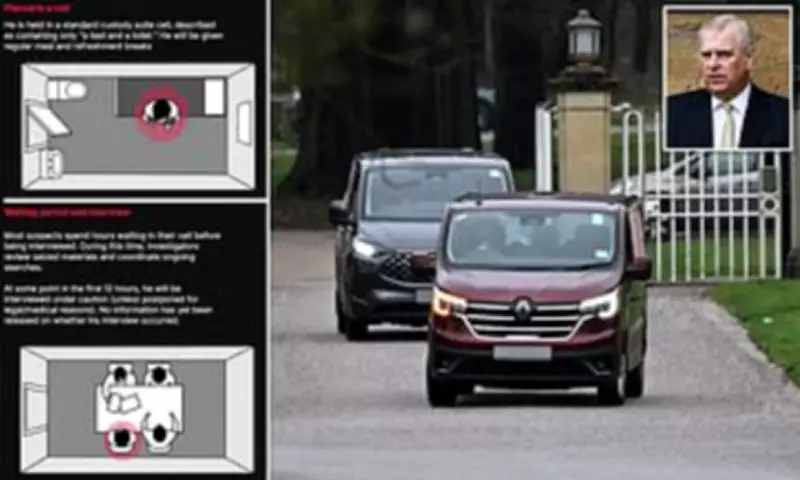
The cell itself offers minimal comforts. "He's got a toilet and a mattress on the bed. There's nothing in there at all," said Mr Wettone. The bed is actually a knee-high bench with a thin vinyl-covered mattress, accompanied by a blue blanket for warmth. Privacy is limited, with toilets partially obscured by half-height walls, and modern custody suites feature CCTV monitoring.
"It's a lonely experience," Mr Wettone described. "It's quite levelling, because the door slams and you're in there on your own, four walls to look at. There's no entertainment or anything." Detainees typically have no access to phones or reading material beyond the Codes of Practice.
The Interview Process
Andrew would have been summoned from his cell for questioning after consulting with his lawyer. Most modern custody suites record interviews on camera, as depicted in Channel 4's 24 Hours In Police Custody, rather than using cassette recorders.
Following the standard caution, Andrew would have been asked to introduce himself for the recording. Suspects typically respond with no comment, provide detailed statements, or submit prepared positions during such interrogations.

Multiple Police Investigations
Andrew's arrest occurs amid multiple police investigations examining various allegations:
- Metropolitan Police investigating claims about royal protection officers and information sharing
- Surrey Police seeking information about an allegation in Virginia Water from the 1990s
- Thames Valley Police assessing claims regarding a 2010 encounter at Royal Lodge
- Several forces examining Epstein's use of UK airports including Stansted, Luton, Edinburgh, and Birmingham
Release Procedures and Birthday Recognition
After questioning, suspects are either charged, released on bail, or released with no further action. Those released typically make their own way home, as police do not provide transportation. "We're not a taxi service," Mr Wettone noted.
As for birthday acknowledgments in custody, Mr Wettone was clear: "Not at all - no cake, no card. There might be a passing recognition on booking in when asked for his date of birth. But I doubt though this was a time for levity or humour."
The former Duke of York can be held for up to 24 hours without charge, spending what was likely his most memorable birthday in circumstances far removed from royal privilege.