

Members of Mississippi’s largest synagogue have walked through the structure for the first time since a fire damaged it in the predawn hours of January 10. The arson attack, which prosecutors say was antisemitic, has only strengthened the congregation’s resolve.
Tree of Life Symbolism Preserved
Black, sweeping lines now form an outline of a tree on the brick wall that once displayed the Tree of Life at Beth Israel Congregation in northeast Jackson. The commemorative brass plaque, though damaged, withstood the fire. Flames traced the trunk, branches, and brass leaves inscribed with congregants’ birthdays, weddings, and anniversaries. The plaque has been sent for restoration, along with five Torahs and religious tapestries. Rachel Myers, a congregation leader and religious school teacher, taped up a child’s drawing of a tree to maintain the symbol. “He wanted to make sure that we keep that Tree of Life going,” she said.
Arson Suspect Awaits Trial
Stephen Spencer Pittman, a Madison County man, awaits trial on federal charges of arson, damage to religious property, and using fire to commit a felony. He has pleaded not guilty. Pittman was arrested hours after the fire at a local hospital where he was treated for severe burns. He allegedly confessed and referred to Beth Israel as the “synagogue of Satan,” according to a federal court document. Surveillance video showed a man splashing liquid; prosecutors allege Pittman called his father after setting the fire and “laughed as he told his father what he did and said he finally got them.”

Congregation’s Resilience
Myers said the fire only made members stronger and even made teaching Hebrew easier. “We’re going to keep doing this, because someone wants us to stop,” she said as the synagogue opened to local media. Around 60 members walked through the building for the first time since the fire. Sarah Thomas, first vice president and lifelong member, described the experience: “It was a good chance to see what it is now and then start to dream and hope for what it will look like when we’re back in here as a community.”
Damage and Recovery
Instead of walls covered in tapestries and artworks, congregants saw barren cinderblock, shattered glass, and empty rafters, as the fire revealed asbestos in the ceiling. “All along these walls were holy scriptures, prayer books, and other works of art you can’t find anywhere else,” said congregation president Zach Shemper, standing in the now-empty library where the attacker broke in and poured accelerant. The arson destroyed many objects, including two Torahs. A faint smell of soot remained, but cleanup is 95% complete. With a local architect, leaders hope construction will start by late summer, aiming to host services by the Jewish New Year in October 2027. Asbestos abatement alone will cost $2 million; total rebuilding costs are not yet known.
Looking Forward
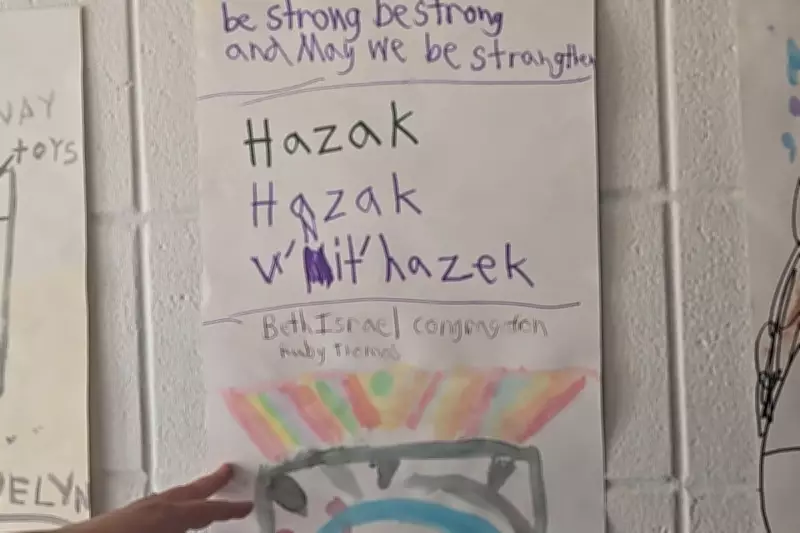
To lift spirits, Myers taped children’s art throughout the synagogue. Congregants discussed improvements, such as more freezers in the kitchen for the annual bazaar. Thomas was excited to see her daughter Ruby’s drawing: bright blue water overcoming red flames, producing a rainbow, with words to a Hebrew song about strength. “Whatever this one person thought he was going to do,” Myers said, “it only made us stronger.”






