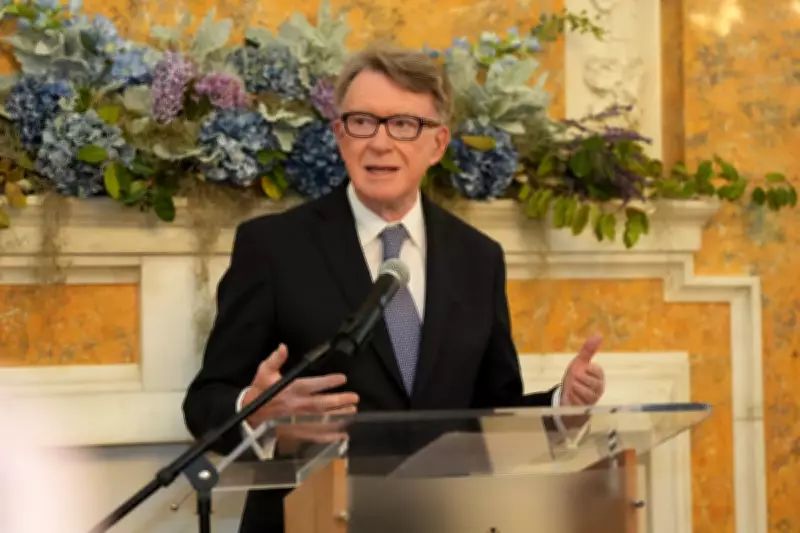
Lord Mandelson's Political Legacy Threatened by Epstein Association
The political career of Lord Peter Mandelson, once dubbed the 'Prince of Darkness' for his mastery of Westminster's power dynamics, has reached a critical juncture. The veteran Labour figure now faces the real prospect of losing his peerage title following mounting pressure over his documented connections with the disgraced financier Jeffrey Epstein.
Resignation and Growing Scrutiny
Lord Mandelson resigned from the Labour Party on Sunday, citing his desire to avoid 'further embarrassment' to the organisation he has served for decades. This dramatic move came as millions of documents relating to Epstein's activities were released to the public, shining an uncomfortable light on the peer's association with the convicted sex offender.
The resignation marks a significant fall from grace for a politician who has weathered numerous previous controversies. However, this latest development appears to present challenges even beyond those that prompted his two previous cabinet resignations in 1998 and 2001.

Documented Connections Emerge
Newly revealed correspondence shows Lord Mandelson maintained supportive communication with Epstein during the financier's legal troubles. Email exchanges published by multiple media outlets reveal the peer telling Epstein he was 'following you closely and here whenever you need' while urging him to 'remember the Art of War' when dealing with prosecutors.
Perhaps most damagingly, Lord Mandelson reportedly encouraged Epstein to 'fight for early release' shortly before his sentencing and told him 'I think the world of you' the day before he began his prison sentence. The peer has since expressed deep regret for continuing the association 'for far longer than I should have done'.
Government Influence Questions
Further revelations suggest Lord Mandelson's connections with Epstein may have influenced government policy during his tenure as Business Secretary under Gordon Brown. Email exchanges from December 2009 indicate the peer was lobbying to modify the so-called 'super tax' on bankers' bonuses, with apparent encouragement from Epstein.
In one email, Epstein appears to ask about making the tax apply only to the cash portion of bankers' bonuses, to which Lord Mandelson reportedly responded that he was 'trying hard to amend' the policy, adding that the 'Treasury [was] digging in but I am on case'. Additional correspondence suggests Lord Mandelson encouraged JP Morgan's chief executive Jamie Dimon to call then-Chancellor Alistair Darling and 'mildly threaten' him regarding the policy.
Financial Transactions and Information Sharing
The depth of the connection appears substantial, with bank statements from 2003 and 2004 reportedly showing Lord Mandelson received payments totalling 75,000 US dollars from Epstein. The financier is also said to have paid for an osteopathy course for Lord Mandelson's husband.
Perhaps more troubling for government transparency are revelations that internal government discussions were shared with Epstein. Correspondence first reported by Tax Policy Associates shows analysis of business lending prepared by government minister Baroness Vadera in August 2009 was passed to the financier. While the sender has been redacted, Lord Mandelson was involved in the discussions referenced.
Political Fallout and Government Response
The growing scandal has prompted decisive action from the highest levels of government. Downing Street confirmed on Monday that Prime Minister Sir Keir Starmer believes Lord Mandelson 'should not be a member of the House of Lords' and has asked the Cabinet Secretary to 'urgently' review all available information regarding contact between the former minister and Epstein.
This represents a significant reversal from Sir Keir's previous position of having 'confidence' in his ambassador to the United States, a role from which Lord Mandelson was removed last year amid earlier questions about his Epstein connections.

A Career of Controversy and Comebacks
Lord Mandelson's political journey began in 1985 as a Labour communications director, with his first election to Parliament coming in 1992. He became a central figure in the New Labour project, serving in the cabinets of both Tony Blair and Gordon Brown while earning his 'Dark Lord' moniker through his adept manipulation of political power structures.
His career has been marked by remarkable comebacks, including returning to cabinet after both his 1998 resignation over a £373,000 home loan from then paymaster general Geoffrey Robinson and his 2001 departure amid the Hinduja passport controversy. After being cleared of impropriety in the latter case, he served as Britain's European Commissioner before being recalled to Gordon Brown's cabinet in 2008 as Business Secretary.
More recently, Lord Mandelson served as chief strategist for Labour in London during the 2010 election and provided advice to Sir Keir Starmer as he sought to win power. His appointment as ambassador to the United States in December was seen as leveraging his trade experience amid Donald Trump's return to the White House and threats of wide-ranging tariffs.
Unprecedented Challenge Ahead
Despite his history of political survival, the Epstein revelations present what appears to be Lord Mandelson's most daunting challenge yet. With the Prime Minister now actively seeking his removal from the House of Lords and opposition parties demanding strong responses, the peer faces scrutiny that threatens to permanently overshadow his substantial political legacy.
The Cabinet Secretary's review will determine whether Lord Mandelson's associations crossed ethical boundaries that even his considerable political skills cannot overcome, potentially marking the final chapter in one of Westminster's most enduring and controversial careers.