JFK's Personal Secretary Believed Government Conspiracy Killed President
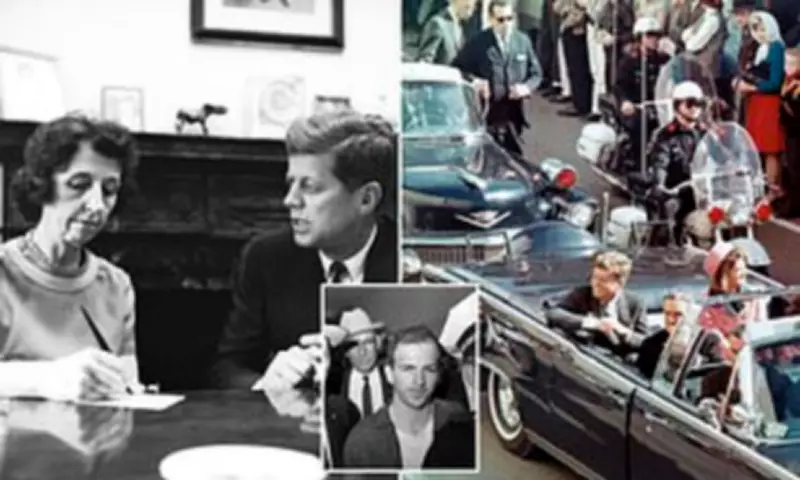
President John F. Kennedy was assassinated by enemies within his own government in a calculated political hit, according to his long-time personal secretary Evelyn Lincoln. This shocking conclusion was discovered in a previously unpublished document written by Lincoln, who served as JFK's White House gatekeeper and was seated in the third car of his motorcade during the fatal shooting in Dallas.
Secretary's Posthumous Revelation
Lincoln's belief in a conspiracy was unearthed from archives at the JFK Library in Boston by Jefferson Morley, editor of JFK Facts and a renowned assassination expert. Morley emphasized that because Lincoln was exceptionally close to Kennedy, her perspective likely mirrored how the president himself would have interpreted his assassination.
"She was a very loyal person. She had turned her mind and her work to him, she served him. And so, yes, I think this thinking does reflect how he would think about this event himself," Morley told the Daily Mail.

Lincoln passed away in 1995 at age 85 and is buried in Arlington Cemetery. Throughout her lifetime, she never publicly disclosed her true opinion about the circumstances behind her boss's death on November 22, 1963. However, in an 11-page addendum to an unpublished memoir titled I Was There, she detailed why she rejected the official narrative that Lee Harvey Oswald acted alone.
A Deliberate Political Murder
Instead, Lincoln concluded that JFK was the victim of a sophisticated conspiracy orchestrated by elements within the U.S. government. She wrote: "From the catbird seat that I had during my 12 years as John F. Kennedy’s Personal Secretary I would have to say that, in my opinion, President Kennedy’s death in Dallas, Texas, was a deliberate professional political murder, planned by a group in government who wanted him removed from office."
Lincoln, the daughter of a congressman, began working for JFK during his first Senate campaign in the early 1950s and remained his personal secretary until his assassination. In the era before cellphones, she served as his crucial conduit to the world, holding the Secret Service codename 'Willow.' She noted that Kennedy insisted she always know his whereabouts, making her the primary link for family, friends, and important contacts.
Motives and Suspect Factions
In her addendum, Lincoln explored various factions with grievances against Kennedy, including:
- Far-right groups and organized crime
- Texans who hated him and Teamsters boss Jimmy Hoffa
- FBI director J. Edgar Hoover and the Ku Klux Klan
- Anti-civil rights organizations and communists
- Madame Nhu, the de facto First Lady of South Vietnam
She found it ironic that many of these factions had representatives in or around Dallas during the assassination, creating a ripe atmosphere for conspiracy. Lincoln speculated that any of these groups could have hired a hitman, noting that such individuals were "dime a dozen" at the time.
The Cuba Connection
Lincoln's central theory pointed to Kennedy's refusal to support a full-scale invasion of Cuba as a primary motive. She described how the Mob, extreme right-wing elements, the CIA, and Cuban exiles were constantly conspiring to overthrow Fidel Castro after losing their operations in Cuba.
The Bay of Pigs invasion, initially approved by Kennedy but later scaled back when he canceled an air strike, infuriated these groups. Lincoln wrote that this failure led to allegations that Kennedy had betrayed the Cuban-exile invasion force, creating a "linkage between the Mob, the CIA and right-wing extremists over what they felt was the President’s moderation toward Castro, his civil rights proposals, his drive for peace and the Kennedys’ crusade against organized crime."
She noted a strange alliance between Richard Nixon, Cuban exile forces, and CIA members involved in the Bay of Pigs, many of whom later participated in Nixon's Watergate break-in and other "dirty tricks" operations.

Internal Government Dynamics
Lincoln also highlighted internal political tensions. She revealed that Kennedy had mused about replacing Vice President Lyndon Johnson as his running mate in the 1964 election. Johnson, aware he might be dropped, left Washington for his Texas ranch weeks before Kennedy's visit.
Additionally, she described how J. Edgar Hoover maintained voluminous personal files on Kennedy containing rumors and potentially embarrassing information. Johnson had access to these files, and Lincoln suggested that Hoover's hostility toward both Robert F. Kennedy and Martin Luther King Jr. influenced the climate.
She observed that Johnson initially maintained there had been a conspiracy but then "hurriedly set the wheels in motion to build a case against Lee Harvey Oswald as being the lone assassin."
Credibility of a Trusted Insider
Jefferson Morley emphasized Lincoln's discretion and proximity to Kennedy as lending credibility to her account. "This is somebody who knew his world, she lived in his world, and so her testimony is important," he said. "She wrote this at the end of her life and never published it... so I think it's valuable testimony from somebody who was very close to JFK."
Morley added that Lincoln's observations carry weight because she was in the room, saw the interactions, and understood the body language of those around Kennedy. "Her thinking reflected his. She was influenced by his thinking. So yes, in some sense, we can say this is his way of thinking," he concluded.
Lincoln's unpublished memoir and its explosive addendum remain a poignant testament from a trusted insider who believed until her death that her president was killed by a conspiracy within the very government he led.