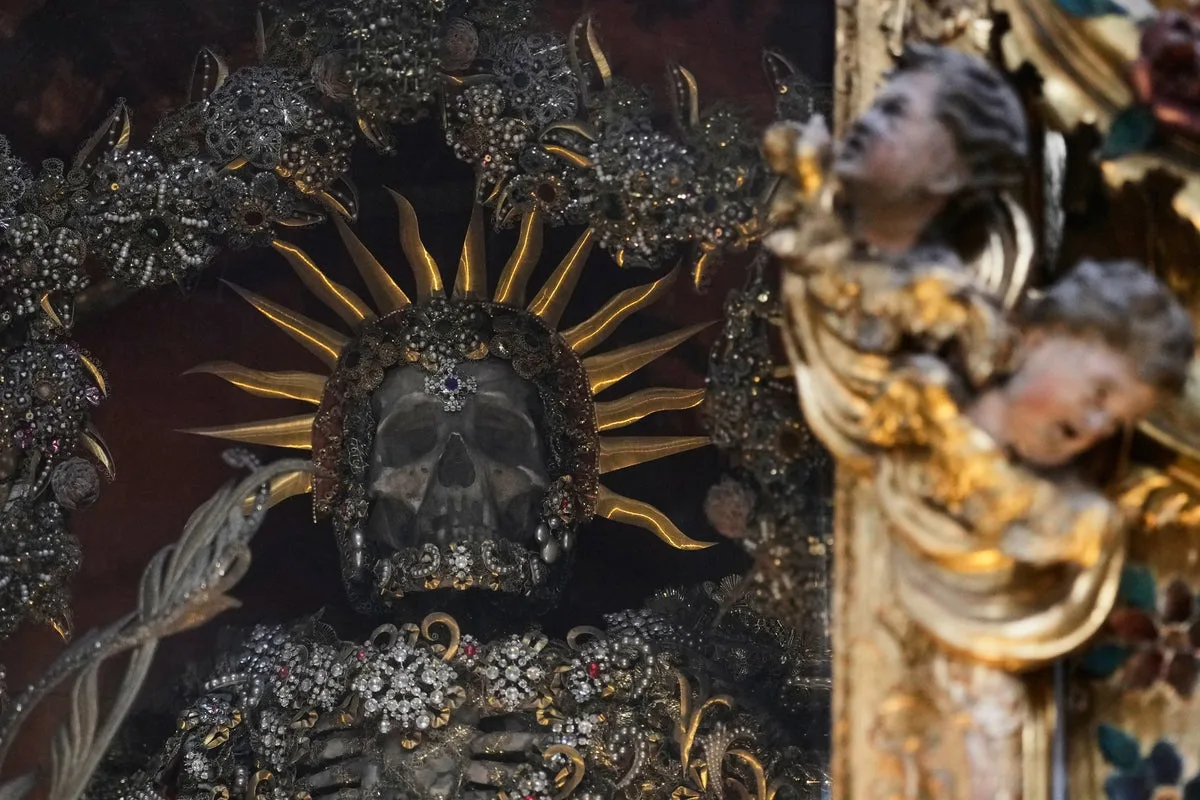
Four complete human skeletons, adorned with silk, brocade, precious stones, and intricate gold and silver filigree, have been a centuries-old fixture at the Catholic monastery church of Banz in southern Germany. Known as Vincenzius, Valerius, Benedictus, and Felix Benedictus, these remains are classified as 'catacomb saints' and were transported from Rome during the late 17th and 18th centuries.
Church custodian Anita Gottschlich described the display as 'a little creepy,' noting that older visitors who saw them as children often seek them out. The skeletons are kept behind wooden panels for most of the year, only revealed on special occasions like All Saints' Day.
These catacomb saints are not unique to Banz; similar skeletal displays are common in Baroque churches across Bavaria, Austria, Switzerland, Czechia, and Italy. They are believed to be remains of early Christian martyrs discovered in Rome's catacombs in the 16th century, later designated as saints by the Church.

Catholic priest Walter Ries explained that during the late 17th and 18th centuries, after the devastation of the Thirty Years' War, people sought an escape from suffering through Baroque art. 'That’s why these eerie skeletons were so beautifully draped and depicted as lifelike as possible,' he said.
Historian Günter Dippold added that the elaborate decoration is meant to show the saint's glorified body after resurrection, not a dead body. The abbots of Banz sent emissaries to Rome in 1680 and 1745 to acquire the skeletons, which were then decorated by nuns in Bamberg.