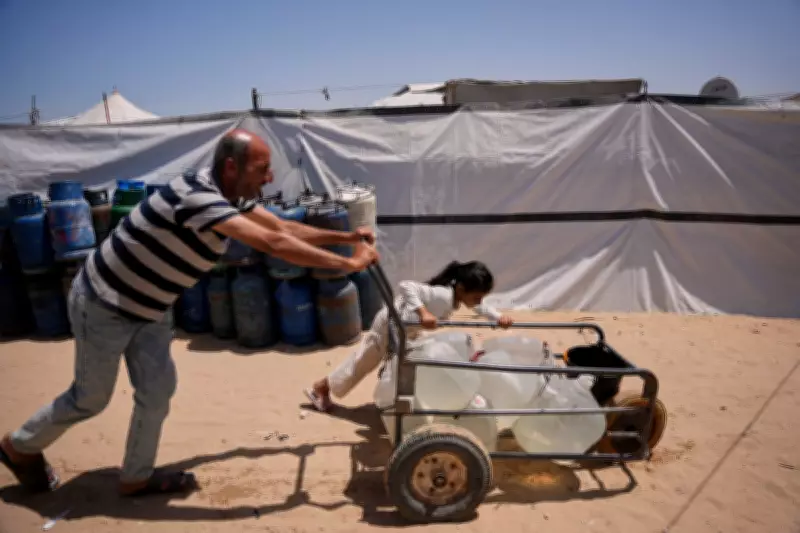
Palestinians in Gaza are marking the 78th anniversary of the Nakba, Arabic for "catastrophe," which refers to the mass expulsion and flight of some 750,000 Palestinians from what is now Israel during the 1948 war surrounding Israel's creation. For many, the current war in Gaza is an even greater catastrophe.
A Village Lost to Time
Yusuf Abu Hamam, a 78-year-old Nakba survivor, recalls being forced to flee his village, al-Joura, as an infant in 1948. The village was demolished by the Israeli military and now lies under neighborhoods of Ashkelon and a national park. Today, the Shati Camp in northern Gaza, where his family resettled, lies largely in ruins after 2½ years of war.
"There is no country left," Abu Hamam said, standing next to his heavily damaged home. "A square kilometer and a half extending from the sea, this is what we are living in … It's indescribable, unbearable."

What Was the Nakba?
For Palestinians, the Nakba meant the loss of most of their homeland. Some 80% of Palestinians living in the area that became Israel were driven from their homes by Israeli forces before and during the 1948 war. After the war, Israel refused to allow Palestinian refugees to return, creating a permanent refugee community that now numbers some 6 million. Around 530 Palestinian villages were destroyed, according to the Palestinian Bureau of Statistics.
Al-Joura was one of them. Seized by the Israeli military in November 1948, soldiers were ordered to destroy every home to prevent the return of Palestinians, according to military archives cited by Israeli historian Benny Morris.
A New Nakba in Gaza
Ne'man Abu Jarad and his wife, Majida, whose ancestors were already in Gaza in 1948, now face what Majida calls "our Nakba." Their hometowns of Beit Lahiya and Beit Hanoun have been razed by Israeli bulldozers and detonations. A new Israeli military base stands near where their house once stood. Rafah, once home to a quarter million people, is also destroyed.
Over the last 31 months, the Abu Jarads have been displaced more than a dozen times. They now live in a tent camp in Khan Younis, with little shelter from the elements. Their daughters have been out of school for over two years.
"The Nakba of '48, I don't think it can be compared to our Nakba," Majida said. "In '48, people were displaced once and settled in one place. But our Nakba is more severe because our displacement has happened multiple times. There is no stability."
Around 90% of Gaza's population has lost their homes, according to UN estimates. Israel's offensive has killed over 72,700 Palestinians, triggered by Hamas's October 7, 2023 attack that killed some 1,200 people and took 251 hostages.
Preserving History Amid Destruction
The 1948 Nakba also brought the loss of Palestinian history. The UNRWA archive, one of the largest collections of Palestinian documents, was nearly lost when staff fled Gaza. They rescued birth, death, and marriage certificates, and refugee registration cards by carrying them in suitcases through checkpoints.
For many, the current war has destroyed what little remained of personal histories. Majida's parents' home in Beit Hanoun was destroyed, along with family photos. "There is nothing left," she said.
Abu Hamam echoed this sentiment: "When this war came, it devoured trees, stones and people. Entire families were erased from the civil registry. Hundreds of families are still buried under the rubble."