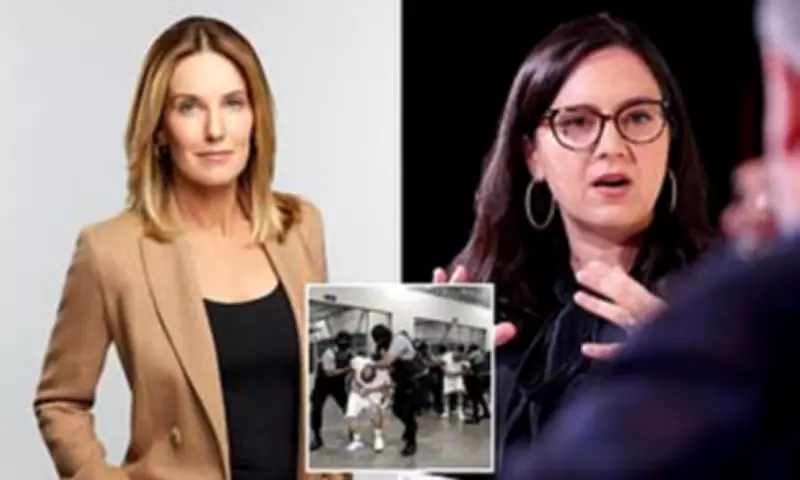
Longtime 60 Minutes correspondent Sharyn Alfonsi is reportedly leaving CBS News after clashing with editor-in-chief Bari Weiss over a story on the Trump administration's treatment of deported migrants.
Alfonsi will leave the network at the end of May when her contract expires, according to a report in Page Six. She has spent most of her career at CBS, starting out as a New York-based correspondent in 2002 before rejoining the network in 2011 after a brief stint at ABC News.
Alfonsi's future at the network has been in question since December, when she vehemently disagreed with Weiss's decision to pull her segment on El Salvador's notoriously brutal CECOT prison. The Trump administration sent around 250 Venezuelan men to the prison in March 2025, a controversial move considering they were not from El Salvador. Those men were later released from CECOT, but dozens of Salvadoran nationals deported from the US remain there.

Though the harsh conditions of CECOT had already been largely reported on in the international media, Alfonsi's segment featured exclusive interviews with deportees who said they had been beaten and sexually assaulted by guards. The story also openly cast doubt on whether some of the prisoners were gang members as claimed by the Trump administration and the friendly Salvadoran government.
But hours before the segment was set to air on December 21, Weiss said Alfonsi and her team did not do enough reporting and that they needed to get an on-camera interview from an administration official. In internal emails obtained by the Los Angeles Times, Alfonsi told her colleagues that Weiss's decision to not air the CECOT piece was 'political.' She argued the story had been vetted and had passed all the standard legal reviews.
Alfonsi also pointed out in her emails that she had reached out to officials within the Department of Homeland Security, the White House and the State Department. None of them offered to comment. 'Government silence is a statement, not a VETO,' Alfonsi wrote. 'Their refusal to be interviewed is a tactical maneuver designed to kill the story.'
Weiss had been the editor-in-chief of CBS News for a scant two months at the time. She rose to the position after Paramount Skydance, which owns CBS, acquired her digital media outlet, The Free Press. Weiss maintained that she did not pull the story for political reasons and did so merely because it 'did not advance the ball.'
'The public knows that Venezuelans have been subjected to horrific treatment at this prison. To run a story on this subject two months later, we need to do more. And this is "60 Minutes." We need to be able to get the principals on the record and on camera,' she reportedly said in an editorial call the day after the story was supposed to air.
Days later, the story accidentally aired on the app for Global Television Network, one of Canada's largest networks, after CBS shared a version of it with them. Copies of the broadcast began to circulate widely on the internet. When the segment did officially air in January, viewers were able to compare the two versions. The body of the story was virtually identical, but the end of the segment was updated to include the administration's comment. The administration also provided pictures of tattoos that had been on two of the migrants Alfonsi had interviewed.
Now that Alfonsi's exit from the network is reportedly more certain, Alfonsi has apparently retained the counsel of Bryan Freedman, a high-profile entertainment lawyer. On April 30, Alfonsi publicly addressed her disagreement with the leadership at CBS over this story for the first time. 'I will not linger on the internal mechanics of the dust-up that led to our CECOT story being pulled, but we have to be honest about what it represents,' she said after receiving the Ridenhour Prize for Courage at the National Press Club in Washington, D.C. 'It wasn't an isolated editorial argument. In my view, it was the result of a more aggressive contagion: the spread of corporate meddling and editorial fear. It's hard to watch,' she added.

Freedman has represented many other media figures upon their contentious exits from network television gigs, including Don Lemon, Tiffany Cross and Tucker Carlson. Megyn Kelly hired Freedman after she was fired from NBC for making controversial comments about blackface in 2018. He negotiated a settlement that secured roughly $30 million, representing the remainder of her $69 million contract.