Scientists have been left stumped after monkeys voluntarily spent long periods playing a touchscreen video game for a new study, driven purely by curiosity without any expectation of a food reward. The findings, according to researchers, may lead to a more comprehensive understanding of how curiosity drives animal behaviour.
Curiosity Without Rewards
Curiosity operates independently of extrinsic rewards like food or mating opportunities and drives animals to explore their environments. However, exactly how some parts of any animal's environment spark more curiosity than others remains unclear. Researchers theorise that curiosity tends to be biased toward moderately complex or uncertain stimuli while avoiding overly simple or complex situations. This is called the 'Goldilocks principle' and also characterises human curiosity. Yet very few studies have explored this impulse in animals.
The Study
Scientists from Japan's Kyoto University assessed how curiosity works in monkeys by exposing them to a touchscreen video game. In recent years, video games have emerged as tools to help train cognitive abilities and improve the quality of life for humans. Studies have also explored whether video games can spark the engagement of animals in laboratories and zoos, potentially helping to improve their welfare.

'I originally studied play behaviour in wild monkeys, so I have long wanted to create situations in the laboratory where monkeys' play behaviour could emerge naturally,' explained Sakumi Iki, an author of the study published in the journal iScience.
The Game Task
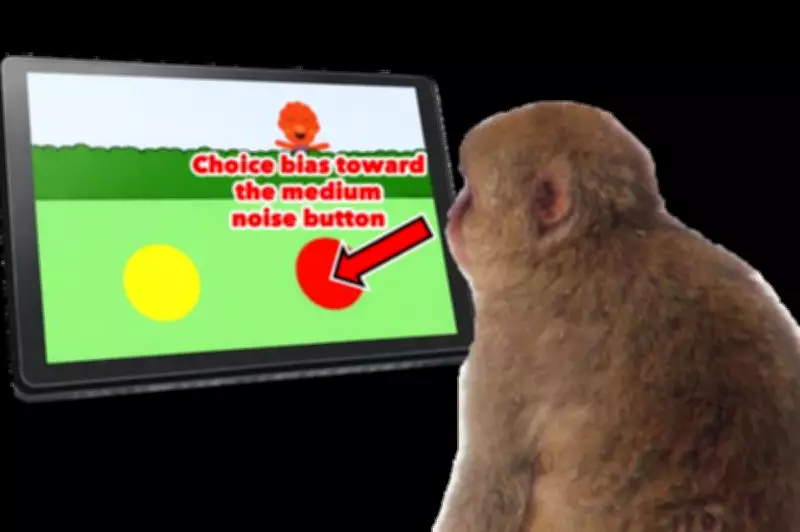
Researchers probed exactly what kind of stimuli could elicit the curiosity of resident Japanese macaques. They developed a touchscreen-based game task inspired by hide-and-seek. In this game, when a monkey presses a button on the touchscreen, a puppet appears at a different location on the screen, depending on the button. The puppet appearances correspond to different levels of noise, with puppets appearing in a less predictable location the higher the noise level.
Scientists observed the monkeys' responses to medium versus low noise, then medium versus high noise. They found that the monkeys chose the medium noise button, which made the puppet appear in a location that was somewhat predictable but still moderately uncertain. This suggests that macaques, like humans, have a tendency to actively explore stimuli with a moderate level of uncertainty compared to stimuli that are too simple or too random.
Surprising Engagement
The monkeys also spent long stretches of time playing the game, supporting the game's success in sparking their curiosity. 'In typical cognitive tasks, monkeys are usually given food rewards to keep them motivated, so I was not very confident they would engage with the game without rewards,' Dr Iki says. 'Yet surprisingly, some monkeys worked on this game for nearly 100 trials even without any reward,' he added.
Future Research
In future studies, researchers hope to apply the findings to develop more games that attract the monkeys' curiosity. They aim to identify the neural and cognitive mechanisms behind curiosity to gain a 'more comprehensive understanding of this phenomenon'.