
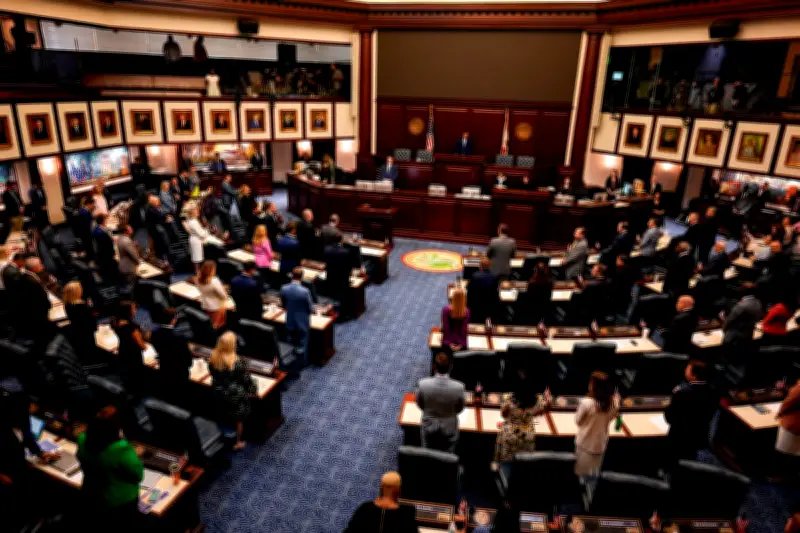
The Florida Supreme Court on Wednesday permitted the use of new US House districts drawn by Republicans in the upcoming midterm elections, marking a significant victory for the GOP in a nationwide redistricting effort aimed at preserving their narrow House majority.
Court Ruling and Legal Challenge
Attorneys representing voters who filed a lawsuit argued that the newly drawn congressional districts violate a state constitutional prohibition against partisan gerrymandering. They requested the court to order the state to maintain the same districts used in the previous election. However, the state supreme court, in a 6-1 decision, denied their request for a temporary injunction without addressing the case's merits. The judges stated they lacked jurisdiction to intervene while the lawsuit proceeds through lower courts.
Impact on Florida's Congressional Seats
Republicans currently hold 20 of Florida's 28 US House seats. The new voting districts, signed into law by Republican Governor Ron DeSantis after a swift two-day special legislative session, could enhance the GOP's chances of winning four additional seats this year. The court's decision provides clarity for prospective congressional candidates, who face a Friday deadline to qualify for the state's 18 August primaries.
James Uthmeier, the Republican attorney general who defended the new districts, declared a "complete and total victory" in a social media post. Opponents expressed outrage and vowed to continue the legal battle, even if it extends into the 2028 election cycle.
Reactions from Opponents
"The Florida supreme court's failure to stop this brazen partisan power grab is not only an assault on democracy, but an abdication of its duty to the people of Florida," said Genesis Robinson, executive director of Equal Ground, a community organizing group involved in the lawsuit. Amy Keith, executive director of Common Cause Florida, described the new districts as "a pretty clear partisan gerrymander" and stated, "We're going to do everything we can to prevent this map from impacting further, future elections."
Context of Mid-Decade Redistricting
Voting districts are typically redrawn after a census near the beginning of each decade. Florida is one of several Republican-led states that have undertaken mid-decade redistricting as part of Donald Trump's plan to maintain a slim House majority in November by reshaping district boundaries to favor the GOP. Florida's legislature approved the new House map on 29 April, the same day the US Supreme Court weakened federal Voting Rights Act protections for minorities while striking down a majority-Black congressional district in Louisiana. Since then, several southern states have moved to eliminate minority districts that have elected Democrats.
Governor DeSantis called lawmakers into a special session before the high court's ruling, having anticipated the outcome. His office asserted that no racial data was used in the map presented to the legislature. The new map redraws a southeastern Florida district that DeSantis's office said was created to help elect a Black representative in compliance with the federal Voting Rights Act.
State Constitutional Provisions
In addition to barring partisan gerrymandering, a constitutional amendment approved by Florida voters in 2010 prohibits districts from being drawn to deny or diminish the ability of racial or language minorities to elect representatives of their choice. It also requires districts to be compact and, where feasible, use existing political and geographic boundaries.




